
On the 22nd, the Indian stock market is seeing a mix of buying expectations driven by rising U.S. tech stocks and caution associated with high crude oil prices and stubbornly high U.S. long-term interest rates. In the background, while a rebound in U.S. AI-related stocks is providing a tailwind for major IT stocks, rising energy costs due to heightened tensions in the Middle East and net selling by foreign investors are weighing heavily on the market.
- Current Status and Trading Activity of India’s Major Stock Indices on the 22nd
- Rise in US Tech Stocks and the Spillover Effect of Buying into the IT Sector
- Macroeconomic Pressures Caused by Surging Crude Oil Prices and Geopolitical Risks
- Financial and Automotive Sector Slowdown and Individual Corporate Earnings Trends
- Scenario for Corporate Earnings Growth and Domestic Demand Recovery Toward the Latter Half of 2026
- Key Metrics Investors Should Watch and Key Points for Risk Management
Current Status and Trading Activity of India’s Major Stock Indices on the 22nd
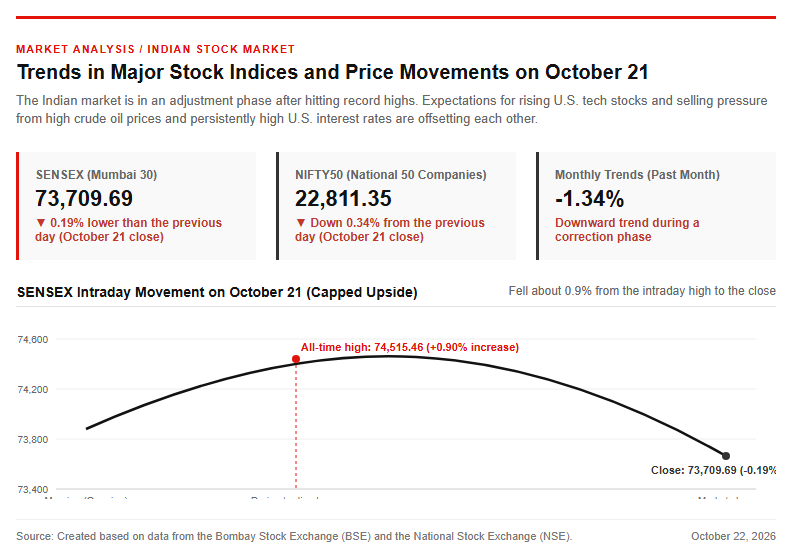
The Indian stock market on October 22, 2026, is expected to start with buying dominance in the morning, driven by the spillover of tech-sector gains in the U.S. stock market the previous day, but is anticipated to face a heavy upside. On October 21, the Bombay Stock Exchange’s benchmark 30-share index, the SENSEX, closed down 0.19 percent from the previous day at 73,709.69 points. Additionally, the National Stock Exchange’s benchmark 50-share index, the NIFTY 50, continued to edge down, falling 0.34 percent to 22,811.35 points. During trading hours, the SENSEX temporarily rose to 74,515.46 points, gaining about 0.90 percent at one point, but selling pressure—centering on financial and auto stocks—increased toward the close, erasing the gains. Currently, the Indian stock market is in an adjustment phase after hitting record highs from late 2025 to early 2026, with the index showing a downward trend of about 1.34 percent over the past month. Among investors, movements to gauge short-term market direction are intensifying, and the balance between the tailwind from the previous day’s U.S. market and domestic selling pressure is expected to be a focal point in the October 22 trading session as well. The following graph shows the recent trend of the stock price indices.
Rise in US Tech Stocks and the Spillover Effect of Buying into the IT Sector
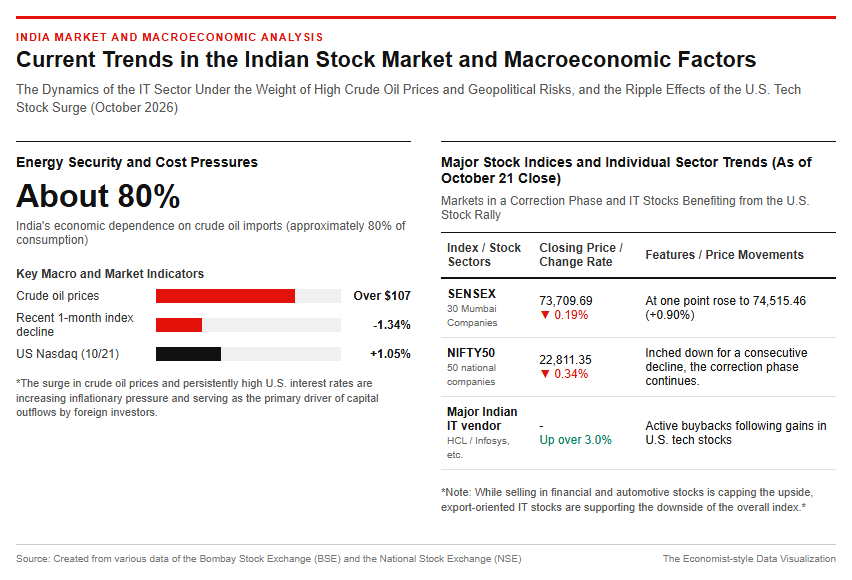
The solid trend of tech stocks in the US market is acting as a powerful tailwind for major Indian IT service companies. In the US market on October 21, 2026, the Nasdaq Composite Index rose by 1.05 percent as excessive concerns over the financial performance of artificial intelligence-related companies eased. Following this trend, buying activity has become active in the Indian market as well, centered around IT stocks with high export ratios. Specifically, the stock prices of major Indian IT vendors such as HCL Technologies, Infosys, and Tech Mahindra each recorded significant gains exceeding 3 percent. Because India’s IT sector depends on client companies in North America and Europe for much of its revenue, the recovery of US tech investment and the continuation of digital transformation demand are directly linked to improved business performance. While domestic demand stocks such as the financial sector are being sold off, the upward trend of IT stocks is clearly supporting the downside of the index as a whole, and whether the stock prices of major IT companies will function to prop up the market on the 22nd remains a major focus.
Concerns Capping the Upside and Industry-by-Industry Performance
Macroeconomic Pressures Caused by Surging Crude Oil Prices and Geopolitical Risks
On the other hand, the biggest factors hindering the sustained rise of the Indian stock market are soaring crude oil prices and geopolitical risks in the Middle East. The fact that crude oil prices remain at a high level exceeding $107 per barrel is a direct blow to the Indian economy, which relies on imports for about 80% of its crude oil consumption. Rising fuel costs and logistics expenses not only increase domestic inflationary pressure, but also widen India’s trade deficit and heighten downward pressure on the local currency, the rupee. This raises concerns about increased raw material procurement costs for companies and a subsequent squeeze on profit margins. Furthermore, against the backdrop of persistently high long-term US interest rates, foreign investors continue to withdraw funds from the Indian market. Overseas investors’ net selling is a major factor capping the upside of the index as a whole, and unless uncertainty over the situation in the Middle East is dispelled, it is considered difficult for market participants’ risk-averse stance to ease rapidly. Please refer to the figure below for the differences in crude oil dependency between major countries and India.
Financial and Automotive Sector Slowdown and Individual Corporate Earnings Trends
Looking at individual company earnings and sector-specific movements, there are signs of weakness in the financial and automotive sectors that have driven the market up to this point. Bajaj Finance, one of India’s largest non-banking financial companies, announced an increase in quarterly profit, but its stock price fell 3.3 percent, leading the market decline after initial signs of credit distress were pointed out in its gold-backed lending division. Additionally, sluggish growth in passenger vehicle sales has sparked concerns, putting cascading pressure on the stock prices of major automakers. On the other hand, major conglomerate Reliance Industries and its digital business subsidiary, Jio Platforms, are providing positive catalysts. The initial public offering of Jio Platforms has drawn extremely high attention, with all shares subscribed within just two hours of the opening of the retail investor offering. Thus, a complex environment continues to persist, featuring a mixture of concerning factors such as deteriorating loan asset quality and localized slowdowns in personal consumption, alongside robust digital transformation demand and large-scale IPO deals.
Future Developments, Key Focus Areas, and Mid-to-Long-Term Outlook
Scenario for Corporate Earnings Growth and Domestic Demand Recovery Toward the Latter Half of 2026
Although a short-term correction phase continues for now, the medium- to long-term growth scenario for the Indian stock market remains robust. India’s real gross domestic product growth rate is projected to be around 7.4 percent from fiscal year 2026 to fiscal year 2027, representing top-tier growth among major economies. In addition, the earnings per share growth rate of the NIFTY 50 companies, which consist of 50 major corporations, is expected to see steady growth of about 10 to 13 percent annually. Because the return of the Indian stock market in 2025 remained a relatively modest increase of plus 10.5 percent compared to other countries, the sense of overvaluation in terms of valuations has been resolved to a certain extent, once again increasing the investment appeal for medium- to long-term investors. Furthermore, the continuation of infrastructure investment by the Indian government and expectations for a shift toward monetary easing by the Reserve Bank of India are expected to support a recovery in domestic demand-led corporate performance. Along with a cyclical economic recovery, the non-performing loan ratio of financial institutions is also maintaining a healthy level of less than 2.5 percent, and a return to a bull market where the NIFTY 50 index aims for the 30,000-point milestone is anticipated over the medium to long term.
Key Metrics Investors Should Watch and Key Points for Risk Management
When looking ahead at the Indian stock market, there are several technical and fundamental indicators that investors should monitor closely. From a technical perspective, key points of interest include whether the 50-day and 200-day moving averages for the NIFTY 50 and SENSEX will act as vital support lines. Furthermore, utilizing technical indicators that measure overheating, such as the Relative Strength Index (RSI), is effective for identifying reversal timings from oversold levels. On the fundamental side, the primary focus is on crude oil price trends and the stability of the rupee. If crude oil prices settle and concerns over trade balance deterioration recede, foreign investors may resume buying back shares at an early stage. Secondly, factors include the U.S. Federal Reserve’s interest rate policy, U.S. tech stock trends, and the progress of quarterly earnings within India. Investors are advised to adopt a diversified investment approach—closely monitoring risks from global macroeconomic volatility while well-balancing their portfolios with external demand and growth sectors like IT and telecommunications, alongside major banking stocks with solid financial foundations.
Reference Page
- 【BSE (Bombay Stock Exchange) Official Portal】[suspicious link removed]
- [Official NSE (National Stock Exchange of India) Portal] [suspicious link removed]
- [Reserve Bank of India (RBI) Official Website] [suspicious link removed]
[#IndianStocks #SENSEX #NIFTY50 #EmergingMarketInvesting #GlobalEconomy #StockMarketOutlook]


コメント