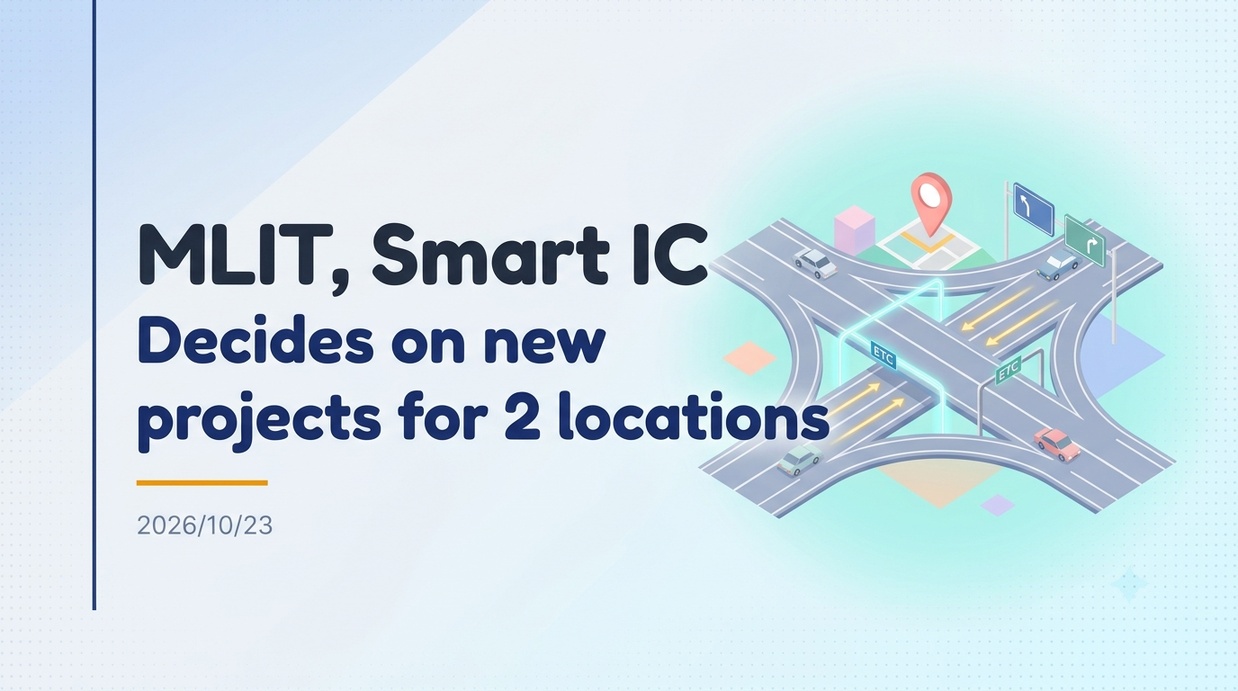
The Ministry of Land, Infrastructure, Transport and Tourism has decided to grant approval for new projects for two smart interchanges and initiate preparatory-stage surveys for three locations. The background behind this is the aim to effectively utilize the existing expressway network to improve regional convenience, enhance logistics efficiency, and strengthen disaster prevention functions.
- Key points of the event: 2 business licenses granted and 3 surveys initiated
- Status of Smart Interchange Deployment Nationwide and Numerical Data
- Features of Smart ICs and Differences from Conventional Interchanges
- The Project Implementation Process Toward New Development and the Role of District Councils
- Expectations for Regional Economic Revitalization and Improvements in Disaster Prevention and Medical Access
- Future Outlook and Key Points: Strengthening Wide-Area Networks and Promoting Road DX
Key points of the event: 2 business licenses granted and 3 surveys initiated
On October 23, 2026, the Ministry of Land, Infrastructure, Transport and Tourism (MLIT) granted business approval to expressway companies for two smart interchanges based on the Act on Special Measures Concerning Road Improvement. As a result, the two target locations have been officially approved as new projects, and development plans for their construction will now move into full swing. Furthermore, on the same day, it was also announced that preparatory-stage investigations would be launched for three new smart interchanges, with the national government taking the lead in examining and detailing their necessity and the surrounding traffic environment in depth. Smart interchanges are dedicated toll-collection facilities that limit participating vehicles to those equipped with ETC systems, offering the advantage of significantly reducing construction and operational costs compared to conventional interchanges. The decision for these business approvals and preparatory-stage investigations is an important measure to strongly promote the enhancement of accessibility across the nationwide expressway network, improve travel convenience for local residents, and facilitate smooth industrial logistics. Moving forward, MLIT plans to proceed promptly with procedures, design, and construction work in close cooperation with relevant local governments and expressway companies toward early project completion and the commencement of operations.
Status of Smart Interchange Deployment Nationwide and Numerical Data
The development of smart interchanges continues to expand steadily across the nationwide expressway network. According to the latest data released by the Ministry of Land, Infrastructure, Transport and Tourism as of October 23, 2026, the number of operational, opened smart interchanges across the country has reached 167. This figure also includes two locations where functional enhancement projects, such as upgrading to full interchanges, are being promoted, contributing to improved convenience in various regions. Additionally, there are 51 locations nationwide currently undergoing construction, design, or land acquisition, and 3 locations where preparatory stage surveys are being conducted. The following figure shows a basic layout of a smart interchange.
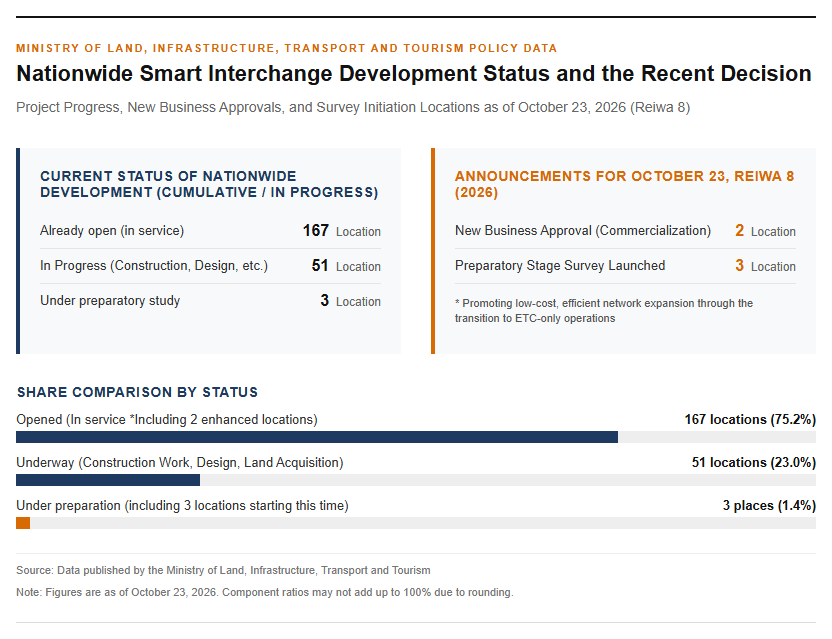
The average distance between interchanges on expressways in Japan is approximately 10 km—about twice as long as in Western countries—and there have been many municipalities that, despite expressways passing through their regions, could not directly access them. Against this backdrop, the nationwide rollout of smart interchanges is being promoted, as they can be additionally installed while reducing construction and management costs.
Institutional Background and Procedural Flow of Smart Interchanges
Features of Smart ICs and Differences from Conventional Interchanges
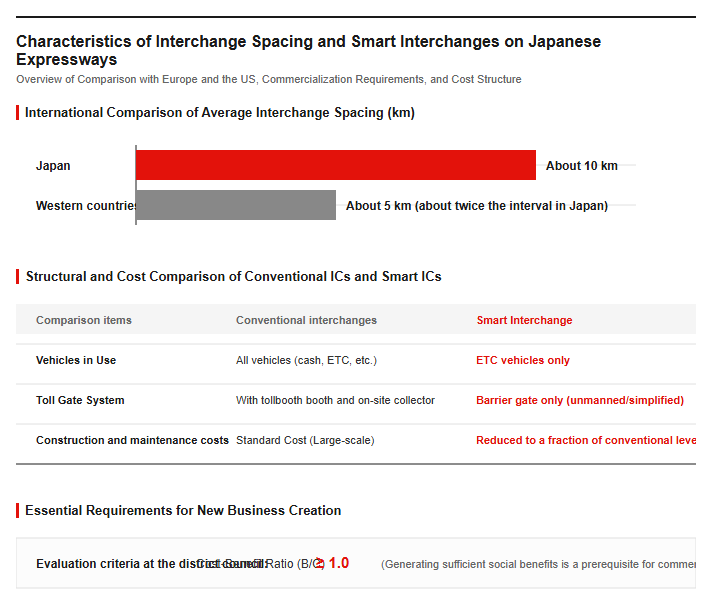
Smart interchanges are dedicated interchanges where vehicle use is restricted exclusively to ETC-equipped vehicles. Their single biggest distinguishing feature from conventional general interchanges is the adoption of a simplified system that eliminates the need to station toll booths or on-site toll collectors, requiring vehicles only to come to a temporary stop in front of a barrier gate to carry out electronic payment. This makes it possible to reduce construction costs to a fraction of those for conventional interchanges, as well as significantly cut long-term maintenance costs, including personnel expenses. In terms of structural types, they are broadly divided into two categories: the SA/PA-connected type, which links to existing service areas or parking areas, and the mainline-direct type, which connects access roads directly to the highway’s main lanes. Furthermore, in recent years, the development of smart interchanges directly connected to private facilities—allowing direct access to large commercial complexes and industrial parks—has also been advancing. Because they allow for flexible designs tailored to local traffic volume and usage purposes, they have become a road infrastructure option that is relatively easy to consider introducing even for municipalities with smaller financial scales.
The Project Implementation Process Toward New Development and the Role of District Councils
Initiating a new smart interchange project requires strict legal requirements and multiple phased procedures. First, a district council is established, consisting of the local government wishing to install the interchange, the connecting road administrator, the expressway company, the Regional Development Bureau of the Ministry of Land, Infrastructure, Transport and Tourism, the local police, and academic experts. The district council examines safety evaluations of surrounding roads, predictions of changes in traffic volume, and a cost-benefit analysis showing the ratio of social benefits to construction costs. As a prerequisite for development, it is mandatory that the cost-benefit ratio (B/C) is 1.0 or higher and that sufficient social benefits are secured. Based on discussions and agreement within the district council, the connecting road administrator formulates a smart IC implementation plan, which is submitted to the Minister of Land, Infrastructure, Transport and Tourism following prior consultations with the prefectural public safety commission and other entities. Finally, the project is officially launched when the Minister of Land, Infrastructure, Transport and Tourism issues the connection permit and business permit pursuant to the Act on Special Measures Concerning Road Improvement and related laws. Furthermore, even after the start of operations, a follow-up survey is conducted one year later to ensure ongoing verification of its effects.
The Benefits of Smart Interchange Development and Future Prospects
Expectations for Regional Economic Revitalization and Improvements in Disaster Prevention and Medical Access
The opening and operation of smart interchanges bring significant ripple effects to local communities and regional economies. By dramatically reducing access times to expressways, logistics efficiency from surrounding industrial parks and distribution hubs is greatly enhanced, leading to the establishment of new corporate sites and the creation of local jobs. In addition, improved access to tourist destinations and roadside rest areas (“Michi-no-Eki”) promotes visitor mobility, contributing to the revitalization of the local economy. Furthermore, strengthening disaster prevention functions and emergency medical systems plays an extremely vital role. In the event of severe disasters such as major earthquakes or storms and floods, they function as alternative detour routes for damaged ordinary roads, supporting the passage of emergency vehicles and the swift transport of relief supplies. From a medical perspective as well, transport times to core hospitals, including tertiary emergency medical facilities, are reduced, which directly translates to improved survival rates. The following figure is an overview diagram illustrating the shortening of access routes to emergency medical facilities and the effects of cooperation with industrial hubs.
It also helps ease congestion on major national highways, thereby contributing to the improvement of the road traffic environment throughout the region.
Future Outlook and Key Points: Strengthening Wide-Area Networks and Promoting Road DX
Smart interchanges are closely linked with the functional enhancement of the wide-area road network and the digital transformation (DX) of road systems promoted by the Ministry of Land, Infrastructure, Transport and Tourism (MLIT). The MLIT aims to make sophisticated use of the entire expressway network, and is promoting complete cashless operations through the future transition of all routes to ETC-only use. Smart interchanges serve as pioneering infrastructure in this regard, and attention is focused on functional improvements to further enhance convenience, such as the expansion of operating hours, upgrading to full interchanges to accommodate large vehicles, and demonstrations of non-stop passing technology that eliminates the need to stop. Furthermore, smart interchanges will serve as critical hubs for data linkage with road-vehicle cooperation systems and next-generation ITS technologies, anticipating the future operation of autonomous trucks on arterial roads. Amid ongoing serious population decline and fiscal constraints faced by local governments, the planned commercialization of new projects and the promotion of development for smart interchanges—which offer low cost and high cost-effectiveness—are expected to play an increasingly vital role in building sustainable and resilient social infrastructure.
Reference page
- 【Development of Smart Interchanges – Ministry of Land, Infrastructure, Transport and Tourism】https://www.mlit.go.jp/road/sisaku/smart_ic/
- 【Business Authorization for Smart Interchanges to Expressway Companies and Initiation of Preparatory Stage Surveys – Ministry of Land, Infrastructure, Transport and Tourism】https://www.mlit.go.jp/report/press/road01_hh_002160.html
- [Smart Interchange Development Project Program Implementation Guidelines – Ministry of Land, Infrastructure, Transport and Tourism] [suspicious link removed]
[#MinistryOfLandInfrastructureTransportAndTourism #SmartInterchange #Expressway #RoadInfrastructure #RegionalRevitalization]


コメント