On November 18, 2026, Kyoto Bank announced that it will expand its venture debt lending target for startups from the previous 10 billion yen to 50 billion yen. This decision is driven by the growing fundraising needs of growth companies and the reinforcement of integrated investment and lending support.
- The Background Behind Expanding the Loan Target Fivefold from 10 Billion Yen to 50 Billion Yen
- Track Record Since Full-Scale Rollout in 2025 and Establishment of a Dedicated Team Structure
- The Function of Venture Debt in Reducing Repayment Burden and Equity Dilution
- Integrated Investment and Financing Solution with KCAP Venture Fund
- Kyoto’s Potential as a University-Originated Startup Cluster
- Utilization of a 100-billion-yen framework for growth investments through the monetization of strategic shareholdings
- Structural Shift from Large Corporate Lending to SME and Startup Lending
- Revenue Models and Risk Management as Seen in the Comparison of the Top Two Regional Banks
- Creation of Innovation and Ecosystem Building in Regional Industries
- Challenges Toward Achieving the FY2028 Targets and Medium-to-Long-Term Outlook
The Background Behind Expanding the Loan Target Fivefold from 10 Billion Yen to 50 Billion Yen
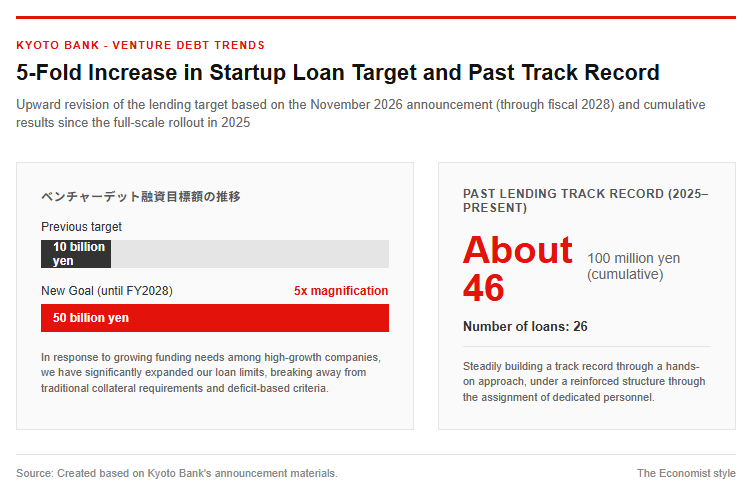
On November 18, 2026, Kyoto Bank (President Mikiya Yasui) announced that it will significantly expand its venture debt (startup loan) target for emerging companies such as startups, raising its goal for fiscal 2028 from the previous 10 billion yen to 50 billion yen. This scale is five times the previous target, marking an unusually large expansion for startup support by a regional bank. In recent years, the market environment surrounding startups accelerating technological development and business expansion has been changing, leading to a growing demand for large-scale growth capital. By significantly expanding its lending framework—which is unconstrained by traditional collateral or deficit criteria—the bank aims to strongly support the creation of companies that will drive the next-generation regional economy. Positioned also as a growth strategy for the entire Kyoto Financial Group, this initiative serves as a core development in regional economic revitalization measures that brings together the group’s comprehensive financial capabilities.
Track Record Since Full-Scale Rollout in 2025 and Establishment of a Dedicated Team Structure
Bank of Kyoto has been rolling out venture debt in earnest starting in 2025, advancing the strengthening of its promotion system by placing specialists equipped with specialized knowledge within the bank. As part of its efforts to date, it has accumulated a venture debt lending track record amounting to a cumulative 26 cases and approximately 4.6 billion yen, yielding steady results. This time, the expansion of the target to 50 billion yen does not simply mean increasing the figures for the lending framework, but is accompanied by the expansion of specialized organizations and the sophistication of screening know-how. Even after a loan decision is made, a hands-on approach is taken to provide core business support through continuous dialogue with client companies. By fully utilizing the network with regional companies and customer base that the bank has cultivated over many years, a system is being established to comprehensively support, from the financial side, the management challenges faced by startups.
Venture Debt Methods and Equity Linkage Mechanisms
The Function of Venture Debt in Reducing Repayment Burden and Equity Dilution
In the growth stage of startups, it is essential to appropriately combine equity financing through stock issuance, which carries no repayment obligation, with debt financing such as bank loans. While equity financing provides managerial freedom and funds for research and development, it carries the risk of reducing the founder’s ownership stake and causing share dilution. In contrast, venture debt has the advantage of providing necessary business funds while minimizing share dilution. As pointed out in the analysis by the Daiwa Institute of Research, growing companies require multi-layered funding functions tailored to their stages, and the role of regional banks as providers of risk capital is of vital importance. The Bank of Kyoto’s venture debt serves as a powerful option for emerging companies to expand their business scale while maintaining a sustainable capital structure.
Integrated Investment and Financing Solution with KCAP Venture Fund
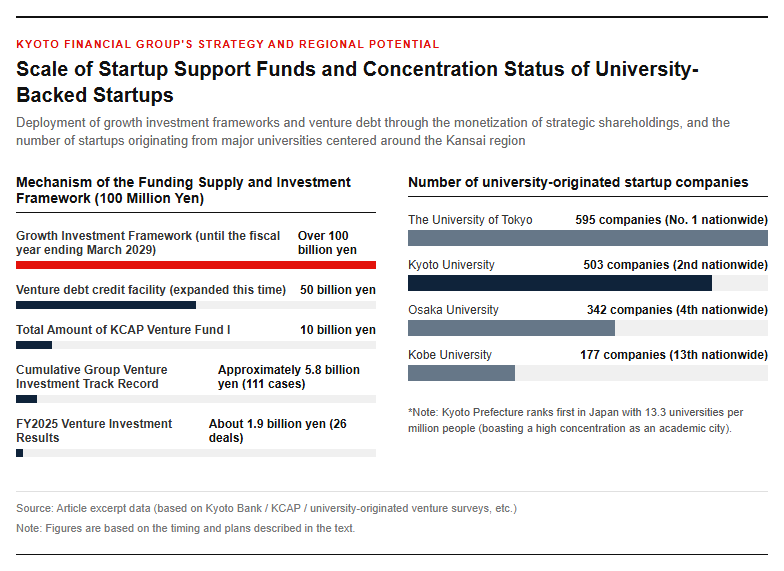
In connection with this loan expansion, the Bank of Kyoto has outlined a policy to further strengthen its collaboration with its group company, Kyoto Capital Partners Co., Ltd. (KCAP). On September 13, 2024, KCAP established the “KCAP Venture No. 1 Fund” with a total capital of 10 billion yen (9.99 billion yen invested by the Bank of Kyoto and 10 million yen by KCAP), through which it invests in high-growth potential companies. The group as a whole has cumulatively executed 111 venture fund investments totaling approximately 5.8 billion yen, and has recorded a track record of 26 investments totaling approximately 1.9 billion yen in fiscal 2025 alone. By integrally providing equity functions through capital investment and debt functions through venture debt—which has now been expanded to 50 billion yen—this enables seamless financing that corresponds to every growth phase of startups.
Startup Support and Business Background in the Kyoto-Kansai Region
Kyoto’s Potential as a University-Originated Startup Cluster
Kyoto Prefecture boasts the highest concentration of universities in Japan, with 13.3 universities per 1 million residents, and is an academic city where students account for approximately 10% of Kyoto City’s population. Against the backdrop of these abundant intellectual assets, the number of startups originating from Kyoto University reached 503 as of October 2025, ranking second in the nation following the University of Tokyo’s 595 companies. Furthermore, with Osaka University at 342 companies (4th) and Kobe University at 177 companies (13th), the entire Kansai region has become a treasure trove of high-potential startups. Capitalizing on these regional strengths, The Kyoto Bank is creating co-creation opportunities between major corporations and startups—such as hosting the “Kyo-Sumi 2025” business matching event on November 11, 2025, which drew 750 participants. A solid foundation is in place for the bank, acting as a local financial institution, to support the growth of advanced technology companies, including university-backed ventures.
Utilization of a 100-billion-yen framework for growth investments through the monetization of strategic shareholdings
Behind Kyoto Bank’s ability to establish a large-scale credit facility lies a robust management foundation and a capital reallocation strategy. Kyoto Financial Group has set an ambitious target to reduce its strategic shareholdings—such as long-held shares in Nintendo, Kyocera, and Murata Manufacturing—by a cumulative total of over 300 billion yen by the end of the fiscal year ending March 2029. The cash and capital generated from these share sales are planned to be allocated not only to shareholder returns, but also over 100 billion yen to growth investments, including venture capital investments and startup loans. A structure has been established to recycle past historical investment successes into fostering the new industries of the next era, functioning as a source of funds for sustainable regional economic development.
Business Structural Reforms and Competitive Environment Among Regional Banks
Structural Shift from Large Corporate Lending to SME and Startup Lending
In recent years, to enhance portfolio profitability and risk efficiency, Kyoto Bank has scaled back its traditional, low-yield lending to large corporations, shifting management resources toward loans for small and medium-sized enterprises (SMEs), structured finance, and startup financing. As of the fiscal year ending March 31, 2026, the balance of loans to SMEs expanded to 3.1269 trillion yen (a 6.2% increase year-on-year), and the balance of structured finance grew to 422.8 billion yen (a 13.1% increase year-on-year). Meanwhile, the bank is taking a selective approach to lending for large corporations, where yields remain at around 0.737%. Expanding venture debt to 50 billion yen is also part of this structural reform; through proactive capital supply to the startup sector—which holds high growth potential and expected yields—the bank aims to simultaneously improve its overall profit margins and strengthen its earnings base.
Revenue Models and Risk Management as Seen in the Comparison of the Top Two Regional Banks
In the regional bank sector, Kyoto Financial Group attracts significant attention as one of the “two major regional banking forces,” alongside Yokohama Financial Group, which holds the top position in total assets. While Yokohama FG is expanding its branch network and solution-oriented sales in the massive Tokyo metropolitan area, Kyoto FG leverages its abundant unrealized gains on strategic shareholdings and high operational efficiency (an Overhead Ratio of 56.4%). Although managing credit risk is a key challenge in expanding loans to startups, Bank of Kyoto maintains sound asset quality with a disclosed non-performing loan ratio of 1.26%. Backed by a robust capital base with a capital adequacy ratio of 12.18% (as of the end of March 2026), it is providing risk-adjusted funding, demonstrating well-balanced risk management.
Ripple Effects on the Regional Economy, Future Developments, and Key Points to Watch
Creation of Innovation and Ecosystem Building in Regional Industries
The establishment of a 50 billion yen venture debt framework is expected to serve not merely as cash flow support for individual companies, but as a catalyst that spreads innovation throughout local industries. Bank of Kyoto launched the “Regional Future Co-Creation Business” in April 2024 and is proceeding with plans to increase the number of employees in its dedicated organization, the “Regional Future Co-Creation Office,” to 26 by fiscal 2026. In the two prefectures and three prefectures of the Kansai region, where traditional industries and manufacturing are concentrated, efforts are accelerating to match the cutting-edge digital technologies and new business models possessed by startups with the management resources of local mid-sized and small-to-medium enterprises. Through the interaction of capital provision via loans and core business support, the formation of a region-originated innovation ecosystem is progressing.
Challenges Toward Achieving the FY2028 Targets and Medium-to-Long-Term Outlook
Moving forward, to achieve the lending target of 50 billion yen by fiscal 2028, further improvements will be required in sourcing deals and screening accuracy. Because venture debt requires advanced appraisal capabilities to appropriately evaluate a company’s future potential and the value of its business plan, the key will be cultivating specialized talent within the bank and strengthening collaboration with external partners. Aiming to become the “top financial group” in the Kansai region, the Bank of Kyoto is honing its ability to provide solutions that go beyond traditional deposits and loans. By continuing to support the long-term process of startups growing and developing into core regional enterprises, the bank is expected to enhance its presence as a regional bank and contribute to driving the growth of the Japanese economy.
Reference page
- [Kyoto Bank Official Announcement] Venture Debt Target Increased to 50 Billion Yen
 京都銀行創業に関するご相談やベンチャーファンドによる資金面の支援等あらゆるニーズにお応えします。www.kyotobank.co.jp
- [Kyoto Bank Growth Enterprise Support] Startup Support & Fund Information
[suspicious link removed]
[#KyotoBank #VentureDebt #StartupSupport #KyotoFinancialGroup #RegionalBankManagement #LoanExpansion #KCAP #RegionalFinance]


コメント