In November 2026, Thinking Machines Lab announced “Inkling 2 Mini,” an open AI model that runs on Macs with 32GB of memory. Behind its ability to combine lightweight local execution on consumer hardware with computational power rivaling large models in tasks like code debugging is the “Looped Transformer” architecture, which repeatedly processes the same neural network layers.
- Key takeaway: A compact 26.4B MoE model enabling local execution.
- Mechanism of the Looped Transformer Architecture and Deepened Computation
- Advantages in Coding and Search Processing Compared to Other Models
- Operating Environments, Tools, and Actual Usage Costs
- Japanese Language Support, Factual Accuracy, and Safety Precautions
- Future Developments and Points of Focus: The Evolution of Local AI Agents and Their Impact on Society
Key takeaway: A compact 26.4B MoE model enabling local execution.
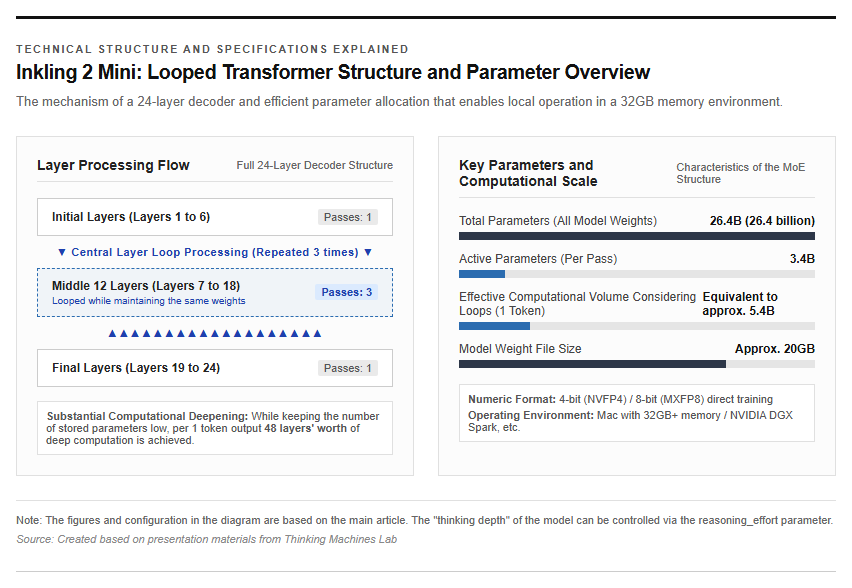
On November 20, 2026, California-based AI research company Thinking Machines Lab released “Inkling 2 Mini,” an open-weight model designed to run smoothly on laptops and local environments. Developed under the leadership of CEO Mira Murati, the model adopts a Mixture of Experts (MoE) architecture with a total parameter count of 26.4 billion (26.4B). The active parameters activated during actual computation are kept to 3.4B per pass, and the model’s weight file is kept to a compact size of approximately 20GB. Licensed under Apache 2.0, it is provided as an open model that can be freely used commercially, modified, and redistributed. It can run completely locally on a single device, such as an Apple Silicon Mac with 32GB or more of memory or an NVIDIA DGX Spark, without communicating with external servers. It is attracting significant attention as a solution for individual developers and enterprise development environments—where confidential data cannot be sent to external cloud services—allowing them to easily build and run AI agents.
Mechanism of the Looped Transformer Architecture and Deepened Computation
The primary technical feature of Inkling 2 Mini is its adoption of the “Looped Transformer” architecture, which iteratively computes the central layers of the internal network. The model consists of a 24-layer decoder structure, where the first and last 6 layers are passed through only once, while the middle 12 layers are looped and processed 3 times using the same weights. This achieves a deep internal calculation equivalent to “6 + 12 × 3 + 6 = 48 layers” per output token without increasing the number of weight parameters stored. The effective computational volume per token, accounting for the loop processing, is equivalent to approximately 5.4B. Furthermore, a key strength is that the model is directly trained from the development stage using a numerical format combining 4-bit precision (NVFP4) and 8-bit precision (MXFP8), meaning there is no performance degradation associated with post-deployment quantization. By adjusting the parameter (reasoning_effort) that controls the “depth of thought” in the model’s mind, users can also control the amount of computation dedicated to inference. The conceptual diagram below illustrates the loop processing and parameter progression in this model.
Analysis of Performance Benchmarks and Real-World Test Results
Advantages in Coding and Search Processing Compared to Other Models
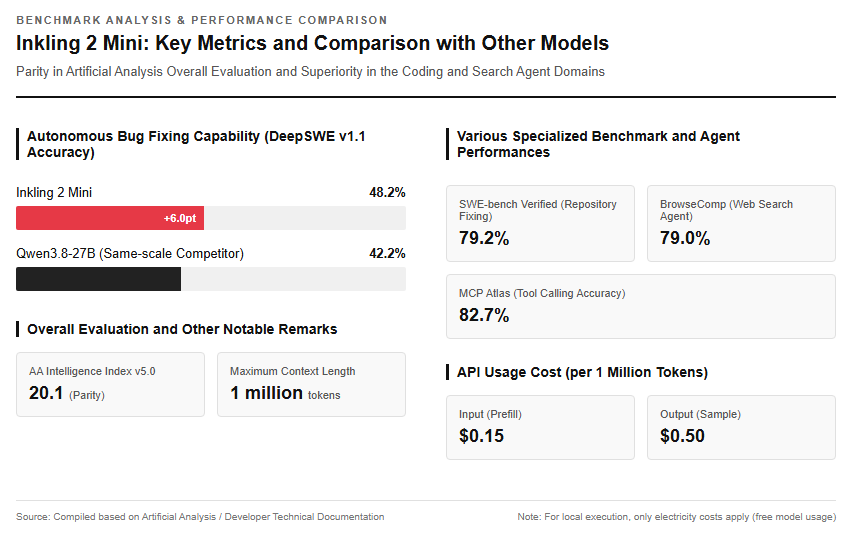
In the comprehensive evaluation index (AA Intelligence Index v5.0) conducted by independent evaluation organization Artificial Analysis, Inkling 2 Mini scored “20.1,” matching competing models of the same scale, such as Qwen3.8-27B. It demonstrates particularly strong performance in coding, search, and agent domains. On the DeepSWE v1.1 benchmark, which evaluates autonomous bug-fixing capabilities, it achieved a 48.2% accuracy rate, outperforming Qwen3.8-27B’s 42.2% by 6.0 points. Additionally, it recorded 79.2% on SWE-bench Verified (with bash execution) for repository-level debugging, 79.0% on BrowseComp for measuring web search agent performance, and 82.7% on MCP Atlas for tool-calling accuracy. It also supports context lengths of up to 1 million tokens (1,048,576 tokens), demonstrating superior capability in understanding long source code and large-scale documents.
Operating Environments, Tools, and Actual Usage Costs
This model can be easily run in a variety of local environments and cloud platforms. Ollama is supported as the simplest execution method, allowing it to be launched with a single ollama run inkling-2-mini command. It is also compatible with other major open-source inference engines such as llama.cpp, LM Studio, Jan, and vLLM. The minimum hardware specifications required for operation are an Apple Silicon Mac with 32 GB or more of memory (such as M3, M4, or M5 models) or an NVIDIA GPU with 32 GB or more of VRAM. When running locally on your own PC, the only cost incurred is electricity, with no model usage fees whatsoever. Additionally, when using “Tinker,” the API platform provided by the developer, the pricing is set at $0.15 per 1 million input (prefill) tokens and $0.50 per 1 million output (sample) tokens. Even with 1 million tokens of input and output, the total comes to around $0.65 (approximately 100 Japanese yen), boasting extremely high cost performance. An illustration of memory allocation and load status during operation is shown below.
Implementation Challenges and Future Application Prospects
Japanese Language Support, Factual Accuracy, and Safety Precautions
Despite its exceptionally high performance, Inkling 2 Mini has several clear limitations and points to keep in mind for practical implementation. According to the official model card, the model’s supported languages are “English and general multilingual,” and output quality and naturalness in Japanese are not officially guaranteed. In Chinese tests, sentence truncation and language mixing have been reported, and careful verification with your own company’s data is recommended before applying it to Japanese tasks. Furthermore, its non-hallucination rate (AA-Omniscience), which indicates the accuracy of knowledge retention, stands at only 63.4%, showing a tendency to cause factual inaccuracies compared to Qwen3.8-27B (71.4%). Because the knowledge itself depends on the total number of parameters (26.4B), making calculations deeper through loop structures does not increase the amount of knowledge itself. In addition, it has been pointed out that when permitted to operate tools as an agent, there is a risk of destructive operations—such as deleting or overwriting important files without prior confirmation from the user—making the application of a sandbox environment and the inclusion of a human-in-the-loop approval process essential during execution.
Future Developments and Points of Focus: The Evolution of Local AI Agents and Their Impact on Society
The emergence of Inkling 2 Mini symbolizes that an era has truly arrived where advanced AI agent capabilities, which previously relied on massive cloud-based models, can be securely brought to personal laptops and in-house servers. Especially for companies handling confidential information that cannot be sent to external APIs—such as proprietary source code, customer personal information, and top-secret financial data—the increase in options for high-performance local models that run locally holds immense significance. Moving forward, further improvements in inference speed and memory efficiency are expected as optimization progresses on open-source infrastructure such as Ollama and vLLM. In addition, whether the new architecture known as the Looped Transformer, which iterates through intermediate layers, will become a standard design approach for future small-scale model development is also a major point of interest. The developer, Thinking Machines Lab, is rolling out an ecosystem that includes its higher-end model, “Inkling 2 Small (594B),” and hybrid AI utilization combining local and cloud environments is projected to accelerate even further.
References
- [Thinking Machines Lab Official Announcement] https://thinkingmachines.ai/news/inkling-2-mini/
- [Hugging Face Official Repository] https://huggingface.co/thinkingmachines/Inkling-2-Mini
- [Hugging Face Official Blog] https://huggingface.co/blog/inkling2mini
[#AI #LocalLLM #Inkling2Mini #ThinkingMachines #Mac #OpenModels #ArtificialIntelligence]
コメント