
On November 23, 2026, the Government of Japan and the Government of the Czech Republic signed a new tax treaty in the capital city of Prague for the first time in approximately 48 years. By lowering withholding tax rates on investment income and introducing provisions to prevent international tax evasion, the treaty aims to eliminate double taxation and further promote investment and economic exchange between the two countries.
- Comprehensive revision for the first time in 48 years since the former treaty was concluded in 1978
- Signing process and future entry-into-force procedures for the new treaty
- Relaxation of withholding tax rates on dividends, interest, and royalties, and economic benefits
- Clarification of business profits taxation and regulatory provisions for capital gains from share transfers
- Countering BEPS through the Principal Purpose Test (PPT) and expanded information exchange provisions
- Impact on the 273 Japanese companies expanding into the Czech Republic and future investment prospects
Comprehensive revision for the first time in 48 years since the former treaty was concluded in 1978
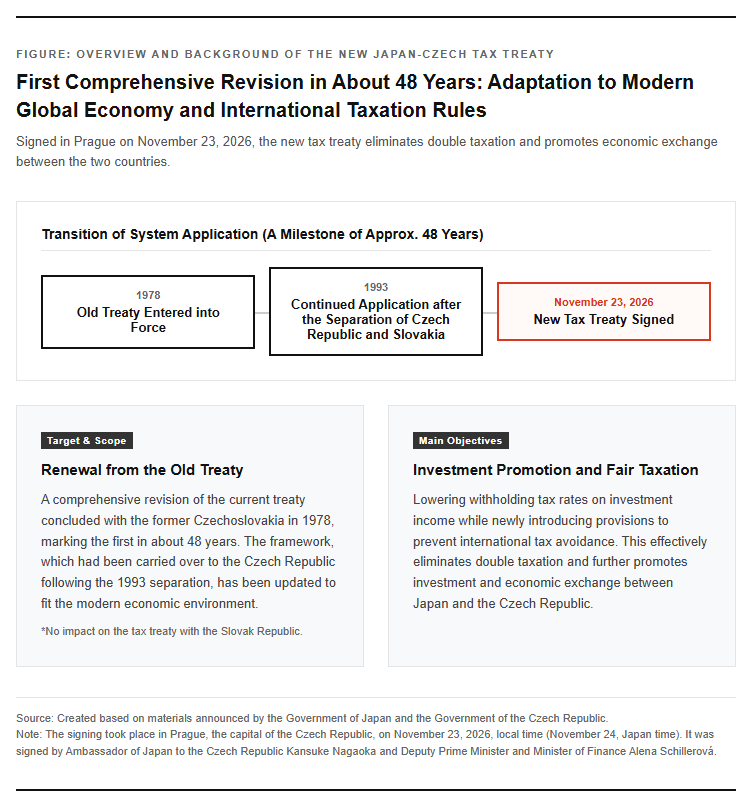
On November 23, 2026 local time (November 24 Japan time), in the capital city of Prague, Czech Republic, Kensuke Nagaoka, Ambassador Extraordinary and Plenipotentiary of Japan to the Czech Republic, and Alena Schillerová, First Deputy Prime Minister and Minister of Finance of the Czech Republic, signed the new tax treaty. Its official title is the “Convention between Japan and the Czech Republic for the Elimination of Double Taxation with respect to Taxes on Income and the Prevention of Tax Evasion and Avoidance.” This treaty comprehensively revises the current treaty with the former Czechoslovak Socialist Republic, which entered into force in 1978, for the first time in about 48 years. The legacy framework—which had continued to apply even after the peaceful dissolution of the Czech Republic and Slovakia in 1993—has been revamped and updated to meet the standards of the modern global economy and international taxation rules. Note that this new tax treaty does not affect the tax treaty currently in force between the Slovak Republic and Japan. The figure below illustrates the overall framework of the conclusion of the new tax treaty between the two countries.
Signing process and future entry-into-force procedures for the new treaty
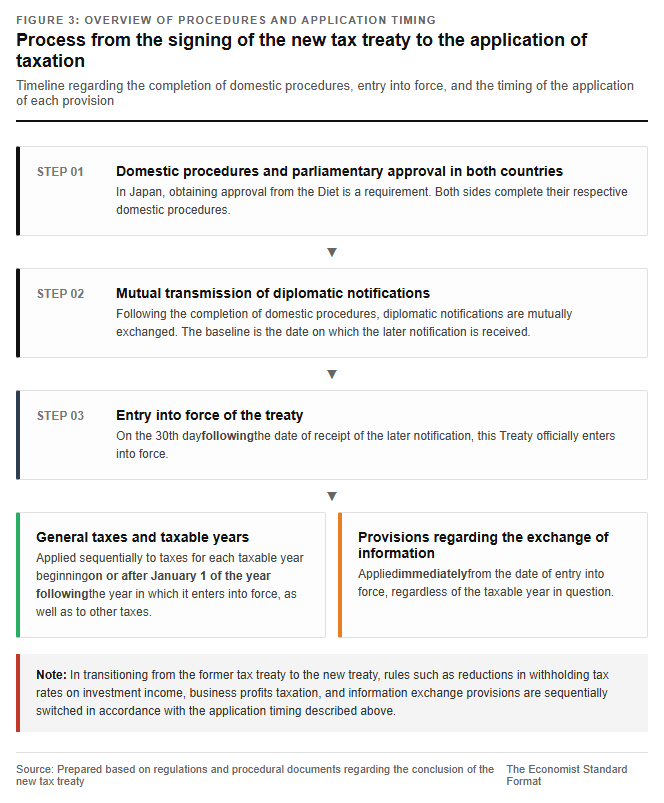
The new tax treaty does not take effect immediately upon signing; it requires the completion of domestic procedures by both parties moving forward. In Japan, obtaining approval from the Diet is a requirement, and after both parties complete their respective domestic procedures, they will mutually notify each other through diplomatic channels. The treaty is stipulated to take effect on the 30th day following the date on which the later notification is received. Regarding the timing of actual application to taxation, it will apply sequentially to taxes for each taxable year beginning on or after January 1 of the year following the year in which the treaty enters into force, as well as to other taxes. However, provisions concerning the exchange of information to enhance international tax transparency will apply immediately from the date of entry into force, regardless of the applicable taxable year.
Lowering of withholding tax rates on investment income and key points of tax revision
Relaxation of withholding tax rates on dividends, interest, and royalties, and economic benefits
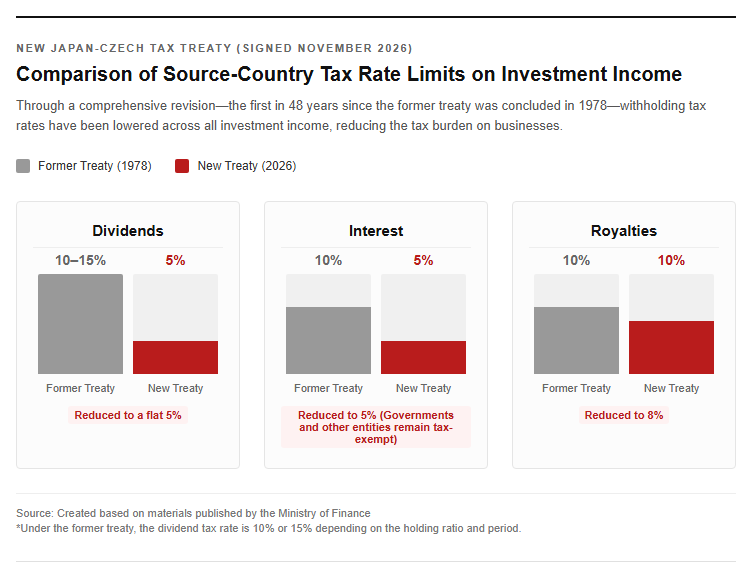
One of the most significant revisions in the new tax treaty is the substantial reduction of upper limits on taxation (maximum tax rates) in the source country for investment income (dividends, interest, and royalties), along with an expansion of tax-exempt categories. Previously, dividends were subject to a withholding tax rate of 10% (if holding 25% or more of voting rights for 6 months or more) or 15%, but the new treaty relaxes this to a flat 5%. Interest is also reduced from the conventional 10% to 5%, while exemptions will continue to be maintained for government-received interest and the like. Additionally, the rate for royalties has been reduced from the conventional 10% to 8%. This reduces the tax burden when Japanese companies expanding into the Czech Republic remit dividends, interest, and license fees from their local subsidiaries to the parent company, thereby improving capital efficiency and eliminating the risk of double taxation. The figure below compares the changes in maximum tax rates for each type of investment income under the old and new treaties.
Clarification of business profits taxation and regulatory provisions for capital gains from share transfers
Clear criteria were also presented regarding the taxation of business profits, which form the foundation of corporate activities. Only when an expanding company establishes a permanent establishment (PE), such as a branch, locally and conducts business there can the source country tax the profits attributable to that permanent establishment. Meanwhile, regarding capital gains from the transfer of shares, a provision has been included allowing the source country to exercise its taxing rights on gains obtained by a person who transfers shares of a corporation when that person owned 10% or more of the issued shares, etc. Furthermore, a mutual agreement procedure is stipulated to resolve tax disputes and non-compliance, establishing a system that guarantees appropriate corrective measures through consultations between the tax authorities of both countries.
Strengthening of anti-tax avoidance measures and the impact on and outlook for Japanese companies
Countering BEPS through the Principal Purpose Test (PPT) and expanded information exchange provisions
Reflecting the outcomes of the BEPS (Base Erosion and Profit Shifting) project promoted by the OECD and G20, the new treaty strictly introduces measures to prevent tax avoidance. Specifically, it incorporates the Principal Purpose Test (PPT), which denies treaty benefits if it is reasonably concluded that obtaining those benefits was one of the principal purposes of any transaction or arrangement. This prevents improper use of the treaty (treaty shopping) through artificial conduit companies. At the same time, the scope of matters and taxes subject to information exchange between tax authorities has been significantly expanded, strengthening the capability to address international tax evasion and artificial tax avoidance practices through information sharing, including bank account information. The figure below illustrates the mechanism for optimizing taxation based on BEPS prevention provisions.
Impact on the 273 Japanese companies expanding into the Czech Republic and future investment prospects
Among Central and Eastern European countries, the Czech Republic is the most active destination for Japanese corporate expansion, with 273 Japanese companies currently operating locally and cumulative investment reaching 2.7 billion euros. Major manufacturing companies such as Toyota Motor, Panasonic, Denso, Daikin Industries, and AGC have established plants there. In recent years, investment has shifted from mere low-cost manufacturing bases to high-tech fields such as R&D (research and development) facilities, semiconductors, AI, and the aerospace industry. Following the entry into force of the Japan-EU Economic Partnership Agreement (EPA) in 2019, the entry into force of this new tax treaty will further enhance tax cost reduction and legal stability. Amid the restructuring of the European market driven by de-Russification and support for Ukraine’s reconstruction, Japanese investment and technological cooperation in the Czech Republic are expected to accelerate even further in the future.
References
- [Ministry of Foreign Affairs] Signing of the Japan-Czech Tax Treaty: https://www.mofa.go.jp/mofaj/press/release/pressit_000001_04503.html
- [Ministry of Finance] New Tax Treaty with the Czech Republic Signed: https://www.mof.go.jp/tax_policy/summary/international/tax_convention/press_release/20261124cz.html
- [KPMG] Czech Republic Investment Guide 2024 Edition: https://kpmg.com/jp/ja/insights/2021/08/czech-businessbook-20210820.html
[#JapanCzechTaxTreaty #EliminationOfDoubleTaxation #ReductionOfWithholdingTaxRates #InternationalTaxation #CounteringBEPS #CzechInvestment #EconomyBusiness]


コメント