
On November 20, 2026, major flea market app operator Mercari announced that personal information belonging to a total of 3,796 users and business partners may have been leaked due to unauthorized access to a sub-contractor of a cloud AI service used for business operations. With the rapid spread of external SaaS and AI tools, the importance of security governance and sub-contractor management across the entire supply chain has once again been brought to light.
- Key Points and Scope of the Personal Information Leak Involving 3,796 Individuals
- Supply Chain Attacks and the Structural Vulnerabilities of AI Service Subcontractors
- Impact on the Stock Market and Corporate Reputation Risk
- Supervisory Responsibility for Outsourced Contractors and Legal Risks Under the Act on the Protection of Personal Information
- Challenges in Data Governance and Input Management Associated with the Adoption of Generative AI
- Strengthening Supply Chain Security and Future Focus Points
Key Points and Scope of the Personal Information Leak Involving 3,796 Individuals
On November 20, 2026, the Mercari Group—comprising Mercari, Inc., Merpay, Inc., and Mercoin, Inc.—announced that there is a possibility of a personal information leak in the cloud-based AI service used for its business operations. A total of 3,796 individuals may have been affected, broken down as 1,522 Mercari users, 571 client representatives, 169 job applicants, and 1,534 group temporary workers, contractors, and former employees. Confirmed information that may have been included consists of names, email addresses, dates of birth, phone numbers, screening information, and details regarding service usage and inquiries. On the other hand, highly sensitive information directly linked to finances and authentication, such as credit card numbers, My Number information, and login passwords, was not included, and no unauthorized use of the leaked information has been confirmed at this time. Please refer to the diagram below for an overview of the company’s procedures for preventing the spread of damage and its investigation workflow.
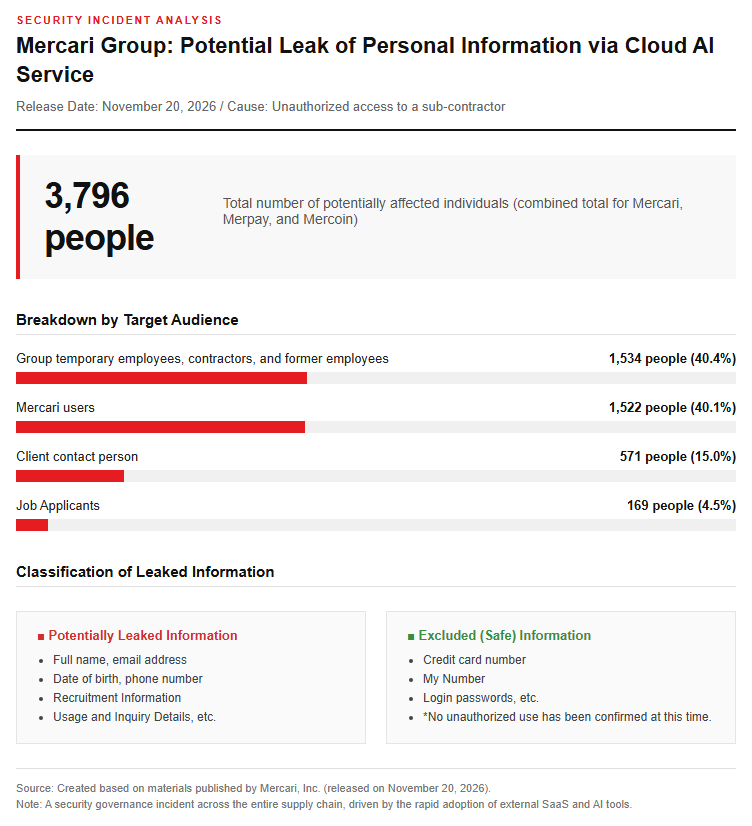
Mercari has begun sending individual notifications to affected parties whose contact information is available, and is issuing warnings to prevent secondary damage.
Supply Chain Attacks and the Structural Vulnerabilities of AI Service Subcontractors
The cause of this incident was not a breach of Mercari’s own systems, but rather unauthorized access by a third party to the environment of Fireworks AI, Inc., a U.S. company to which the provider of the external SaaS “Notion AI” had sub-contracted data processing. A portion of the text entered into Notion AI’s chat feature by Mercari employees between October 5 and October 24, 2026, as well as records of AI responses, were stored in Fireworks AI’s environment. Upon being notified by Notion on November 10, 2026, Mercari immediately established a countermeasures team and began an investigation. On November 12, Mercari received a report from Notion stating that the deletion of the relevant records in that environment and the disconnection of the connection had been completed. Additionally, procedures for invalidating and reissuing business system authentication credentials included in the affected records were immediately completed. This has made clear the typical structural threat of supply chain-style cyberattacks, where significant data leaks can be triggered via third parties or sub-contractors of AI vendors, even without direct attacks on a company’s own systems.
Economic Impact and Corporate Legal Responsibilities
Impact on the Stock Market and Corporate Reputation Risk
The public disclosure of a personal information leak incident directly impacts corporate value and stock market valuation. According to a research report by Cyber Security Cloud, Inc. analyzing 110 leak cases disclosed between January and December 2021, approximately 80% of listed companies that made a timely disclosure of a personal information leak recorded a stock price decline on the day following the announcement, with a maximum drop of 21.6% and an average drop of 2.8%. Furthermore, it was found that the downward trend was not merely temporary; 30 days after the announcement, the average drop rate expanded to 5.2%, showing a tendency for the decline to continue widening. For Mercari—which has maintained a 10-percent take rate in the flea market app market and leveraged a secure transaction environment as a pioneer of domestic C2C platforms—maintaining trust from users and investors is fundamental to its management. Immediately following the discovery of an information leak, market turbulence tends to materialize as reputation risks, such as falling stock prices and damage to brand identity, making the long-term and continuous securing of transparency in security measures an important factor in investment decisions.
Supervisory Responsibility for Outsourced Contractors and Legal Risks Under the Act on the Protection of Personal Information
From a legal perspective, even if a data breach is caused by deficiencies at a subcontractor, the contracting company cannot escape liability. Article 25 of the Act on the Protection of Personal Information (APPI) stipulates the obligation to exercise necessary and appropriate supervision over subcontractors, requiring companies to ascertain whether subcontractors and sub-subcontractors are taking appropriate safety management measures. Furthermore, based on Article 26 of the same Act, in the event of a data breach involving more than 1,000 individuals or a breach for illicit purposes—or if such a breach is suspected—companies are obligated to submit a preliminary report to the Personal Information Protection Commission (within roughly 3 to 5 days from the date of awareness), a final report (within 60 days in cases such as cyberattacks), and notifications to the affected individuals. Past court precedents have also shown that in breach incidents caused by employees of subcontractors or sub-subcontractors, the contracting company’s breach of supervisory duty and employer liability are contested, creating the risk of having to pay damages for emotional distress and bear response costs demanded by victims. Please refer to the figure below for the structure regarding organizational responses to security incidents and legal obligations.
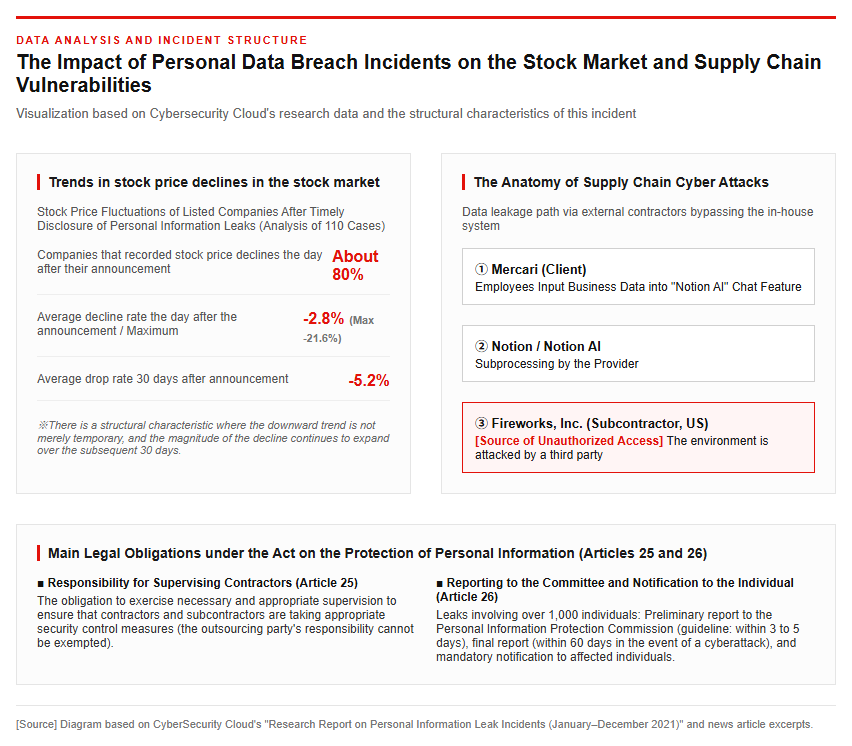
Companies must go beyond contractual confidentiality clauses and establish an effective governance framework that includes the technical measures of subcontractors.
Recurrence Prevention Measures and Future Security Outlook
Challenges in Data Governance and Input Management Associated with the Adoption of Generative AI
While the internal adoption of generative AI and SaaS is rapidly progressing for the purpose of operational efficiency and productivity enhancement, shadow IT and insufficient governance in data input have become new vulnerabilities. In this incident, the risk was magnified by employees entering personal information and system credentials into AI services during their daily operations. The Cybersecurity Management Guidelines formulated by the Ministry of Economy, Trade and Industry (METI) and IPA also list understanding the status and implementing measures across the entire supply chain, including business partners and contractors (Directive 9), as a crucial item. After the incident came to light, Mercari took emergency measures to limit the information handled in Notion AI’s chat function, but going forward, the filtering of information input into AI tools and the strict enforcement of access privileges will be essential. When companies promote the use of AI, there is an urgent need not only to formulate usage guidelines, but also to implement technical data protection measures that guarantee confidential information and personal data are not transmitted to or stored in external training data or secondary contractors.
Strengthening Supply Chain Security and Future Focus Points
This incident demonstrates that in modern digital business, relying solely on a company’s own security measures is insufficient, and that emergency response frameworks (CSIRT) and risk management across the entire supply chain are essential. Looking ahead, the first point of attention is Mercari’s review of how it uses external services, including AI tools, and the specific implementation of recurrence prevention measures. The second is the progress of third-party investigations by Notion and Fireworks, as well as the strengthening of log auditing systems at sub-contractors. As the IPA’s Incident Response Guidelines indicate, preventing the spread of damage, transparently disclosing the facts, and thoroughly centralizing information management are key to restoring a company’s social credibility. Furthermore, discussions regarding the Reiwa 8 (2026) amendment to the Act on the Protection of Personal Information include expanding the scope of penalties for illegal provision offenses and increasing statutory penalties, meaning stricter regulations are also anticipated. Whether companies can implement multi-layered risk assessments that look beyond the cloud services they use to include their sub-contractors will be the most critical issue in future digital management.
Reference page
- [Regarding the Possibility of Information Leakage Due to Unauthorized Access to a Subcontractor of a Cloud Service Used by Our Group | Mercari, Inc.] https://about.mercari.com/press/news/articles/20261120_incidentreport/
- [Announcement of “Research Report on Personal Information Leakage Disclosure and Changes in Stock Prices” | Cyber Security Cloud, Inc.] https://www.cscloud.co.jp/news/report/202202174115/
【#Mercari #PersonalDataLeak #UnauthorizedAccess #SupplyChainRisk #GenerativeAIGovernance #Cybersecurity #StockPriceImpact #PersonalInformationProtectionAct】

コメント