The Central Bank of Russia will announce its key interest rate at its October policy meeting. Amid the intersection of severe inflation and the expansion of wartime finances, global attention is focused on how the central bank will steer its monetary policy.
- Key Points of the October Interest Rate Announcement and Policy Rate Trends
- Expanding Fiscal Expenditure and Persistent Inflationary Pressures
- Governor Nabiullina’s Trials and Pressure from Home and Abroad
- The Distorted Financial Transmission Mechanism and Its Impact on Businesses and Households
- Fiscal Dominance Risk and Central Bank Liquidity Absorption
- Future Outlook and Key Points to Watch in the Russian Economy
Key Points of the October Interest Rate Announcement and Policy Rate Trends
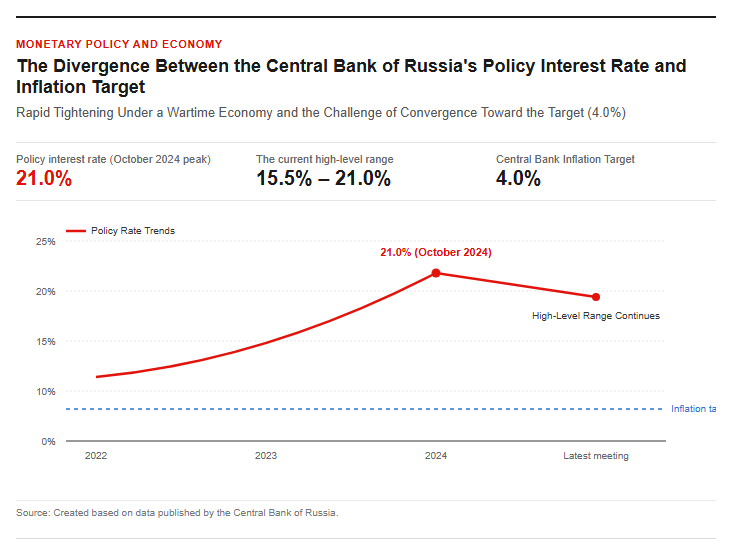
The Central Bank of Russia will announce its key interest rate at its October policy-setting meeting. The Russian economy has faced rapid price increases driven by geopolitical tensions and massive military spending since 2022. In response, the central bank has implemented aggressive monetary tightening, including raising the policy rate to a record-high 21.0% in October 2024. Since then, the policy rate has remained at elevated levels between 15.5% and 21.0%, and whether the bank will maintain its stance of prioritizing inflation control will be the central focus of the upcoming October announcement.
Behind the central bank’s continued aggressive tightening lies a strong resolve to bring the inflation rate closer to its 4.0% target. However, amid ongoing fiscal stimulus centered on the military-industrial complex, some point out that the cooling effect on private-sector capital demand and the broader economy remains limited. The following chart shows the trends in policy interest rates and price movements.
Market attention is focused on whether the central bank will implement further rate hikes or keep high interest rates on hold to show consideration for the economy. In financial markets, concerns over a resurgence of inflationary pressures are intersecting with the frustrations of private-sector companies struggling with rising borrowing costs, making this interest rate decision a crucial juncture for gauging the short-term direction of the Russian economy.
Expanding Fiscal Expenditure and Persistent Inflationary Pressures
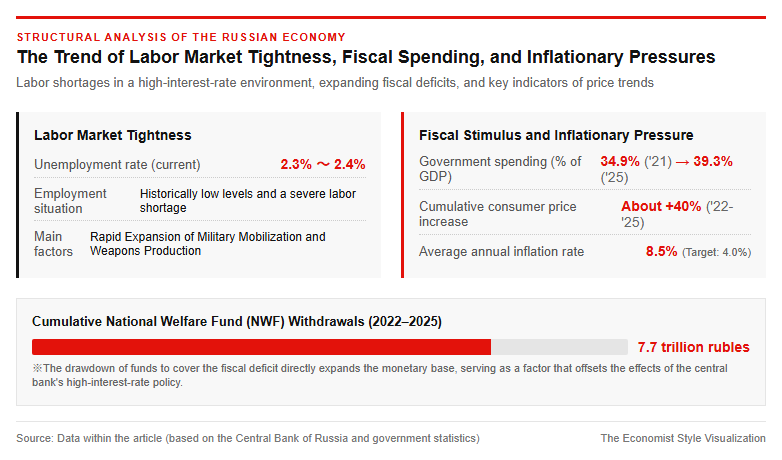
The fundamental reason why the central bank cannot abandon its hawkish stance lies in the rapid expansion of Russia’s fiscal policy and the persistent inflationary pressure accompanying it. From 2022 to 2025, Russia’s consumer prices rose by a cumulative total of approximately 40%, with the average annual inflation rate reaching 8.5%. This significantly exceeds the central bank’s target of 4.0%. General government expenditures have surged in nominal terms, with the share of government spending in GDP rising from 34.9% in 2021 to 39.3% in 2025.
The primary driver of the spending increase is heavy funding for defense and related industries, and a cumulative 7.7 trillion rubles was withdrawn from the National Welfare Fund (NWF) between 2022 and 2025 to plug the fiscal deficit. The drawdown of funds from the National Welfare Fund means that money is transferred from the central bank’s accounts to the accounts of budget recipients, which has the effect of directly expanding the monetary base. In this way, because the Ministry of Finance’s fiscal expansion policy continues to supply massive liquidity to the market, a structural condition has been created in which it is difficult to immediately suppress the underlying trend of price increases, no matter how high interest rates are maintained by the central bank.
Monetary Policy Leaders and Spillover Effects on the Private Economy
Governor Nabiullina’s Trials and Pressure from Home and Abroad
Elvira Nabiullina, Governor of the Central Bank of Russia, is an expert who has made prompt policy decisions during the 2014 ruble crisis and the 2020 pandemic, earning high praise from international economists. She was named Euromoney’s Central Bank Governor of the Year in 2015. Although it was reported that she offered to resign immediately after the 2022 military invasion, she remained in office at the request of President Putin, preventing a complete economic collapse through the introduction of capital controls and emergency interest rate hikes.
However, criticism of the persistently high policy rate is currently mounting among high-ranking government officials and the business community. Political factions—including the Minister of Economic Development—and emerging conglomerates argue that high interest rates are stifling investment and growth in non-military industries and elevating the risk of corporate bankruptcies. In response, Governor Nabiullina has countered that economic overheating and labor shortages are driving up prices, continuing to emphasize the central bank’s independence and the importance of meeting its inflation targets. Whether the central bank can maintain its strict monetary tightening hinges on political trust from President Putin and the power balance with the growing opposition.
The Distorted Financial Transmission Mechanism and Its Impact on Businesses and Households
Despite the high-interest-rate environment exceeding 20.0%, the ripple effects of monetary tightening in the Russian economy are significantly distorted. Due to the government’s preferential lending schemes and prioritized funding for military-related sectors, state-strategic sectors are able to continue borrowing while evading the impact of high interest rates. Meanwhile, private manufacturing and service industries, as well as households, which are ineligible for such preferential treatment, face directly prohibitive borrowing costs, driving an escalating dual-track structure.
Furthermore, driven by the rapid expansion of military mobilization and weapons production, the unemployment rate has fallen to historic lows of 2.3% to 2.4%, resulting in a severe labor shortage. The following figure shows corporate capacity utilization rates and labor market tightness.
Businesses have no choice but to raise wages to secure talent, creating a “wage-price spiral” in which these costs are passed on to service and consumer goods prices. While interest rate hikes by central banks would normally strongly dampen demand in a regular market economy, the current reality—characterized by massive government military demand and preferential loans—concentrates the burden solely on the private sector, partially neutralizing the effectiveness of monetary policy.
Fiscal and Monetary Inconsistency and the Medium- to Long-Term Economic Outlook
Fiscal Dominance Risk and Central Bank Liquidity Absorption
The challenge of macroeconomic policy in Russia lies in the insufficient coordination between the monetary policy of the central bank and the fiscal policy of the Ministry of Finance. Normally, countercyclical management aimed at reducing the fiscal deficit is required during periods of economic expansion, but since 2023, Russia’s fiscal policy has increasingly moved in a stimulus-driven, non-countercyclical direction. While GDP growth recorded high levels of 4.1% in 2023 and 4.9% in 2024, the government’s fiscal deficit expanded from 1.6% to 2.2% of GDP, and reached 3.9% in 2025.
Large-scale government bond issuance by the Ministry of Finance and the drawdown of sovereign wealth funds increase liquidity in financial markets. The central bank sets high interest rates as a lightning rod to absorb excess market liquidity, conducting selling operations and reserve requirement adjustments, but it cannot keep up with the speed of fiscal stimulus. Although the situation has not reached “fiscal dominance”—where the central bank intentionally keeps the government’s borrowing costs low—a structure in which aggressive spending by the Ministry of Finance offsets the central bank’s inflation-control measures has become entrenched, and policy inconsistency is a factor prolonging this state of affairs.
Future Outlook and Key Points to Watch in the Russian Economy
As for future developments and points to watch, a key question is whether the Russian economy can break free from its current high-inflation, high-interest-rate structure and smoothly return to a cruising speed around its potential growth rate of 1.0%. According to forecasts by the World Bank and the International Monetary Fund (IMF), Russia’s real GDP growth rate in 2026 is projected to slow to around 0.6% to 0.8% due to slowing private investment and cooling household consumption resulting from prolonged high interest rates. The ultimate focus moving forward will be whether the country can stabilize prices while preventing an economic stall.
Even after the central bank’s October interest rate announcement, close attention will be paid to whether the inflation rate continues to decline steadily toward the target of 4.0%. Whether the government can push forward with defense spending cuts and value-added tax rate adjustments (such as raising the rate from 20% to 22%) from 2026 onward, and how crude oil price trends and the impact of additional U.S. and European sanctions will affect the current account, will dictate the interest rate trajectory. All eyes will be on the Central Bank of Russia’s next policy decisions as to whether the tight labor market will ease alongside an economic slowdown, or whether the military-first structure will become entrenched and lead to stagflation where low growth and inflation coexist.
Reference page
- [Russian Journal of Economics – Fiscal and monetary policy interaction in Russia, 2000–2025][suspicious link removed]
- 【Bank of Russia – Monetary Policy and Statistics】[suspicious link removed]
- 【World Bank – Russian Federation Economic Update】[suspicious link removed]
- 【Swedish Defence Research Agency (FOI) – Central Bank of Russia Analysis】[suspicious link removed]
[#RussianEconomy #RussianCentralBank #PolicyInterestRate #InflationCountermeasures #FiscalPolicy]

コメント