
On November 25, 2026, Computex Inc. announced “AI-Assisted Debug Technology,” which connects the “PALMiCE4” JTAG emulator with generative AI via MCP to operate actual hardware and analyze bugs. This development is driven by industry-wide challenges: the inherent difficulty of validating actual hardware in embedded development, and the growing debugging bottlenecks and understanding debt associated with the proliferation of AI-generated code.
- Overview of “AI-Assisted Debug Technology” Enabling Actual Hardware Operation
- Background of Development: The Hardware Barrier Faced by Embedded Systems
- MCP and Architecture Supporting Natural Language Operation and Autonomous Analysis
- Safety Controls to Prevent Malfunctions and Compatibility with a Wide Variety of AI Agents
- Debugging Bottlenecks and Market Trends Arising from the Expansion of Generative AI Development
- Practical Implementation Requirements and Future Points of Focus in Embedded Development
Overview of “AI-Assisted Debug Technology” Enabling Actual Hardware Operation
On November 25, 2026, Computex Inc., headquartered in Kyoto City, Kyoto Prefecture, announced the development of an AI-assisted debug technology that links generative AI with the PALMiCE4, an Arm core-compatible JTAG emulator. This technology is scheduled for release in December 2026. While the development of web and mobile applications has seen rapid progress in AI-driven code generation and testing, the development of embedded systems linked with hardware has made it difficult to directly verify internal behaviors on actual devices, limiting the application of AI. The newly announced technology connects AI agents and debuggers via the open-standard MCP (Model Context Protocol), enabling direct operation of actual hardware using natural language and automated investigation of bug causes.
Developers can give instructions to the debugger in Japanese, such as “Stop the program and display PC/SP/R0” or “Display the memory contents of 8 bytes starting from address 0x1000.” The mechanism allows the AI to autonomously execute CPU control and acquire register information via the PALMiCE4. The following diagram shows the overall picture of how the AI-assisted debug technology controls actual hardware.
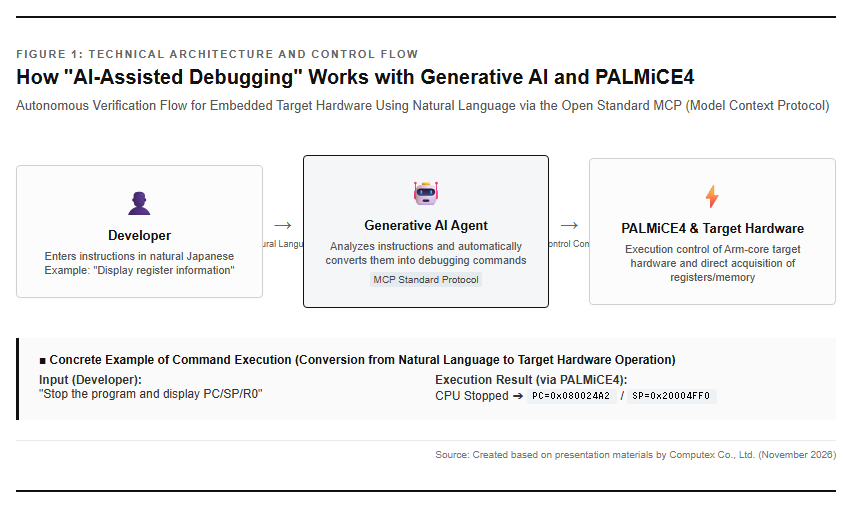
Furthermore, for complex problems such as “The buffer total calculation is occasionally incorrect, find the cause,” the AI voluntarily gathers necessary information, forms hypotheses, and conducts verification.
Background of Development: The Hardware Barrier Faced by Embedded Systems
In conventional embedded development, when utilizing AI for debugging, the targets have been mainly limited to static analysis of source code and checking log outputs. Confirming real-time state changes in the CPU registers, memory, and peripheral circuits of actual hardware requires advanced skills to manually operate specialized debugging tools (JTAG emulators), which has been a major barrier to AI adoption. In recent years, while the proliferation of AI-generated code has dramatically improved implementation speed in early development stages, a tremendous amount of time is spent analyzing memory corruption and exception handling errors that occur exclusively in actual hardware environments.
To solve this problem, Computex built an MCP server dedicated to the PALMiCE4, developing a mechanism that allows AI agents to invoke debugger functions as needed. This significantly simplifies the actual hardware verification process, which previously required specialized knowledge, making it possible to simultaneously shorten development time and improve quality. The following diagram shows a comparison of the verification flow between conventional debugging methods and AI-assisted debugging.
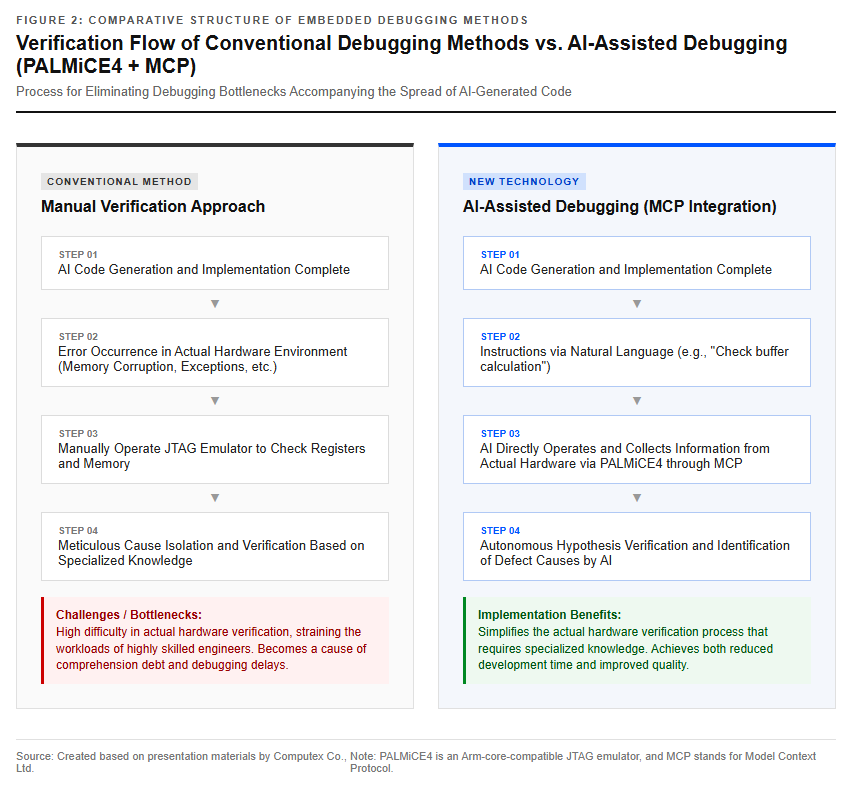
The emergence of this technology marks a critical turning point that expands the application scope of AI agents beyond software development into physical AI and embedded domains involving hardware.
Technical Mechanisms and Safety Operation Initiatives
MCP and Architecture Supporting Natural Language Operation and Autonomous Analysis
The core of this technology lies in the design of the MCP interface optimized for AI agents. The functional architecture is structured so that the AI can accurately select the advanced features of the debugger while minimizing the token consumption issues typical in interactions with LLMs. In addition to program execution control, it supports acquiring task states in an RTOS (Real-Time Operating System) and independent control of each core in multi-core processors. Furthermore, even in trace analysis where massive amounts of data are generated, it is equipped with a mechanism for the AI to efficiently extract necessary execution paths and variable change histories.
In the analysis process, upon receiving a general bug report from a developer, the AI operates the PALMiCE4 to investigate the required memory ranges and register values. Once the cause of the bug is identified, the factor and proposed fix are reported in Japanese. By having the AI autonomously cycle through hypothesis-verification loops that humans used to spend hours on, the time required for debugging is dramatically reduced.
Safety Controls to Prevent Malfunctions and Compatibility with a Wide Variety of AI Agents
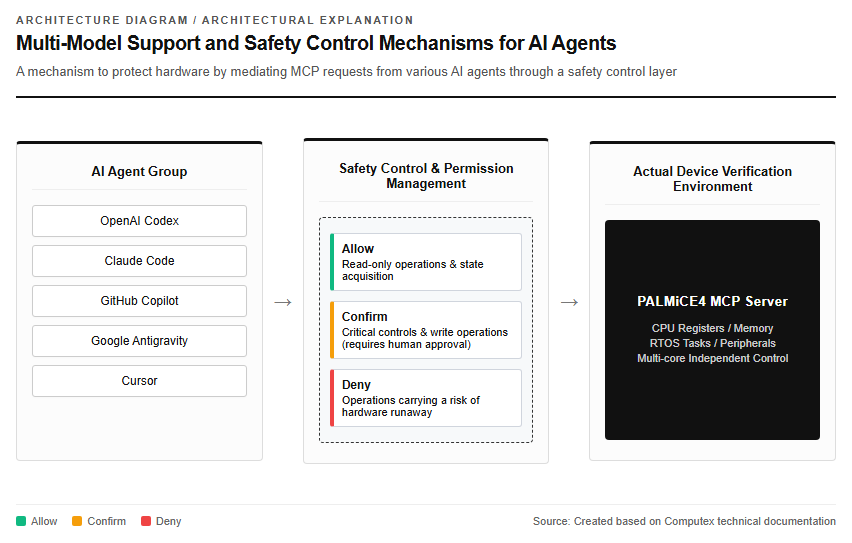
When an AI directly operates actual hardware, the point that requires the utmost attention is the risk of hardware damage caused by unintended writes or runaway behavior. To ensure safety in actual device operations, this technology introduces a security mechanism that allows fine-grained setting of operation permissions—”allow,” “deny,” or “confirm”—for each debug function. By making human approval mandatory for critical control and write operations, the design prevents AI runaway.
Another major feature is flexible multi-agent support that does not depend on any specific AI model. Specifically, it supports major AI agents such as OpenAI’s Codex, Anthropic’s Claude Code, GitHub Copilot, Google Antigravity, and Cursor. It is possible to select and integrate tools to match environments already introduced in the development field, allowing implementation without disrupting the development team’s existing workflow. The following figure shows the conceptual diagram of the connection between the safety control mechanism and various AI agents.
The “Understanding Debt” Challenge in the AI Era and Future Prospects
Debugging Bottlenecks and Market Trends Arising from the Expansion of Generative AI Development
While automatic code generation by generative AI is becoming commonplace, the difficulty of debugging is emerging as a challenge across the industry. According to research data, while state-of-the-art LLMs achieve high scores of over 70% in code synthesis tests, their success rate in actual debugging tasks drops sharply to under 15%. Furthermore, the increase in AI-generated code has brought attention to the “AI paradox”—where pull request review time increases by 91% and bugs increase by 9%—as well as the ballooning of “understanding debt,” where no one can explain the logic of the code. In academic societies as well, research is progressing rapidly, such as ASAD (which dynamically forms AI teams according to bug complexity) and AgentStepper (which debugs AI behavior using step execution and Git history).
Against this backdrop, the market for AI-utilized software testing and debugging is expanding rapidly. According to an analytical report by Fortune Business Insights, the global AI-enabled testing market size is projected to grow from 1.01 billion US dollars (approx. 1.01 billion USD) in 2025 to 1.21 billion USD in 2026, and reach 4.64 billion USD by 2034 at a compound annual growth rate (CAGR) of 18.30%.
Practical Implementation Requirements and Future Points of Focus in Embedded Development
The models compatible with the AI-assisted debugging technology provided by Computex are PALMiCE4-ARM supporting 32-bit cores, PALMiCE4-ARM64 supporting 64-bit cores, and PALMiCE4-CM dedicated to Cortex-M. Because this function is provided as a standard feature of PALMiCE4, no additional costs are incurred, but its use requires enrollment in the PALMiCE4 user support system. Note that usage fees for the generative AI services to be integrated are subject to the user’s individual contracts. At the time of release in December 2026, a free evaluation loan service allowing users to test this technology on actual boards is also scheduled to be implemented.
Moving forward, the transition from an era where AI merely writes code to “AI-driven development,” which performs dynamic verification and self-repair on actual hardware, is expected to accelerate. The skills required of developers will likewise shift from simply the speed of writing code to advanced verification capabilities for monitoring and directing the behavior of AI agents while ensuring the safety of actual hardware.
Reference Pages
- [Computex Co., Ltd. AI-Assisted Debugging Detailed Page] https://www.computex.co.jp/lp/ai_assist_debug.htm
- [Computex Co., Ltd. Press Release (PR TIMES)] https://prtimes.jp/main/html/rd/p/000000007.000051800.html
- [ASAD: Adaptive Software Agents for Debugging (arXiv)] https://arxiv.org/abs/2601.09822
- [AgentStepper: Interactive Debugging of Software Development Agents (arXiv)] https://github.com/sola-st/AgentStepper
- [Ministry of Economy, Trade and Industry “Guidelines on Interpretation and Application of Civil Liability in AI Utilization”] https://www.meti.go.jp/press/2026/04/20260409001/20260409001.html
[#AIDebugging #GenerativeAI #EmbeddedDevelopment #PALMiCE4 #Computex #MCP #UnderstandingDebt #AIAgents]


コメント