Following successive interest rate hikes by the Bank of Japan, approximately 60% of domestic companies reported a “negative impact” on their business performance and operations. Behind this is a situation where, in addition to prolonged inflation and soaring labor costs, a direct increase in borrowing interest rates and a decline in consumer purchasing power are rapidly squeezing corporate earnings.
- Key points of the corporate impact survey and rapidly spreading caution
- Disparities in negative impacts by industry and scale
- The reality of interest rate hike inquiries from main banks
- Passing on costs to secure profits and reviewing capital investments
- Rising Cost of Capital and the Redefinition of Asset Ownership
- Portfolio Metabolism through Business Restructuring and Carve-Outs
Key points of the corporate impact survey and rapidly spreading caution
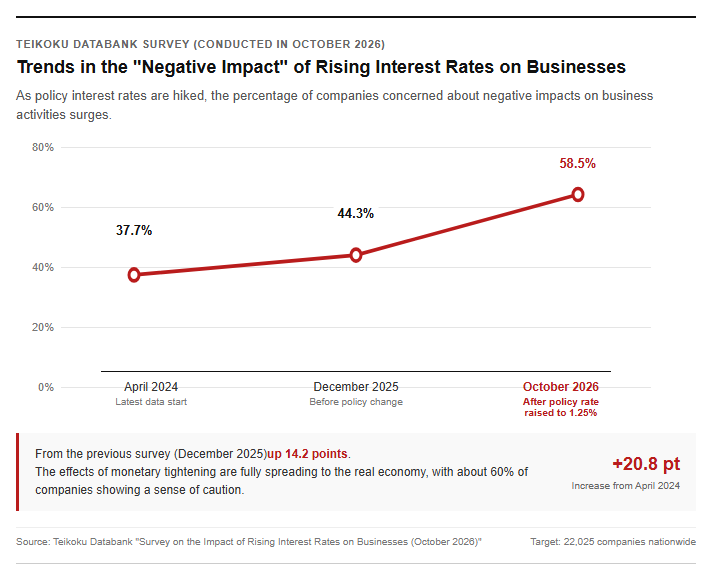
According to the “Survey on the Impact of Rising Interest Rates on Corporations (October 2026)” conducted by Teikoku Databank, Ltd. between October 19 and October 31, 2026, targeting 22,025 companies nationwide, 58.5% of companies responded that “the negative impact is greater” on their business activities. Following the Bank of Japan’s decision at the Monetary Policy Meeting on September 18, 2026, to raise the policy interest rate from around 1.00% to around 1.25%, the effects of monetary tightening are fully spilling over into the real economy. Looking at past survey trends, the proportion of companies concerned about negative impacts has increased remarkably as follows:
- April 2024 survey: 37.7%
- December 2025 survey: 44.3%
- October 2026 survey: 58.5%
The increase from the previous survey was 14.2 points, marking a significant increase of 20.8 points compared to April 2024. Meanwhile, only 2.6% of companies answered that “the positive impact is greater,” and as “undecided” responses decrease, a sense of crisis among companies is rapidly intensifying. In the Japanese economy, where monetary easing has continued for a long period, the hike in policy interest rates brings about a direct increase in costs known as interest payments, plunging companies into a critical phase that tests their very management structure. Please refer to the trend graph below.
Disparities in negative impacts by industry and scale
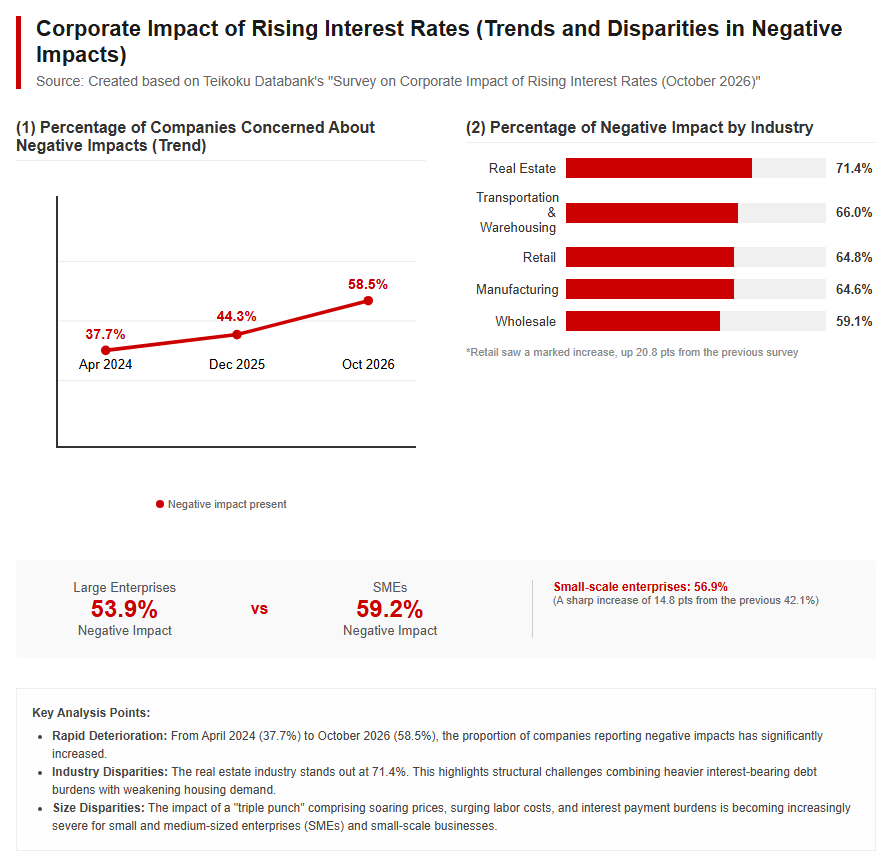
The negative effects of rising interest rates show remarkable disparities depending on company size and industry characteristics. By company size, small and medium-sized enterprises (SMEs) reported a negative impact of 59.2%, exceeding large enterprises at 53.9% by 5.3 points. Among small businesses in particular, the response rate for negative impact reached 56.9%, surging by 14.8 points from 42.1% in the previous survey. In addition to soaring raw material and labor costs, the structural triple punch of mounting interest payment burdens to financial institutions is directly hitting the earnings of small and medium-sized enterprises.
By industry, the real estate sector had the highest negative impact at 71.4%, making it the only industry exceeding 70%. The real estate sector relies heavily on interest-bearing debt associated with development and land acquisition, facing a direct increase in borrowing interest rate burdens. Furthermore, it is suffering from a double bind of diminished demand, such as hesitance to buy and a decrease in affordable purchase amounts due to rising residential mortgage rates for individuals.
The industries with the next highest impacts are as follows:
- Transportation and Warehousing: 66.0%
- Retail: 64.8% (largest increase of 20.8 points from the previous survey)
- Manufacturing: 64.6%
- Wholesale: 59.1%
Particularly in the retail industry, consumer trends favoring thriftiness due to rising interest rates and increased loan repayment burdens present challenges that directly and immediately translate into declining sales volumes and lower spending per customer. The distribution of impacts by industry is shown in the figure below.
Bank inquiries regarding interest rate hikes and specific corporate financial responses
The reality of interest rate hike inquiries from main banks
Amid the spreading caution toward rising interest rates, requests for interest rate hikes from financial institutions are also proceeding at a rapid pace. According to the survey results, the percentage of companies that received inquiries about interest rate hikes from their transactional financial institutions, such as their main bank, reached nearly half at 47.7% of the total. A breakdown shows that “there was an inquiry and rates have already been raised” accounted for 28.9%, while “there was an inquiry about a future hike” accounted for 18.8%. This highlights the fact that changes in monetary policy are materializing not as mere projections, but as actual changes in borrowing contract conditions.
By size, 48.7% of SMEs received inquiries, surpassing large enterprises at 41.7% by 7.0 points. By industry, the real estate sector recorded the highest rate of “inquiries received” at 57.0%, with 43.9% of those companies responding that “rates have already been raised.” The real estate sector cannot easily cut off bank borrowings in order to maintain continuous business operations, creating a structure where they have no choice but to accept the post-hike interest rate conditions.
In the manufacturing industry, 54.8% of companies, and in the transportation and warehousing industry, 53.8% of companies received inquiries, and rising interest rates on long-term borrowings associated with capital investment and short-term borrowings for operating funds are beginning to gradually squeeze corporate cash flows.
Passing on costs to secure profits and reviewing capital investments
In response to the increasing burden of interest payments caused by rising interest rates, the top countermeasures implemented or considered by companies are listed below:
- Passing on costs to product and service prices: 33.0%
- No particular countermeasures: 29.6%
- Prioritizing the repayment of borrowings: 22.3%
- Accumulating cash on hand: 19.2%
- Downsizing, postponing, or canceling capital investments: 16.3%
The most common response, “price pass-through,” is an effort to reflect interest rate burdens in selling prices, but mere price hikes carry the risk of driving customers away and reducing sales volume. Advanced pricing strategies are required to determine the appropriate scope of pass-through in accordance with a company’s own added value, while carefully assessing price competition with competitors and customer acceptance.
On the other hand, many companies are tightening financial management, such as prioritizing debt repayments and building up cash reserves. Some analyses suggest that if the policy interest rate rises further to 1.5%, corporate ordinary profits overall will be pushed down by a cumulative 2.2% (approximately 2.6 trillion yen). Particularly for small and medium-sized enterprises with high interest-bearing debt dependence and low profit margins, strengthening resilience to interest rate hikes has become an urgent task. If moves to downsize or postpone new capital investments become prolonged, there are also concerns that this could lead to a future decline in productivity and a loss of growth opportunities.
Mid- to Long-Term Management and Business Strategies in a “World with Interest Rates”
Rising Cost of Capital and the Redefinition of Asset Ownership
As the Japanese economy transitions in earnest to a “world with interest rates,” corporate business evaluation criteria are being forced into a fundamental transformation. With the rise in 10-year government bond yields and the entrenchment of inflation, the cost of capital (WACC) has been pushed up, and the profitability of low-growth, capital-intensive businesses—which was tolerated in the conventional low-interest-rate environment—is now being strictly questioned. Moving beyond the mere perspective of whether interest payments on borrowings can be met, generating a return (ROIC) commensurate with the invested capital has become a central management issue.
Under high-interest-rate conditions, the excessive in-house ownership of long-term, fixed, low-turnover assets itself constitutes a major potential financial risk. As methods for improving ROE utilizing financial leverage become more difficult, the importance of asset-light management that enhances total asset turnover and capital efficiency is increasing. Companies need to re-evaluate each business and asset they hold, asking, “Who can hold and operate this to extract maximum value at the lowest cost of capital?”
Concentrating management resources on core businesses that have strong pricing power and are difficult for competitors to substitute, while reviewing assets with low capital efficiency and non-core divisions, holds the key to sustainably enhancing corporate value.
Portfolio Metabolism through Business Restructuring and Carve-Outs
As an era with interest rates becomes the norm, the strategy of “protecting everything” where a company holds all businesses independently has reached its limits. It is essential to accelerate the “metabolism of the portfolio” by proceeding with the sale of unnecessary assets and the reorganization of non-core businesses, reallocating funds to growth areas. Business carve-outs are attracting attention as a concrete solution to this.
Even for non-core businesses that do not meet the cost of capital within a corporate group, there are not a few cases where sufficient profitability and internal rate of return (IRR) can be achieved by spinning them off and making them standalone, specialized entities. In recent years, the types of investment entities and alternative function providers serving as receptacles for carved-out businesses have diversified.
- PE Funds: Enhancing corporate value through strengthened governance and business restructuring
- Infrastructure Funds: Operations focusing on long-term, stable cash flows
- Leasing Companies: Lightweighting balance sheets through the separation of ownership and usage
- Sogo Shosha (General Trading Companies): Mid- to long-term support combining operational capabilities and financial strength
Companies that build flexible management structures premised on interest rate fluctuations and resolutely renew their business portfolios by utilizing external asset receptacles are the ones that will successfully navigate the challenging environment ahead.
Reference Pages
- Teikoku Databank, “Survey on the Impact of Rising Interest Rates on Businesses (October 2026)”
- Bank of Japan, “Monetary Policy and Financial Market Data”
[#RisingInterestRates #JapaneseEconomy #BusinessStrategy #TeikokuDatabank #RealEstateMarket #PricePassThrough #CashFlow #CarveOut]

コメント