The Japanese government has published a draft budget guideline for the coming fiscal year that explicitly stipulates ensuring fiscal sustainability and respecting the independence of the Bank of Japan. This move is designed to address turbulence in the bond market as well as risks from inflation and rising interest rates stemming from large-scale fiscal stimulus, thereby securing market credibility.
- Key points of the budget guidelines stipulating fiscal sustainability and BOJ independence
- The philosophy and background of “Responsible Proactive Fiscal Policy” in the Basic Policy 2026
- Rising long-term interest rates and supply-demand concerns in the government bond market
- The policy-making dilemma under a depreciating yen and inflationary pressures
- Funding structure utilizing special accounts and “bridge bonds”
- Key points for future budget formulation and the path to fiscal consolidation
Key points of the budget guidelines stipulating fiscal sustainability and BOJ independence
In November 2026, the Japanese government submitted and published its draft guideline for compiling the fiscal 2027 budget, which starts in April 2027. The policy document explicitly states the pursuit of sustainable fiscal policy while strengthening the economy’s supply capacity and potential growth rate through the promotion of domestic investment. It also incorporates expectations for the Bank of Japan to respect autonomy in currency and monetary control and to conduct appropriate monetary policy operations so that the BOJ can sustainably and stably achieve its 2% inflation target. Following large-scale spending plans from the previous year, caution regarding increased Japanese Government Bond (JGB) issuance and excessive inflation had been growing in the bond and foreign exchange markets, prompting the government to demonstrate an attitude prioritizing market credibility while maintaining an aggressive fiscal stance. Regarding the amount of new JGB issuance for the next fiscal year, specific figures were not directly stated, and a policy was established to appropriately manage issuance by incorporating the results of expenditure reviews and revenue reforms.
The philosophy and background of “Responsible Proactive Fiscal Policy” in the Basic Policy 2026
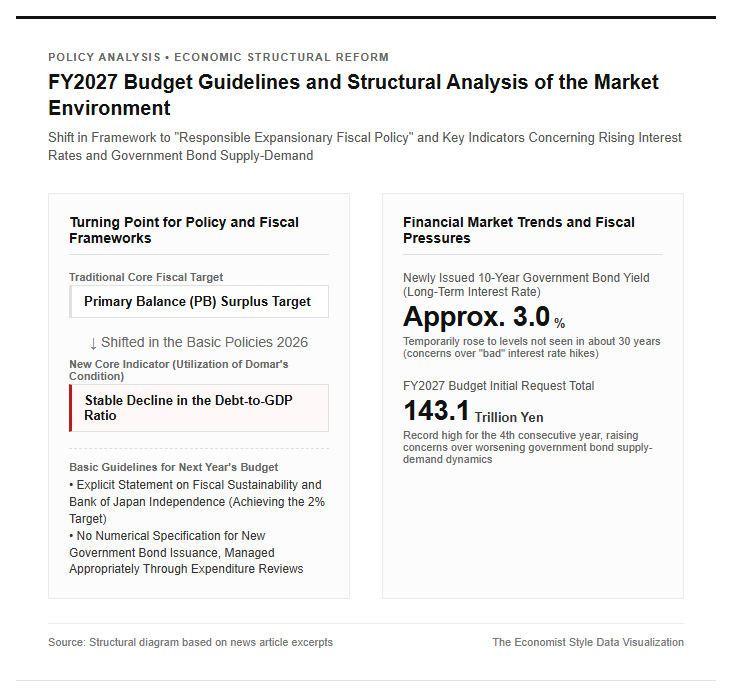
The “Responsible Proactive Fiscal Policy” advocated by the Takaichi administration aims for a framework that achieves economic growth through public and private strategic investments and improves fiscal sustainability through increased tax revenue. In the Basic Policy 2026 established by the government, the core indicator shifted away from the traditional primary fiscal deficit/surplus target for national and local governments—achieving a primary balance surplus—toward the stable decline of the total debt-to-GDP ratio. This is underpinned by the “Domar shift” concept, which posits that if the nominal GDP growth rate exceeds the nominal interest rate, the government’s debt-to-GDP ratio will stabilize or decline. This calculation is based on the premise that fiscal discipline can be maintained if the nominal growth rate is increased while a sharp surge in debt-servicing costs is curbed; however, deep-seated concerns persist in the market regarding a loosening of fiscal discipline and the expansion of expenditures. While promoting growth investment by creating frameworks such as the “Strong and Prosperous Japan” investment quota, the government is pressed to carefully gauge the landing point for JGB issuance amounts.
Trends in financial markets and challenges for fiscal and monetary policies
Rising long-term interest rates and supply-demand concerns in the government bond market
In Japan’s bond market, the yield on newly issued 10-year government bonds (long-term interest rates) has strengthened its upward trend, temporarily reaching close to 3%, the highest level in about 30 years. Behind the rising interest rates are the persistence of overseas interest rates at high levels, expectations of interest rate hikes by the BOJ, and caution regarding increased JGB issuance accompanying the government’s fiscal expansion. With the preliminary budget request for fiscal 2027 reaching approximately ¥143.1 trillion—marking a record high for the fourth consecutive year—market movement concerned about the deterioration of JGB supply and demand is spreading. Private banks, the primary buyers, are showing a cautious stance toward purchasing government bonds amid increasing lending and rising volatility, which is further fueling instability in the yield curve. The widening of the term premium associated with JGB holding risk is perceived as “bad interest rate hikes,” acting as a factor that increases the government’s debt-servicing cost burden and constrains the range of policy options.
The policy-making dilemma under a depreciating yen and inflationary pressures
In the foreign exchange market, a weak-yen, strong-dollar trend persists due to speculations surrounding the timing of the BOJ’s additional rate hikes and the government’s stance on monetary policy. By signaling that the government aims to simultaneously improve the nominal GDP growth rate and suppress interest rates, the market widely interpreted that “the government might suppress BOJ rate hikes,” and the resulting delay in rate-hike expectations fueled the depreciation of the yen. However, cost-push inflation driven by the weak yen and high raw material prices is increasing transaction costs for households and small- and medium-sized enterprises. The structure in which the BOJ maintains an accommodative environment while the government expands fiscal spending acts as stepping on the economic accelerators twice, resulting in even stronger upward pressure on long-term interest rates. To guarantee fiscal stability, a well-balanced steering approach is deemed indispensable—appropriately suppressing inflation expectations through appropriate rate hikes by the BOJ and preventing a surge in long-term interest rates.
Expenditure management and medium- to long-term economic and fiscal outlook
Funding structure utilizing special accounts and “bridge bonds”
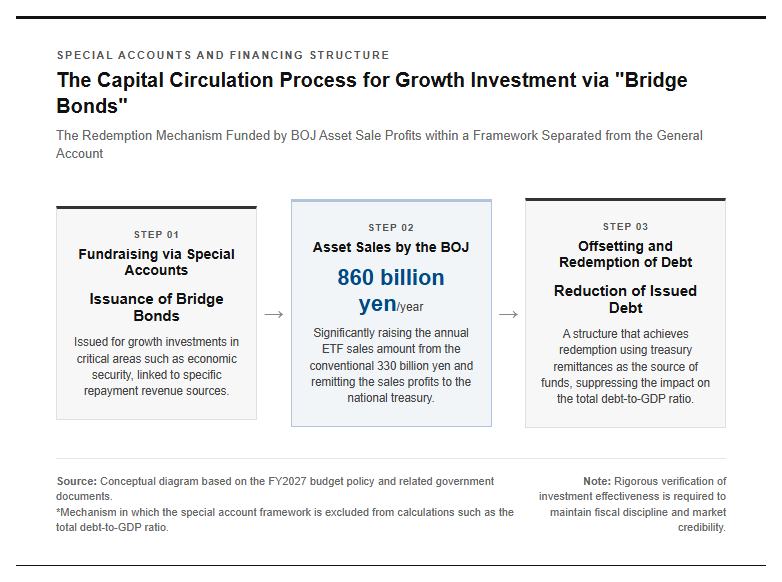
What stands out in the FY2027 budget policy is the ingenuity in financing and expenditure management in specific growth areas. The government has outlined a policy to manage investments in vital areas such as economic security in a special account separate from the general account. These projects are planned to be funded by issuing “bridge bonds” tied to pre-arranged repayment sources, using future profits from the Bank of Japan’s sales of Exchange Traded Funds (ETFs) and other assets as redemption resources. The BOJ has decided to increase its annual ETF sales amount from the conventional 330 billion yen to 860 billion yen, adopting a structure where the resulting profits are paid into the national treasury to offset the issued debt. While such special account frameworks are excluded from the calculation of the total debt-to-GDP ratio and the primary balance, winning the market’s trust will require concrete redemption plans and rigorous verification of investment effects.
Key points for future budget formulation and the path to fiscal consolidation
In its recommendations submitted to Finance Minister Satsuki Katayama in November 2026, the Fiscal System Council strongly warned that in this new stage of fluctuating prices and interest rates, “there has never been a time when securing market trust was more important.” As the annual budget scale swells, the extent to which new government bond issuance can be suppressed throughout the year will serve as a crucial evaluation index for the bond market in future budget formulation processes. Prime Minister Takaichi has indicated an intention to cap new government bond issuance at around 40 trillion yen, but the effectiveness of “itemized requests” in rough estimates and expenditure reviews is being called into question. Furthermore, if growth investments fail to translate into increased future tax revenues, there is a risk that only a fiscal burden will remain. To ensure medium- to long-term fiscal sustainability, the utmost priority will be to achieve both price stability and enhanced growth potential by avoiding overly optimistic economic assumptions and thoroughly enforcing expenditure efficiency alongside a practical PDCA cycle.
Reference Page
- [Japan announces budget policy ensuring fiscal sustainability and BOJ independence – ARAB NEWS]https://www.arabnews.jp/business/%E6%97%A5%E6%9C%AC%E3%81%8C%E8%B2%A1%E6%94%BF%E6%8C%81%E7%B6%9A%E5%8F%AF%E8%83%BD%E6%80%A7%E3%81%A8%E6%97%A5%E9%8A%80%E7%8B%AC%E7%AB%8B%E3%82%92%E7%A2%BA%E4%BF%9D%E3%81%99%E3%82%8B%E4%BA%88%E7%AE%97%E6%96%B9%E9%87%9D%E3%82%92%E5%85%AC%E8%A1%A8-3001588
[#JapaneseEconomy #BudgetGuidelines #FiscalSustainability #BOJIndependence #ResponsibleExpansionaryFiscalPolicy #LongTermInterestRates #GovernmentBondIssuance #EconomicPolicy]


コメント