
US mid-sized excess and surplus (E&S) insurance leader Kinsale Capital Group saw its shares plunge about 7% in after-hours trading despite reporting third-quarter 2026 financial results that beat market expectations. Behind the strong operating earnings, the announcement of the resignation of its Chief Financial Officer (CFO), who had supported the company’s finances since its founding, and a decline in premiums in the commercial real estate sector triggered investor caution.
- Better-than-Expected Operating Profit and a Plunge in After-Hours Trading
- Factors Behind the Decrease in Net Income and Temporary Losses Associated with Portfolio Restructuring
- Brian Petrucelli’s Departure and New Leadership Structure Through Internal Promotions
- Psychological Anxiety Caused by Management Changes in the Market and Past Precedents
- Declining Insurance Premiums and Capital Surplus Pressures in the Commercial Real Estate Sector
- Low-cost management through proprietary technology and future prospects for success
Better-than-Expected Operating Profit and a Plunge in After-Hours Trading
After the market close on October 22, 2026, Kinsale Capital Group (NYSE: KNSL), a major U.S. excess and surplus (E&S) specialty insurer, released its financial results for the third quarter of 2026. Diluted operating earnings per share reached $5.70, delivering strong results that significantly exceeded the analyst consensus estimate of $5.11. Total revenue also increased by 3.0% year-over-year from $410.9 million (based on net earned premiums) to $454.8 million, beating the consensus estimate of $404.61 million. Underwriting income, the foundation of the insurance business, expanded from $105.67 million in the same period last year to $107.06 million, once again demonstrating healthy profitability.
However, the company’s stock, which had finished regular trading up 3.70% from the previous day at $390.64, temporarily tumbled between 6.56% and about 7% in after-hours trading immediately following the earnings release, plunging to around $365.00. The primary catalyst for the wave of selling, despite strong financial results that beat market expectations, was the announcement of the departure of the company’s Chief Financial Officer (CFO) since its founding, which was disclosed alongside the positive earnings. This suggests that investors grew more cautious about future financial discipline and executive stability rather than focusing solely on the quarterly profit performance. The chart below shows the trend of market reactions before and after the earnings announcement.
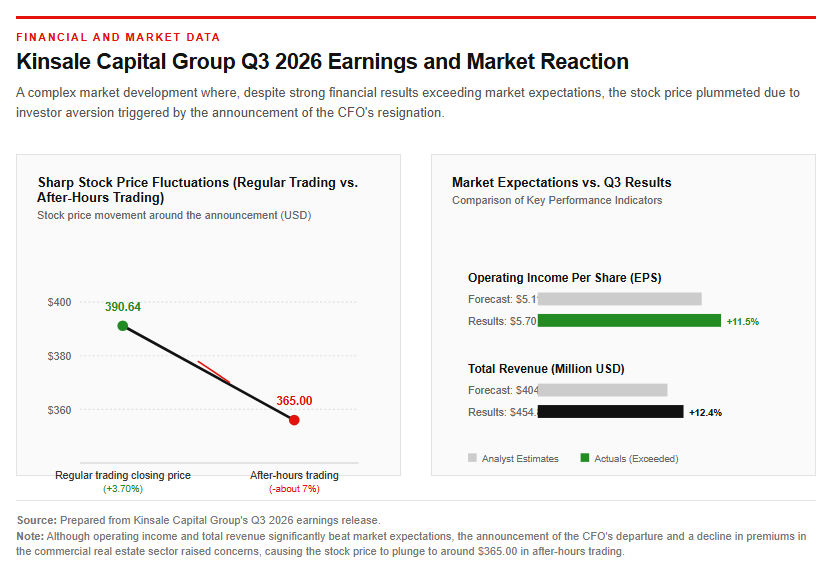
- Diluted operating income: $5.70 (above the market estimate of $5.11)
- Quarterly total revenue: $454.8 million (exceeding market expectations of $404.61 million)
- Underwriting profit: $107.06 million (up from $105.67 million in the same period last year)
- After-hours stock price: Plummeted about 7% from $390.64 to $365.00
Factors Behind the Decrease in Net Income and Temporary Losses Associated with Portfolio Restructuring
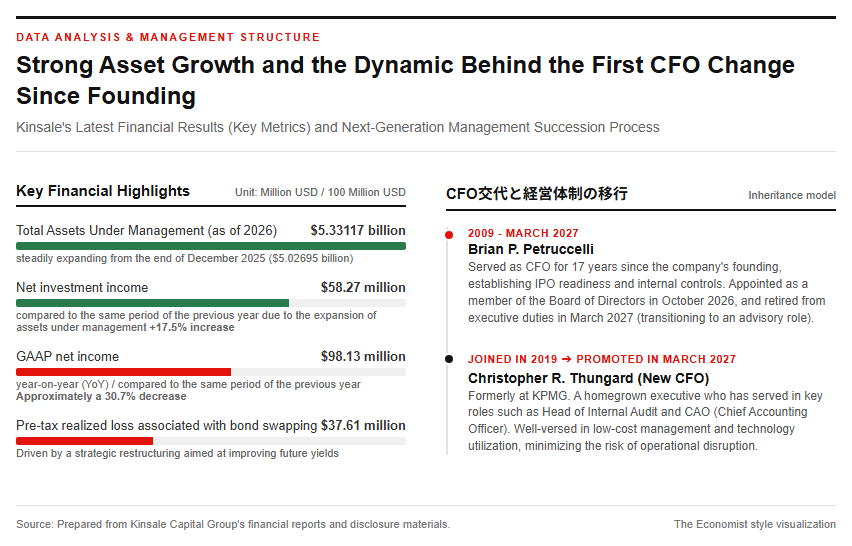
Another factor that raised market concerns in the quarterly earnings results is the apparent significant decrease in net income. GAAP net income for the third quarter of 2026 stood at $98.13 million ($4.36 per diluted share), recording a decrease of approximately 30.7% from $141.65 million ($6.09 per diluted share) in the same period of the previous year. However, this profit decline was not due to a deterioration in the insurance business itself, but was mainly caused by the recording of a pre-tax loss of $37.61 million on the sale of fixed-income securities associated with the strategic restructuring of its investment portfolio.
With the aim of boosting long-term investment returns, the company sold equity holdings with unrealized gains to switch to promising stocks, while disposing of low-yielding fixed-income bonds at a loss and reinvesting in higher-yielding bonds. Although this accounting treatment weighed on net income for the current quarter, it had no material negative impact on book value per share (BPS). Net investment income itself expanded steadily by 17.5% from $49.60 million in the same period of the previous year to $58.27 million, and assets under management have also steadily increased from $5,026.95 million at the end of December 2025 to $5,331.17 million at the end of September 2026.
- GAAP Net Income: $98.13 million (approx. 30.7% decrease year-over-year)
- Pre-tax realized loss from bond swapping: $37.61 million (restructuring aimed at improving future yields)
- Net Investment Income: $58.27 million (up 17.5% year-over-year due to growth in assets under management)
- Total Assets Under Management: $5.33117 billion (up from $5.02695 billion as of the end of December 2025)
The Drama Surrounding the Replacement of the CFO, a Pillar Since the Company’s Founding, and Its Repercussions
Brian Petrucelli’s Departure and New Leadership Structure Through Internal Promotions
The biggest factor that overshadowed the strong financial results and triggered the stock price decline was the announcement of the departure of Brian P. Petrucelli, Executive Vice President, Chief Financial Officer, and Treasurer, who has built the company’s financial foundation since its founding era. Petrucelli has headed the finance department for over 17 years since the company’s inception in 2009, and is one of the most crucial figures who led the 2016 initial public offering (IPO) and the establishment of a robust internal control system. He is scheduled to be appointed as a director effective October 22, 2026, and will step down from his executive position on March 2, 2027.
Christopher R. Tangard, who has served as Senior Vice President and Chief Accounting Officer (CAO) since March 2024, has been slated for promotion to the incoming CFO. Tangard previously served as an audit senior manager at major accounting firm KPMG before joining Kinsale as Director of Internal Audit in June 2019. He is a homegrown executive who has steadily climbed the ranks, being promoted to Assistant Vice President of Internal Audit in March 2021 and Vice President of Finance in March 2023. Michael P. Kehoe, Chairman and CEO, emphasized that Tangard is deeply familiar with the company’s low-cost operating model and technology utilization, expressing strong confidence in a smooth leadership transition.
- Outgoing CFO: Brian P. Petrucelli (with the company since its founding in 2009)
- Personnel schedule: Appointment as Director effective October 22, 2026, and retirement from Executive Officer effective March 2, 2027.
- Successor CFO: Christopher R. Tanguay (current CAO, U.S. Certified Public Accountant)
- Career history: Former KPMG employee, joined Kinsale in 2019, where he held various positions in internal audit and finance.
Psychological Anxiety Caused by Management Changes in the Market and Past Precedents
In the stock market, the transition of key executives at a company that has delivered exceptional financial performance over the long term strongly triggers investor anxiety, even if it is a planned and smooth succession. This is because, while the CEO oversees business strategy, the CFO directly manages the lifeblood of an insurance company: maintaining underwriting discipline, arranging reinsurance, managing equity capital, and estimating reserves. Since Kinsale has boasted a return on equity (ROE) that has overwhelmed its competitors since its IPO, concerns are easily generated regarding a loosening of discipline or a slowdown in growth due to the departure of its foundational pillar since the founding era.
Examining past cases of CFO departures at U.S. public companies, there is a widespread tendency for stock prices to decline immediately following the announcement of the departure of an executive with strong market confidence. However, a structure in which a carefully nurtured internal successor takes over—rather than a sudden external appointment—and the predecessor remains on the board to continue providing advice is regarded as an ideal transition model to minimize medium- to long-term disruption. Given that Mr. Tangard has already led the company’s earnings releases and SEC filings as CAO, the risk of operational disruption is expected to be limited. The following chart outlines the impact pathways through which a CFO transition affects corporate value.
- Market concerns: The risk of a retreat from the robust financial discipline maintained for 17 years since the company’s founding
- The Unique Characteristics of Insurance Companies: The Weight of CFO Judgment in Reserve Valuation and Reinsurance Strategies
- Advantages of the Transition Structure: A planned succession in which the predecessor remains on the board and the internal CAO is promoted
- Historical precedent: An orderly internal promotion system contributes to the stability of medium- to long-term corporate performance.
Structural Changes and the Wave of Intensifying Competition in the E&S Insurance Market
Declining Insurance Premiums and Capital Surplus Pressures in the Commercial Real Estate Sector
Along with the CFO personnel change, what investors disliked in this earnings report was the sluggish growth in Gross Written Premium (GWP) and the significant revenue decline in the commercial real estate sector. Gross Written Premium for the third quarter of 2026 stood at $462.87 million, a 4.8% decrease from $486.25 million in the same period of the previous year. The primary factor behind this was a 19.3% year-over-year decline in premiums across the entire real estate division, with the core commercial real estate sector experiencing a drastic drop of 26.8%. Premiums in the same sector also fell by 32.7% in the second quarter of 2026, indicating a continuing trend of declining sales.
This is driven by a capital glut and softening rate competition in the excess and surplus insurance market. According to research by Fitch Ratings, U.S. policyholder surplus reached approximately $1.2 trillion as of the end of September 2025. Backed by abundant capital, primary insurers stepped up their underwriting, creating headwinds that caused renewal rates for commercial property insurance to drop by 5% to 10%. In response, Kinsale’s management has maintained a policy of avoiding unprofitable price competition, upholding strict underwriting discipline, and carefully selecting deals. While this resulted in a decrease in premium revenue, the company successfully defended its healthy underwriting margins.
- Q3 2026 Gross Written Premiums: $462.87 million (down 4.8% year-over-year)
- Commercial Real Estate Sector Trends: Down 26.8% in Q3, Down 32.7% in Q2
- Market Capitalization Environment: U.S. Policyholder Surplus Swells to $1.2 Trillion Scale
- Management’s Response: Rejecting excessive competition in a soft-rate market and thoroughly prioritizing underwriting selection focused on profit margins.
Low-cost management through proprietary technology and future prospects for success
While concerns persist over a slowdown in growth, an indicator of Kinsale’s strong business foundation is its low combined ratio. The combined ratio, which combines the loss ratio and the expense ratio, is a measure of insurance underwriting profitability; a figure below 100% signifies an underwriting profit. In the third quarter of 2026, the company’s combined ratio was 75.4% (53.4% loss ratio, 22.0% expense ratio), maintaining exceptionally high profitability that is well below the industry average. The annualized return on equity (ROE) for the first nine months of 2026 also remained at a high level of 26.6%.
The source of the company’s competitive advantage lies in the underwriting data it has independently accumulated over the 17 years since its founding and its proprietary technology platform. It has established a system to rapidly evaluate complex small- and medium-sized risk cases brought in by agents using a web-based automated system, processing them at a lower expense ratio than competitors. Furthermore, while commercial real estate struggles, premiums in the casualty insurance business remain resilient, increasing by 0.9% year-on-year, with a diversified product portfolio spanning entertainment, environmental, and energy sectors underpinning financial performance. The key focus moving forward will be whether the company can maintain its proprietary technology infrastructure and disciplined underwriting under the new leadership structure to sustain profitable growth.
- Q3 2026 Combined Ratio: 75.4% (Underwriting profit of $107.06 million)
- ROE (annualized) for Jan–Sep 2026: 26.6% (maintaining high capital efficiency)
- Source of Competitive Advantage: 17 Years of Data Accumulation and a Low-Cost Structure Driven by In-House Developed Systems
- Key Points to Watch: The timing of the bottoming out of property insurance premiums and the sustainability of profit growth under the new CFO structure
Reference page
- [Kinsale Capital Group Reports Third Quarter 2026 Results] https://ir.kinsalecapitalgroup.com/news/news-details/2026/Kinsale-Capital-Group-Reports-Third-Quarter-2026-Results/default.aspx
- [Official Announcement Regarding Chief Financial Officer Personnel Changes at Kinsale Capital Group] https://www.businesswire.com/news/home/20261022454300/en/
- [U.S. Securities and Exchange Commission (SEC) Annual Report Form 10-K (Kinsale Capital Group, Inc.)] https://www.sec.gov
[#KinsaleCapital #USStocks #EarningsFlash #InsuranceIndustry #CFOTransition #StockMarket]

コメント