
Broadcom has extended its custom semiconductor supply contract with Apple until 2031. The background is the strategic alignment between the two companies: the rapid increase in AI inference demand and the need to stabilize the supply chain.
- Continuing the partnership until 2031
- Range of Key Components Supplied
- Apple’s 20% sales stability and cash flow
- Sharp rise in market stock prices and analyst evaluations
- Technical advantage that dispels concerns about fully in-house development
- Responding to Uncertainties in Semiconductor Supply Chains
- Custom silicon powering Apple Intelligence
- The Importance of Networks in AI Data Centers
- Broadcom’s Leadership in the Custom ASIC Market
- Stabilizing the supply chain and becoming an AI foundry toward 2031
Continuing the partnership until 2031
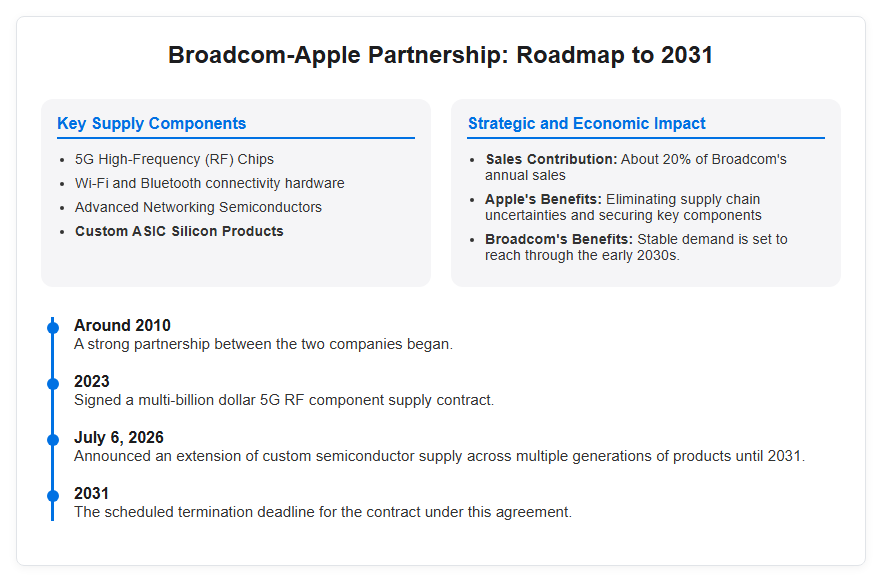
On July 6, 2026, U.S. semiconductor giant Broadcom announced that it had signed a multi-year contract with tech giant Apple to supply custom semiconductors, extending the partnership until 2031. This agreement builds on the multi-billion dollar contract the two companies signed in 2023 on 5G high-frequency (RF) components. According to documents Broadcom filed with the U.S. Securities and Exchange Commission (SEC), this extension guarantees the development and supply of custom chips across multiple generations of Apple products, not limited to a single product.
This long-term partnership is an important step for both companies to strengthen their “win-win” relationship amid ongoing global semiconductor shortages and geopolitical risks. For Apple, this offers the advantage of ensuring supply reliability of key components up to the early 2030s. On the other hand, for Broadcom, it secured stable demand from Apple, one of the world’s most valuable companies, over a long period. Please refer to the diagram below.
Range of Key Components Supplied
With this contract renewal, Broadcom will continue to supply key communication components for the iPhone. This includes RF chips to connect iPhones to cellular networks, hardware for Wi-Fi and Bluetooth connections, and more advanced network semiconductors. What is particularly noteworthy is that this contract goes deep into providing “custom ASICs (application-specific integrated circuits).” ASICs are semiconductors designed for specific functions, directly contributing to power saving and improved product performance.
Broadcom’s technology has supported Apple’s extensive ecosystem, including not only the iPhone but also iPads, Macs, and Apple Watches. The company’s expertise in analog chips and RF technology has reached a level that is extremely difficult for other companies to replace in a short period. Apple has long sought to develop these components in-house, and this 2031 contract extension once again proves that Broadcom remains an indispensable partner in RF front-ends and complex wireless connectivity.
2. Market Reaction: Maintaining a Massive Revenue Base and Stock Price Rebound
Apple’s 20% sales stability and cash flow
The main reason investors enthusiastically welcomed this news was Apple’s overwhelming presence in Broadcom’s revenue structure. According to analysts’ estimates, Apple is one of Broadcom’s largest customers, accounting for about 20% of its annual revenue. Locking in this massive cash flow for more than five years has transformed the company’s non-AI semiconductor division’s revenue into an extremely predictable and stable source of income.
This stable hardware revenue enables Broadcom to actively reinvest in its current cloud AI portfolio. Amid the surge in demand for data centers driven by the AI boom, maintaining a solid position in the existing consumer device market has provided strong evidence that the company has a growth engine that does not rely solely on specific data center customers. Additionally, hardware revenue, which maintains high profit margins, continues to serve as a solid foundation supporting the company’s R&D spending and capital expenditures.
Sharp rise in market stock prices and analyst evaluations
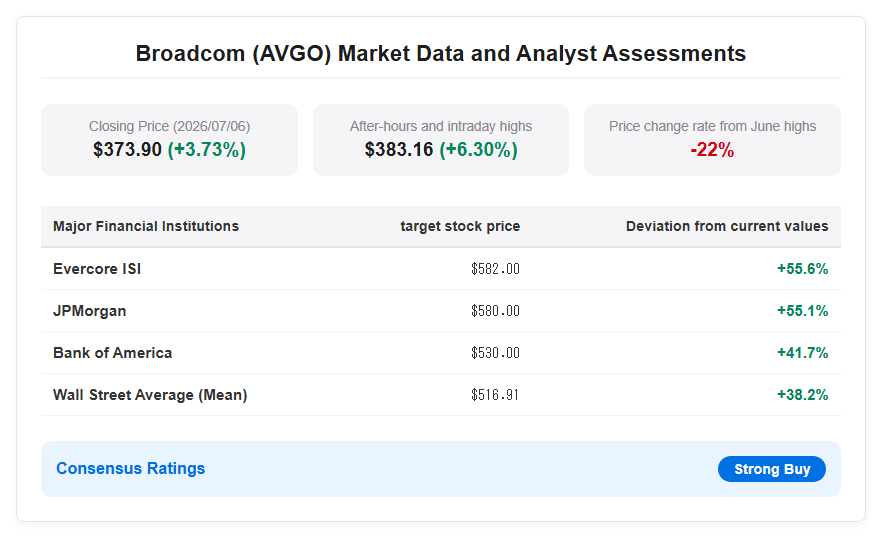
Following the announcement on July 6, 2026, Broadcom’s stock price surged more than 6% in after-hours trading in the U.S. stock market, and later closed up 3.73% at $373.90. This sharp rise was a positive factor that cleared market uncertainty, as the company’s stock had fallen about 22% from its June high over the previous weeks. Investors highly appreciate that concerns about Apple’s removal from Broadcom have been resolved for the time being.
Wall Street analysts are also giving a bullish rating across the board. JP Morgan raised its target price to $580, while Bank of America and Evercore ISI have set high targets ranging from $530 to $582. Barchart’s consensus rating remains “Strong Buy,” with an average target price of around $517, suggesting more than 35% potential for upside from current levels. This contract extension reaffirms that Broadcom is not just riding the wave of AI-related stocks, but also possesses an unwavering competitive advantage in the traditional mobile market. Please refer to the diagram below.
3. Strategic Background: Apple’s In-House Focus and Broadcom’s Expertise
Technical advantage that dispels concerns about fully in-house development
In recent years, Apple has accelerated its shift to in-house designed “Apple Silicon,” achieving great success with its A and M series processors. Additionally, Apple has introduced its proprietary “N1” Wi-Fi chip and begun developing its own modem, and there have long been concerns in the market that Apple might eventually completely replace Broadcom’s chips with its own chips. However, the current contract extension until 2031 indicates that these concerns were premature.
Especially in the fields of RF (radio frequency) chips and analog semiconductors, advanced physical design and manufacturing know-how are required, differing from processors that primarily rely on digital processing. Broadcom has accumulated decades of intellectual property in this field, and even Apple seems to have judged that it is unrealistic to mass-produce components with equivalent performance and reliability at the mass production level in a short period. This choice can be seen as a strategic compromise for Apple to focus its resources on higher-value AI and software features.
Responding to Uncertainties in Semiconductor Supply Chains
For Apple, extending the partnership with Broadcom also strongly serves as a risk reduction in the supply chain. Currently, Taiwan’s TSMC, Apple’s main manufacturing partner, is facing extreme strain on its production lines due to explosive demand from AI-related companies like NVIDIA. Apple CEO Tim Cook has acknowledged that manufacturing bottlenecks have previously suppressed iPhone sales, and he is well aware of the risks of over-reliance on certain foundries and vendors.
The 2023 agreement with Broadcom focused on 5G RF components manufactured in the United States. This also reflects Apple’s efforts to diversify supply hubs geographically. By securing Broadcom through 2031, Apple has established a system to prioritize the acquisition of custom chips essential for AI inference and other purposes, even in a highly competitive market environment. Amid rising geopolitical tensions, signing long-term contracts with reliable, top-tier external suppliers has become a “safety net” to stabilize Apple’s hardware supply network.
4. Next-Generation AI Infrastructure: Expectations for the Server Chip “Baltra”
Custom silicon powering Apple Intelligence
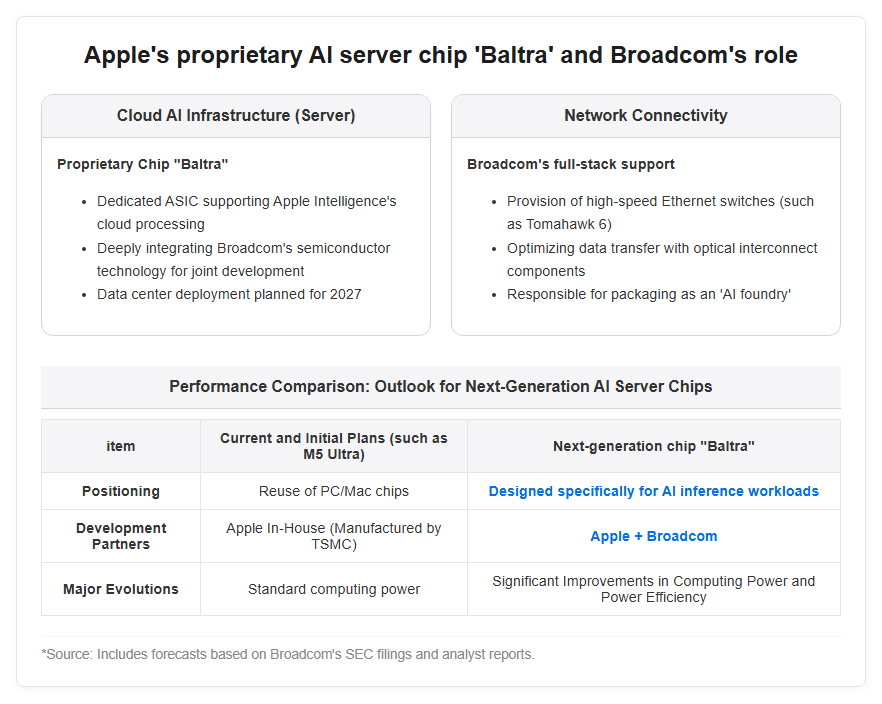
One of the most significant developments in this partnership is the supply of custom ASICs to support Apple’s proprietary AI feature, Apple Intelligence. Apple is currently rushing to build server infrastructure not only for device AI but also for cloud AI processing. At the core of this cloud infrastructure is an AI server chip internally codenamed “Baltra,” which incorporates Broadcom’s semiconductor technology.
Baltra is expected to be a significant upgrade of the standard Mac chips Apple currently uses for AI servers and the originally planned M5 Ultra chip. It is expected to be deployed in Apple’s cloud data centers as early as 2027. With Broadcom’s involvement, this new chip will not only feature high computing power but also advanced network capabilities and power efficiency to stably handle large-scale AI workloads. This paves the way for advanced AI services, such as the next-generation version of Siri, to be delivered to Apple users more quickly and securely.
The Importance of Networks in AI Data Centers
Broadcom’s role goes beyond simply chip design to enhance the overall “connectivity” of AI data centers. To conduct AI inference and training at scale, tens of thousands of accelerators must be efficiently linked, where high-speed Ethernet switches and optical interconnect components are indispensable. Broadcom is also a global leader in this field, deploying cutting-edge technologies such as the “Tomahawk 6,” which has a 102.4Tbps switch capacity.
In the partnership with Apple, Broadcom’s network technology is likely to be deeply integrated to optimize data transfer within “superclusters” built by Bartra-class AI servers. This will allow Apple to build a more controllable and low-cost AI computing infrastructure optimized for its own models and ecosystem, rather than continuing to buy more Nvidia GPUs. For Broadcom, this presents a golden opportunity to deeply penetrate every layer of Apple’s AI strategy, from consumer devices to cloud infrastructure. Please refer to the diagram below.
5. Future Developments: Evolution into an AI Foundry and Outlook for 2031
Broadcom’s Leadership in the Custom ASIC Market
Broadcom is evolving from a mere wireless chip supplier into a full-stack “AI foundry” level enabler. Hoc Tan, President and CEO of the company, has projected that the AI-focused semiconductor business will exceed $100 billion in revenue by 2027. The company plays a central role not only in Apple, but also in developing Google’s TPU (Tensor Processing Unit) and custom processors for AI pioneers such as Meta, OpenAI, and Anthropic.
In particular, processors such as Jalapeño, a processor dedicated to large language model (LLM) inference jointly developed with OpenAI, partially replace Nvidia’s general-purpose GPUs, aiming to dramatically improve power efficiency. Broadcom offers a comprehensive solution that includes everything from chip design implementation to packaging, high-speed interfaces, and Ethernet network construction. Thus, the trend of major tech companies choosing Broadcom as a partner when developing their own chips is becoming the standard winning formula in the industry.
Stabilizing the supply chain and becoming an AI foundry toward 2031
The contract extension through 2031 has enabled Broadcom to make its capital investment plans for manufacturing and research and development (R&D) more reliable over the next five years or more. Supported by the demand from its largest customer, Apple, the company can redirect funds toward even more ambitious AI infrastructure investments. Meanwhile, Apple has acquired enough “time allowance” to improve the quality of its proprietary communication modems and AI server chips through its partnership with Broadcom.
The future focus will be on the performance of the “Baltra” chip, expected to take full swing after 2027, and how it will contribute to Apple’s competitiveness in AI services. Additionally, how far Broadcom can expand similar long-term contracts to other clients and solidify its position as the “shadow ruler of AI infrastructure” after NVIDIA is also an important evaluation criterion. Looking ahead to the 2030s, Broadcom’s strategy to continue deep symbiosis with Apple across both mobile and cloud sectors is set to reshape the dynamics of the entire semiconductor industry.
[#ブロードコム #アップル #半導体 #AIインフラ #カスタムASIC #iPhone #米国株 #サプライチェーン]


コメント