On July 8, 2026, U.S. Central Command launched additional attacks on Iran in retaliation for attacks on commercial ships in the Strait of Hormuz, and President Trump effectively declared the end of the ceasefire. Behind this is the renewed intense armed clashes over freedom of passage at a key international crude oil transportation hub.
- Retaliation for attacks on merchant ships in the Strait of Hormuz
- President Trump’s Declaration of the End of the Ceasefire
- Claims of damage and serious violations within Iran
- New York Crude Oil Futures Surge Amid Inflation Concerns
- Tokyo Stock Exchange Market Reaction: Bright and Dark Sides of Semiconductor and Cyclical Stocks
- Reactivation of U.S. Economic Sanctions and Withdrawal of Mitigation Measures
- Japan’s Energy Security Is Shaking Its ‘90% Dependence’
- Impact on the Shipping Industry and the Spike in War Insurance Premiums
- Shake over OPEC Plus and UAE’s Withdrawal Announcement
- The collapse of the ceasefire agreement and the chain of “20-fold retaliation”
- Preparing for the “Unexpected” in the Economy and Business
Retaliation for attacks on merchant ships in the Strait of Hormuz
On July 8, 2026, U.S. Central Command (CENTCOM) announced through its official social media that it had launched a new attack on Iran. This operation is a direct countermeasure against Iran’s attacks on three merchant ships navigating the Strait of Hormuz. The U.S. side condemned Iran’s attack on the vessel as an unjust and dangerous act, strongly condemning it as a clear violation of the ceasefire agreement.
The main objective of this military operation is to weaken Iran’s military capabilities in the Strait of Hormuz, through which about a quarter of the world’s maritime oil trade passes, threatening freedom of navigation. U.S. Central Command stated that it would impose a heavy price on Iran through a series of attacks. The following map shows the areas targeted by the attack.
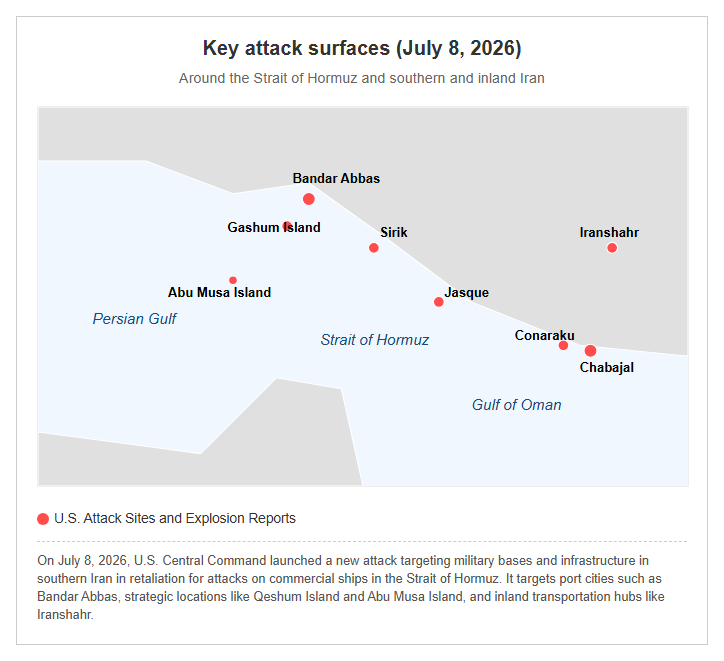
While the U.S. military has previously targeted Iranian radar facilities and missile launchers in previous military interventions, this additional attack suggests the possibility of targeting an even broader range of military and security infrastructure.
President Trump’s Declaration of the End of the Ceasefire
U.S. President Donald Trump declared that the previous ceasefire between the U.S. and Iran is “over” after Iran attacked multiple vessels in the strait. On his way back from the NATO summit in Turkey, Trump revealed to reporters on the presidential plane that Iran had approached a new deal, but expressed doubts about whether the proposal was worthwhile.
The Trump administration has emphasized that Iran has retaliated “twentyfold with every attack,” and is prepared to take even fiercer military action in response to future provocations. Since the large-scale military operation “Epic Fury” began at the end of February 2026, the two countries have repeatedly engaged in temporary ceasefires and armed clashes, but with the leader-level declaration of an end to the ceasefire, the situation in the Middle East has once again plunged into a state of serious tension.
The launch of the attack at a time when working-level nuclear talks were scheduled to resume underscores how difficult the path to resolution through dialogue has become.
Claims of damage and serious violations within Iran
Following attacks by the United States, intense explosions and chaos have spread within Iran. According to reports from Iran’s national broadcaster IRIB, multiple explosions were confirmed in southern Hormuz Garn provinces such as Bandar Abbas, Sirik, and Qeshm Island. In particular, the port city of Chabahar experienced power outages due to airstrikes, with damage including shrapnel hitting the local Imam Ali Hospital.
Additionally, explosions have been reported near the airport runway in Iranshahr, indicating that U.S. targets have extended from coastal areas to inland transportation hubs. Iran’s Foreign Ministry fiercely criticized the series of events as a serious violation of the memorandum signed by both countries. They issued a statement declaring that they would take resolute measures to protect national security, raising concerns about a further chain of retaliatory attacks.
Since the death of Supreme Leader Ayatollah Khamenei, Iran has maintained a readiness of all-out resistance under the successor Mojtaba Khamenei, and the risk of attacks on U.S. military bases in neighboring countries has increased.
[Impact on the Market and Economy] Soaring Crude Oil Prices and Financial Market Turmoil
New York Crude Oil Futures Surge Amid Inflation Concerns
Following the announcement of additional attacks by the United States, the energy market reacted immediately. On July 8, 2026, in the New York crude oil futures market, the benchmark WTI (West Texas Intermediate) price surged to the $76 range per barrel at one point. This is the result of growing investor concerns that global oil supply will be halted as the risk of blockade in the Strait of Hormuz has become a reality.
The rise in crude oil prices carries the risk of a resurgence of global inflation. For countries with low energy self-sufficiency, rising import costs are a factor driving overall prices higher. Market participants have also pointed out that if the conflict drags on, crude oil prices could surpass $100 per barrel, highlighting the increased cost burden on households and businesses as a serious issue.
Central banks around the world are becoming increasingly cautious about the so-called ‘chain price hikes,’ which affect not only petroleum products but also food and daily necessities through rising logistics costs.
Tokyo Stock Exchange Market Reaction: Bright and Dark Sides of Semiconductor and Cyclical Stocks
On the morning of July 9, 2026, the Tokyo stock market saw clear contrasts in stock prices by sector, amid heightened tensions in the Middle East. The Nikkei Stock Average temporarily rose more than 1,600 yen from the previous day, closing at 68,180.55 yen, up 1,361.50 yen at the previous close. This was driven by buying in AI and semiconductor-related stocks following the rise in U.S. semiconductor stocks.
However, looking at the overall market, only about 40% of the stock prices on the Tokyo Stock Exchange Prime Market rose, with more than half of the stocks declining. In particular, economically sensitive stocks such as automobiles, retail, and aviation, which are directly affected by rising crude oil prices, saw a rush of selling. While funds are fleeing to the semiconductor sector, which is less affected by Middle Eastern developments, a wide range of companies supporting the real economy are under the heavy pressure of geopolitical risks.
Market participants analyze that, with no end in sight from the military conflict, investors’ risk-averse attitude continues, and unstable market developments are inevitable for the time being.
Reactivation of U.S. Economic Sanctions and Withdrawal of Mitigation Measures
Alongside military attacks, the U.S. government is also increasing economic pressure. On July 7, 2026, the U.S. Treasury Department announced that it would immediately lift sanctions easing measures regarding the sale of Iranian crude oil, which had been temporarily permitted. This aims to cut off Iran’s main sources of foreign currency and deplete its funding for military activities.
This measure increases the risk of secondary sanctions imposed on third-country companies and banks that continue to do business with Iran. U.S. government officials have emphasized that Iran’s actions in the Strait of Hormuz should be met with appropriate consequences, and while continuing diplomatic negotiations, they have clearly shown a stance to push through with economic ‘snapbacks’ (forced reinstatement of sanctions).
The strengthening of economic sanctions further worsens Iran’s domestic inflation rate and contributes to a collapse in the value of the currency, real. The inflation rate, which had already reached 42.5 percent by December 2025, is expected to rise further due to these additional sanctions, pushing citizens’ lives within Iran to the brink of collapse.
[Supply Networks and Energy] The crisis of the Strait of Hormuz being blockaded
Japan’s Energy Security Is Shaking Its ‘90% Dependence’
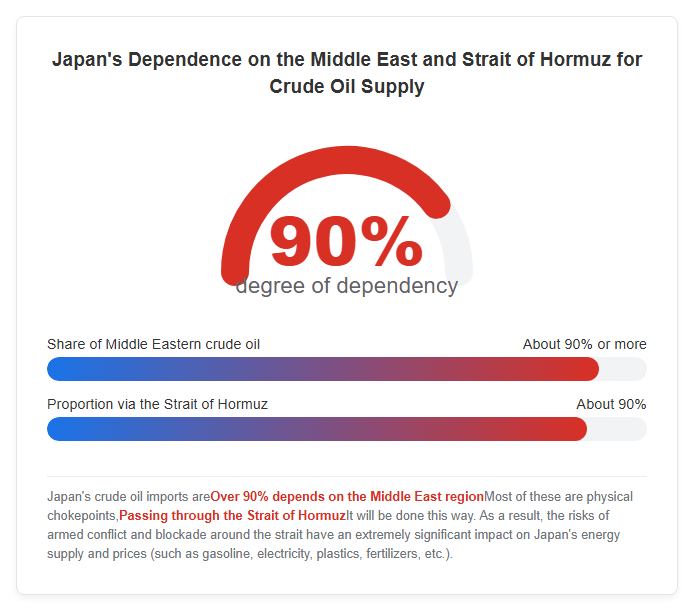
The reason Japan will be most severely affected by the 2026 Middle East crisis lies in its extreme supply structure. About 90 percent of Japan’s crude oil imports pass through the Strait of Hormuz, and the physical or economic closure of this “energy lifeline” is directly linked to the lives of Japanese citizens. Whenever concerns over armed clashes or mine-laying around the strait increase, Japan’s energy supply faces the risk of being cut off.
With the safety of ships passing through the Strait of Hormuz not guaranteed, oil wholesalers inevitably raising prices for gasoline and kerosene. In fact, due to severe restrictions on strait navigation, domestic gasoline prices in Japan soared, and correspondingly, electricity prices continued to rise.
The government is working hard to release oil reserves and secure alternative sources, but it is difficult to change the current situation of being overly dependent on the Middle East in a short period. This additional attack has once again highlighted the vulnerabilities of Japan’s energy security. The graph below shows Japan’s energy dependence.
Impact on the Shipping Industry and the Spike in War Insurance Premiums
The tense situation in the Strait of Hormuz has dealt a devastating blow to the global shipping industry. With the risks of Iranian Revolutionary Guard firing and seizure of ships becoming apparent, major marine insurance companies have reflected ‘war risk’ in their prices and significantly raised premiums. The surge in insurance premiums has become such an economic burden for shipowners that they have abandoned navigation, causing many merchant ships to voluntarily avoid passage through the strait.
Normally, more than 100 ships pass through the Strait of Hormuz per day, but reports indicate that by late April 2026, the number of ships passing through the Strait per 24 hours had plummeted to just about 7. Shipping companies have had to significantly change their routes or wait at ports, leading to rising logistics costs and supply chain delays on a global scale.
Major shipping companies such as NYK Line and Mitsui O.S.K. Lines are also being forced to make cautious operational decisions while closely monitoring the situation. The entire industry is facing an unprecedented predicament, caught between ensuring seafarer safety and economic rationality.
Shake over OPEC Plus and UAE’s Withdrawal Announcement
The intensification of the Middle East situation has also created cracks in the cooperative framework among oil-producing countries. In April 2026, the United Arab Emirates (UAE) announced its withdrawal from OPEC Plus, sending shockwaves through the global oil market. The UAE had long been frustrated that its domestic oil production capacity reached about 4.85 million barrels per day, yet OPEC Plus quota system limited production to 3.2 million barrels.
The economic losses from this war combined with the desire to prioritize strategic relations with the U.S. and the Trump administration led the UAE to take a hardline stance by withdrawing without prior consultation with Saudi Arabia. This indicates that conflicts of interest are intensifying even within Middle Eastern oil-producing countries.
The volatility of the price adjustment framework known as OPEC Plus has made the crude oil price determination mechanism unclear, further increasing market volatility. The UAE’s withdrawal holds the potential to fundamentally change the future nature of oil supply and the political balance among oil-producing countries.
[Future Outlook] Medium- to Long-Term Risks and Lack of Exit Strategies
The collapse of the ceasefire agreement and the chain of “20-fold retaliation”
The temporary ceasefire agreement brokered by Pakistan in April 2026 effectively collapsed within just a few months. Additional attacks by the United States and President Trump’s tough remarks show that finding a peaceful settlement through dialogue is extremely difficult. Iran is also intensifying its opposition, calling for a “ceasefire on all fronts,” and is unable to escape the “spiral of retaliation” where the use of force leads to further military actions.
Unless the Trump administration’s goal of “regime change” is achieved, there is no guarantee that military attacks will stop. Meanwhile, Iran prioritizes maintaining a regime centered on its supreme leader, leaving very little room for compromise.
If the conflict continues to escalate, the attacks could target not only nuclear facilities and military bases but also civilian infrastructure such as oil refineries and power plants. The “endless conflict” involving the entire Middle East is becoming the biggest uncertainty in the international community from the latter half of 2026 onward.
Preparing for the “Unexpected” in the Economy and Business
The news of the launch of this additional attack highlights the importance of incorporating geopolitical risks as “anticipated” management challenges for business leaders. Events such as the blockade of the Strait of Hormuz and the sharp rise in crude oil prices should no longer be recognized as temporary accidents, but as structural risks that can persist over the long term.
What companies are required of is not only short-term risk management such as diversifying sourcing sources and thorough inventory management, but also accelerating “decarbonization (GX) strategies” to reduce dependence on fossil fuels. Building a management structure that is less affected by energy price fluctuations will determine medium- to long-term competitiveness.
Furthermore, for the Japanese government, it is urgent not only to follow the U.S. but also to rebuild its own Middle East diplomatic channels and demonstrate leadership in both securing resources and easing conflicts. As the international order of the 21st century is greatly shaken, the question is how Japanese companies will adapt to the era of ‘geopolitical economics,’ where the economy and security are inseparable.
[#イラン情勢 #ホルムズ海峡 #原油高騰 #経済ニュース #地政学リスク #トランプ大統領 #エネルギー安全保障 #日本経済]


コメント