On July 13, 2026, the United States made a dramatic announcement to resume its maritime blockade against Iran. The Islamabad Memorandum, just signed in June, has effectively collapsed, and the situation in the Middle East has once again plunged into an extremely severe crisis.
- Background of the reintroduction of maritime blockades and military deployment
- President Trump demands a 20% ‘transit fee’
- The Collapse of the Islamabad Memorandum and the Breach of the Agreement
- Record surge in crude oil prices and logistics stagnation
- Concerns over financial market turmoil and a resurgence of inflation
- Natural gas supply crisis and lack of alternative routes
- Accelerating investment in permanent strait bypass infrastructure
- Japan’s Energy Security and Diplomatic Role
- Future Points of Focus and Objective Indicators to Watch Out For
Background of the reintroduction of maritime blockades and military deployment
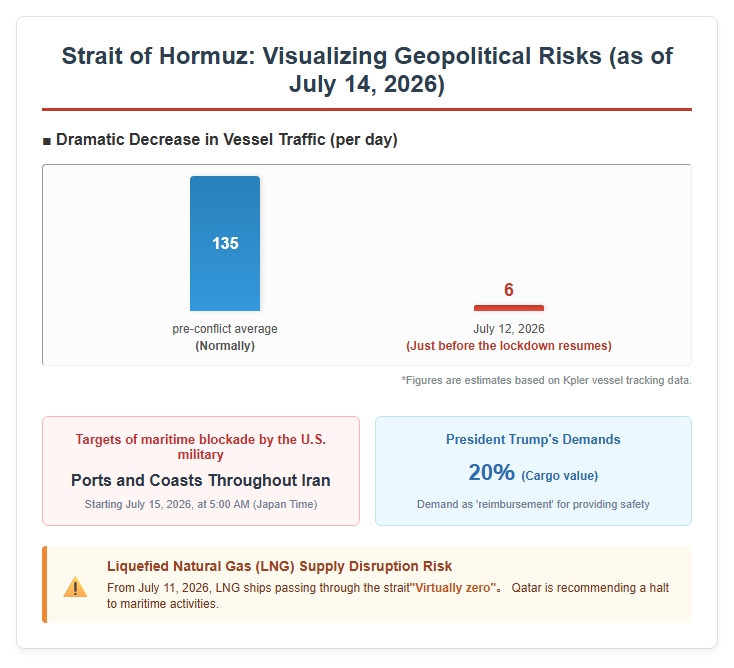
On July 13, 2026, U.S. President Donald Trump announced that he would resume a maritime blockade targeting all Iranian ports and coastal areas. According to U.S. Central Command, this measure will begin at 5:00 a.m. Japan time on July 15, 2026. Prior to this decision, the U.S. military had conducted three consecutive days of airstrikes against Iran aimed at reducing its ability to attack international shipping through the Strait of Hormuz, pushing military tensions to a peak. The blockade applies to ships entering and leaving Iran, while vessels without permission are subject to blockage, course changes, and capture. Trump has made it clear that the United States will take charge of managing the Strait of Hormuz, aiming to maximize pressure on Iran. To visually grasp this tense situation, please refer to the diagram below.
President Trump demands a 20% ‘transit fee’
At the same time as the maritime blockade resumed, Trump introduced the extremely unusual “20% redemption plan.” This requires the U.S. to pay 20% of the cargo value for all cargo passing through the Strait of Hormuz as compensation for the safety and security provided by the United States. Based on current crude oil prices, each ultra-large tanker would incur a massive cost of about $32 million (approximately 5.2 billion yen). This level far exceeds the maximum $2 million in tolls Iran has previously collected. However, the specific implementation rules regarding who will bear these fees and which institutions will collect them remain undecided, bringing significant uncertainty to the market. The United Nations International Maritime Organization (IMO) immediately expressed a firm opposition to the collection of fees in the straits used for international navigation.
The Collapse of the Islamabad Memorandum and the Breach of the Agreement
This situation effectively means that the “Memorandum of Ending Hostilities (Islamabad Memorandum)” signed between Washington and Tehran on June 17, 2026, has effectively collapsed. This agreement aimed for a permanent ceasefire after 60 days of further negotiations, but the breakdown was triggered by the Iranian Revolutionary Guard attacking a Qatari LNG carrier on July 6, 2026. Trump called this memorandum a “failed test” that Iran did not respect, suggesting a low willingness to continue negotiations. On the other hand, Iran has also expressed its recognition that the tentative agreement with the United States has undoubtedly entered a critical stage, and has launched retaliatory attacks targeting U.S. military bases in Kuwait and Bahrain.
Market and Economic Shocks: Soaring Energy Prices
Record surge in crude oil prices and logistics stagnation
Following the reopening of U.S. lockdowns and Trump’s toll demands, crude oil prices on July 13, 2026, surged to a record level. North Sea Brent futures closed at $83.30 per barrel, up 9.6% from the previous trading day, and WTI futures closed at $78.14, up 9.4%. This is the largest single-day increase since May 2020. With hopes for an early recovery in maritime transport dashed, geopolitical risks are once again being priced in. Traffic through the Strait of Hormuz has also dropped dramatically, with only six vessels confirmed on July 12, 2026. Compared to the pre-conflict average of 135 ships per day, logistics are almost paralyzed. Many vessels are engaging in ‘dark operations,’ suspending the disclosure of location information (AIS), and unvisibility risks are spreading throughout the waters.
Concerns over financial market turmoil and a resurgence of inflation
The sharp rise in energy prices has once again raised concerns about global economic inflation. A board member of the U.S. Federal Reserve (FRB) warned that if inflation indicators remain elevated, short-term monetary tightening will have to be considered. As a result, the probability of a rate hike at the July 2026 FOMC interest rate futures market has surged. The entire financial market has become more risk-off, with U.S. stocks declining mainly on the Nasdaq Composite Index, and tech stocks facing the main selling pressure. Additionally, the outlook for long-term high interest rates has diminished the appeal of financial assets, with gold prices falling below the $4,000 per ounce mark. The market is now fully pricing in the possibility of two rate hikes by the end of March 2027.
Natural gas supply crisis and lack of alternative routes
Even more serious than oil is the supply of liquefied natural gas (LNG). Since July 11, 2026, no LNG vessels have been confirmed transiting the Strait of Hormuz, resulting in virtually zero traffic. Following the attack on a Qatari LNG carrier, QatarEnergy halted its production recovery plan for Ras Raffan, one of the world’s largest LNG production sites, and the Qatari Ministry of Transport recommended a temporary halt to all maritime activities. While there are some detour routes for crude oil via pipelines in Saudi Arabia and the UAE, there is no alternative maritime route for LNG to be transported to the global market in a short period. Due to this supply halt, natural gas prices in Europe and spot prices in Asia have continued to soar significantly compared to pre-war levels, making securing energy for the winter a major challenge.
Medium- to Long-Term Outlook: A New International Order and Japan’s Challenges
Accelerating investment in permanent strait bypass infrastructure
As turmoil in the Strait of Hormuz has prolonged beyond initial expectations, investments in logistics infrastructure to avoid making the strait a “single point of issue” are accelerating. Logistics giant DP World is in talks on plans to build a new multipurpose port and container terminal in the Fujairah region of the UAE’s east coast to completely bypass the Strait of Hormuz. This is driven by the sharp drop in handling volume at Jebel Ali Port, the UAE’s main hub, by up to 95% after the conflict began. Additionally, the UAE is moving forward with projects to double the export capacity of existing crude oil pipelines by 2027, strengthening efforts to structurally eliminate geopolitical risks. Such structural changes suggest that the post-recovery industry environment may not return to its previous level.
Japan’s Energy Security and Diplomatic Role
For Japan, the restrictions on passage through the Strait of Hormuz, on which about 90% of crude oil imports depend, are literally a matter of life and death. In past attack phases, there have been sharp increases in gasoline and electricity costs, as well as increases in food and medical prices through petrochemical products. With the reopening of the lockdown this time, Japan-related ultra-large tankers are caught between safety risks and sanctions risks. The Japanese government is required not only to respond urgently by releasing oil reserves, but also to expand renewable energy and diversify LNG procurement sources for structural de-dependency. Furthermore, as the United States, China, and Pakistan move to mediate a ceasefire, Japan is building its own diplomatic channels and developing a strategy to play an independent role in the Middle East.
Future Points of Focus and Objective Indicators to Watch Out For
Several objective indicators will be important for assessing future developments. First, the focus is on whether the U.S. “20% commission” initiative will be legally institutionalized, and how it will be applied to existing charter and carriage agreements. Additionally, since paying tolls to Iran carries sanctions risks based on U.S. counterterrorism authority, corporate practitioners must pay close attention to payment routes. Indicators confirming future stabilization include halting attacks on commercial vessels, resuming LNG vessel traffic, and downgrading threat assessments by the Joint Maritime Information Center (JMIC). Conversely, if zero tanker transit continues or official operations at major ports are confirmed, it signals a ‘worsening situation,’ indicating that the potential for commercial use has further declined.
[#ホルムズ海峡 #海上封鎖 #トランプ大統領 #原油高騰 #イラン情勢 #エネルギー安全保障 #世界経済 #物流危機]
コメント