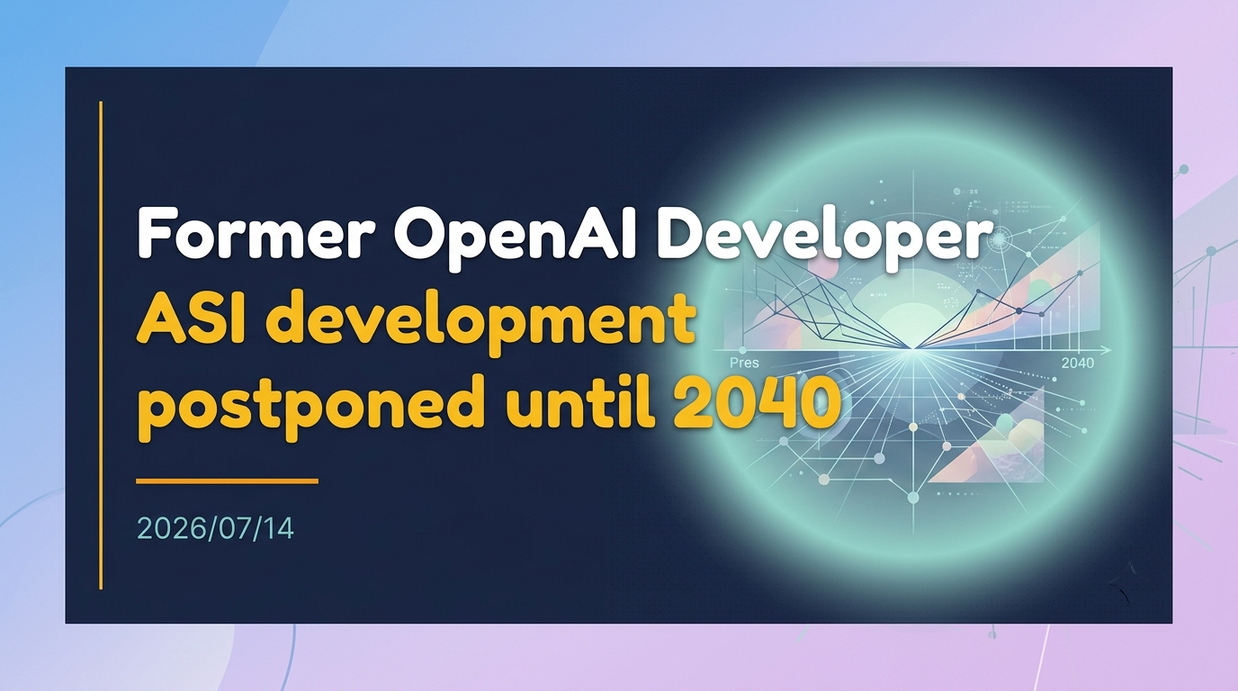
The nonprofit AI Futures Project, founded by former OpenAI researcher Daniel Cocotailo, has announced a policy proposal called “AI 2040: Plan A,” which deliberately delays the birth of artificial superintelligence (ASI) until 2040,,。 This recommendation presents a concrete roadmap to avoid the risk of human extinction brought about by the disorderly development competition between the US and China and to ensure safety,,。
- The Current State of AI Development and the Background for Adjustment to “AI 2040”
- Phased scaling and timeline up to 2040
- Introduction of Mutually Proven Computing Destruction (MACD)
- Full disclosure of research and development and tracking of computing resources
- A dramatic shift to 50% US GDP growth and a 12% employment rate
- A plan to provide a million annual citizen dividend by 2039
- Critical Perspective: Internal Review and the ‘Dry Firewood’ Issue
- The Multipolar AI Power Landscape and Its Impact on Japan
The Current State of AI Development and the Background for Adjustment to “AI 2040”
As the global race to develop artificial intelligence (AI) intensifies, attention is focused on the timing and impact of ASI, which possesses intelligence surpassing that of humans. Daniel Cocotailo, who previously belonged to OpenAI’s governance division, left the company in April 2024 due to concerns over its safety neglect, and in 2025, he established the nonprofit research organization “AI Futures Project,,,。 Initially, in its April 2025 report, “AI 2027,” the agency warned that with the realization of recursive self-improvement (RSI), where AI improves its own programs, superintelligence could emerge as early as 2027, leading humanity to lose control,,。
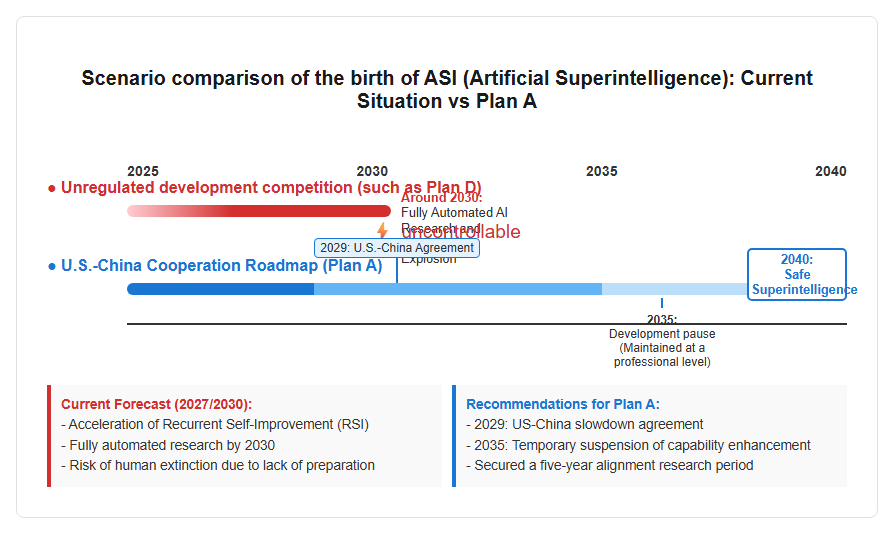
However, the latest update, “AI 2040: Plan A,” revises the forecast of ASI reach to 2030 and presents new solutions. This plan is not merely a technical forecast; it is a concrete policy roadmap led by the U.S. and China to build an international coordinated framework and intentionally postpone the birth of superintelligence until 2040. Behind this is a strong sense of crisis that if chaotic competition continues, AI research will be fully automated around 2030, leading to an uncontrollable ‘intelligence explosion.’ Please refer to the diagram below.
Phased scaling and timeline up to 2040
The timeline proposed by “Plan A” is based on a very detailed phase division. First, by 2029, the U.S. and China aim to sign an international agreement to avoid reckless competition in superintelligence. If this agreement is reached, it will temporarily avoid the full automation of AI research predicted in 2030 and shift to a process of gradually improving capabilities within human control. Specifically, the strategy is to temporarily suspend AI capabilities around 2035 at the “top-level human expert” level, and then devote the next five years to establishing AI safety measures called “AI alignment” and improving social systems,,,。
And only in 2040, when we have sufficient assurance of safety, will we break the seal and allow the transition to superintelligence (ASI). At this stage, it is expected that the “handover” will be advanced from human-centered governance to an AI ecosystem aligned with humans. By establishing this ten-year grace period, the aim is to prevent extreme concentration of power by certain states and corporations, and to establish a system where all humanity can benefit.
The mechanisms of ‘destruction of computational resources’ and ‘transparency’ that support international cooperation
Introduction of Mutually Proven Computing Destruction (MACD)
The most controversial concept introduced by Plan A to ensure the effectiveness of the agreement is “Mutual Assured Computing Destruction (MACD),” which applies nuclear deterrence theory,,。 This is a concept in which the United States and China build each other’s major data centers in locations where the other side is geopolitically vulnerable to attack or destroy. For example, by placing a U.S. data center in Mongolia and a Chinese data center in Canada, if either party breaks the agreement and secretly accelerates ASI development, it maintains a state where its computing resources can be immediately destroyed.
This “trustless” system seeks to fundamentally eliminate the very motivation to seize sole supremacy. Also, large-scale data centers can be observed from space, making concealment difficult. This deterrent system focused on “computational resources” is a proposal based on cold realism, setting it apart from traditional governance that relies on “goodwill promises.”
Full disclosure of research and development and tracking of computing resources
The second pillar of the plan is full transparency of AI research. It requires that all research results related to algorithms, experiments, and safety be made publicly open source to prevent certain companies or nations from secretly monopolizing breakthroughs. On the other hand, for powerful AI units (the weight of the model), strict management is enforced to prevent theft and misuse.
Supporting this transparency is a monitoring system that covers about 99% of the world’s AI computing resources (compute) for declaration and verification. Global computing power, which was about 20 million in H100 equivalents in 2026, is projected to increase to 60 billion by 2034. We fully manage the distribution channels for these vast semiconductors, and through sensors installed in each data center, we mutually monitor whether undeclared training is being conducted,,。
The Future of ‘Citizen Dividends’ Brought by Supergrowth and Full Labor Replacement
A dramatic shift to 50% US GDP growth and a 12% employment rate
“Plan A” makes bold predictions about the economic benefits humanity will gain along the way while controlling technological innovation. In the 2030s, automation driven by AI will rapidly advance, with the U.S. real GDP growth rate estimated to rise from the usual 3% to an annual rate of 50% during certain periods. This is a situation that far exceeds current economic norms and can truly be called an “industrial revolution driven by intelligence.”
However, as a trade-off, the labor market is forced to undergo dramatic changes. With advances in automation, the U.S. employment rate, which was 62% in 2027, is projected to drop to just 12% by 2040. In other words, the majority of all labor in society will be replaced by AI and robots. To avoid social disruption caused by this rapid change, the proposal also suggests setting strict caps on AI and robot production capacity, and artificially controlling the pace of change by selling these limits through auctions.
A plan to provide a million annual citizen dividend by 2039
To prepare for a future where income distribution through labor no longer functions, the core of Plan A is the introduction of the “Citizen’s Dividend.” This system uses computational resources and robotics usage license fees collected by the government from companies as funding to provide cash directly to all adult citizens.
According to the report’s model values, this citizen dividend is expected to start at $45,000 (about 7 million yen) per person annually in 2032, reach about $1 million (about 150 million yen) by 2035, and reach $10 million (about 1.5 billion yen) by 2039. This figure assumes that global GDP will swell about 200 times by the 2030s, assuming infinite productivity driven by superintelligence. While careful discussion is needed regarding its reality, it is positioned as an important social infrastructure that redistributes the wealth generated by AI from a select group of monopolies to ordinary citizens, ensuring their livelihoods.
Future developments and the feasibility of Noteworthy “Plan A”
Critical Perspective: Internal Review and the ‘Dry Firewood’ Issue
This grand plan has also drawn harsh criticism from experts. The AI Futures Project incorporates a self-verification process, such as paying former OpenAI researcher Richard Ngo to write critical articles. Mr. Ngo questions the optimistic prediction that the largest transfer of power in human history—the “handover of governance to AI”—will proceed in just two years.
Also, Tom Davidson’s criticism of “dry tinder” is important. Even if the agreement temporarily halts software progress, computing resources as hardware will continue to increase in the meantime, reaching more than 10,000 times the current scale by 2040. This causes the intellectual explosion to accelerate at a furious pace, igniting the vast accumulated “firewood” at the moment the agreement collapses, thereby increasing risk. The authors respond to this by deterring with MACD, but the question of whether a decision to destroy their own economic foundation is politically feasible remains unresolved.
The Multipolar AI Power Landscape and Its Impact on Japan
If the “Plan A” scenario is realized, the global AI power balance will shift dramatically. By 2040, the share of computing resources is projected to be 35% in the United States, 20% in China, and 45% in other countries (Rest of the World), envisioning a multipolar structure. If research transparency and development slowdowns progress, it may prevent U.S. and Chinese companies from running alone, and allow latecomers like Japanese firms to access cutting-edge technologies.
According to the proposers’ own estimates, the probability of ‘Plan A’ actually being executed is low at 3–15%, while ‘Plan D’, which continues to run chaotically, is predicted to have the highest probability at about 33%. However, this proposal was not an abstract argument like “stop AI,” but rather a concrete approach to oversight by presenting a deadline for signing an agreement in 2029, delivering a powerful blow to policymakers worldwide. Going forward, the main focus will be how much this “AI security” debate can be elevated into a more realistic debate in international politics,,。
[#AI #ASI #人工超知能 #OpenAI #ダニエルココタイロ #AI2040 #米中関係 #シンギュラリティ]

コメント