- Progress on Partnership Talks Between Nvidia and Rebellions
- South Korea’s National Initiative “K-Nvidia” and Expectations for Rebellions
- Technical Advantages of Inference-Optimized NPUs “Rebel100” and “ATOM-Max”
- The Aim Behind NVIDIA’s “Light Acquisition” Strategy
- Antitrust Law and Regulatory Barriers as a National Strategic Asset
- IPO Plans for 2027 and Future Outlook
Progress on Partnership Talks Between Nvidia and Rebellions
On August 21, 2026, it was reported that U.S. semiconductor giant NVIDIA is advancing partnership discussions with Rebellions, a South Korean AI semiconductor design startup. According to multiple sources, these discussions are in the early (preliminary) stages, with possibilities ranging from a technical partnership and capital investment to even a full acquisition. In mid-August 2026, NVIDIA CEO Jensen Huang held a direct meeting with Park Sung-hyun, co-founder and CEO of Rebellions, at NVIDIA’s headquarters in Santa Clara, California. The fact that Jensen Huang met with him in person indicates that these negotiations hold a high priority in NVIDIA’s strategy. However, the negotiations at this stage remain preliminary, and specific transaction terms and contractual frameworks have not yet been finalized. Therefore, uncertainties still remain that the partnership talks could break down without reaching a final agreement. Since its founding in 2020, Rebellions has achieved rapid growth in the data center semiconductor design sector, and the contact itself with NVIDIA is drawing significant attention within the industry.
South Korea’s National Initiative “K-Nvidia” and Expectations for Rebellions
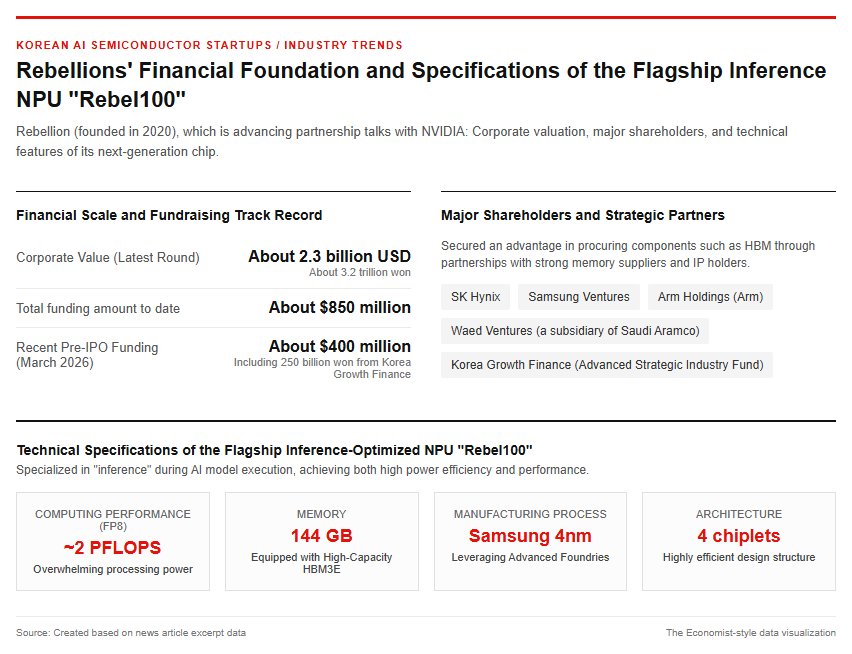
Rebellions is positioned as a core company (priority enterprise) in the “K-Nvidia” initiative promoted by the South Korean government with the aim of fostering a national semiconductor industry. Since its founding in 2020, the company has raised a total of approximately $850 million, and its corporate value in its most recent funding round is estimated at approximately $2.3 billion (about 3.2 trillion won). In March 2026, it raised approximately $400 million in a pre-IPO round and received a direct investment of 250 billion won (approximately $166 million) from the Korea Growth Finance’s “Advanced Strategic Industry Fund.” Furthermore, the company’s list of shareholders and investors includes powerful industry giants such as SK Hynix and Samsung Ventures, which represent the global memory semiconductor sector; Arm Holdings, a major global semiconductor IP powerhouse; and Waed Ventures, a subsidiary of Saudi Aramco. Due to its strong ties with Samsung Electronics and SK Hynix, Rebellions has the strength of being able to preferentially procure vital materials such as High Bandwidth Memory (HBM), which is indispensable for high-performance AI chips.
Technical Advantages of Inference-Optimized NPUs “Rebel100” and “ATOM-Max”
Rebellions’ strength lies in its design technology for Neural Processing Units (NPUs) specialized for the massive “inference” processing that occurs during AI model execution. The company’s flagship product, “Rebel100,” utilizes Samsung Electronics’ 4nm process and a 4-chiplet architecture. By equipping it with a large capacity of 144GB of HBM3E memory, it achieves an outstanding computing performance of approximately 2 PFLOPS (FP8) with extremely high power efficiency.
Please refer to the figure below.
Additionally, on May 2, 2025, Rebellions released a white paper announcing its high-performance accelerator, the “ATOM-Max.” Within a 350W power envelope, this ATOM-Max delivers 128 TFLOPS (FP16) and up to 1024 TOPS (INT4) of performance. It supports PCIe Gen5 x16-based card-to-card communication, enabling low-latency multi-card expansion for up to eight cards. In terms of Tokens-per-Second per Watt (TPS/W)—a metric of power efficiency (Performance-per-Watt) required for data center operations—it features greater efficiency than its competitor NVIDIA’s L40S, contributing to a reduction in the total cost of ownership (TCO) for data centers.
Nvidia’s Technology Lock-In Strategy and the Uncertainties It Faces
The Aim Behind NVIDIA’s “Light Acquisition” Strategy
To solidify its monopolistic position in the intensifying AI semiconductor market, NVIDIA has been deploying a “light acquisition” strategy to effectively bring the technology and talent of promising startups in-house. At the end of 2025, the company signed a non-exclusive technology licensing agreement with U.S.-based AI inference chip developer Groq, effectively locking them in by acquiring its design technology and a large number of engineers while keeping Groq’s independent organization intact. Furthermore, in August 2026, it concluded a massive $6 billion software licensing agreement with Poolside, a developer of AI coding models, while simultaneously making a $1 billion investment that boosted the startup’s valuation to $12 billion. Behind NVIDIA’s investment of such massive funds lies a strong intention to quickly build a robust defensive barrier (ecosystem) to counter competitors in the “inference” chip market—which is projected to vastly surpass the training market in future scale—unlike the AI “training” chip market that the company currently dominates.
Antitrust Law and Regulatory Barriers as a National Strategic Asset
NVIDIA’s acquisition of Rebellions and large-scale capital partnership face a major hurdle in the form of rigorous scrutiny by regulatory authorities in various countries. Because NVIDIA holds a dominant share of the global AI chip market, particularly for training, any M&A aimed at further increasing market share will be strictly scrutinized for antitrust violations by the U.S. Department of Justice (DOJ), the European Union (EU), South Korea’s Fair Trade Commission, and others. In fact, U.S. Senator Elizabeth Warren and others viewed the 2025 partnership agreement between Groq and NVIDIA as a “de facto acquisition” and raised concerns from the perspective of anti-monopoly, launching an official investigation. In addition to this, the South Korean government positions its domestic semiconductor industry as a nationally critical strategic asset. Because the acquisition of Rebellions—which plays a central role in the “K-NVIDIA” initiative—by foreign capital represents a risk of losing domestic industrial sovereignty, the South Korean government is expected to take a cautious and vigilant stance regarding the trends of the partnership.
IPO Plans for 2027 and Future Outlook
Rebels has already announced plans for an initial public offering (IPO) on the main board of South Korea’s KOSPI market in the first or second quarter of 2027 (the first half of 2027) as part of its own growth strategy. Furthermore, looking to the future, the company is also considering a dual listing in the United States via ADRs (American Depositary Receipts). The existence of a clear IPO schedule serves as a factor that narrows the room for negotiation with NVIDIA. Rebels’ management team, along with major shareholders SK Hynix and Samsung, will be forced to make a difficult decision regarding which to prioritize: the synergies gained by coming under NVIDIA’s umbrella, or the growth potential of going public through an independent IPO.
The diagram below illustrates the development of the AI inference market and the geopolitical changes brought about by the partnership between the two companies.
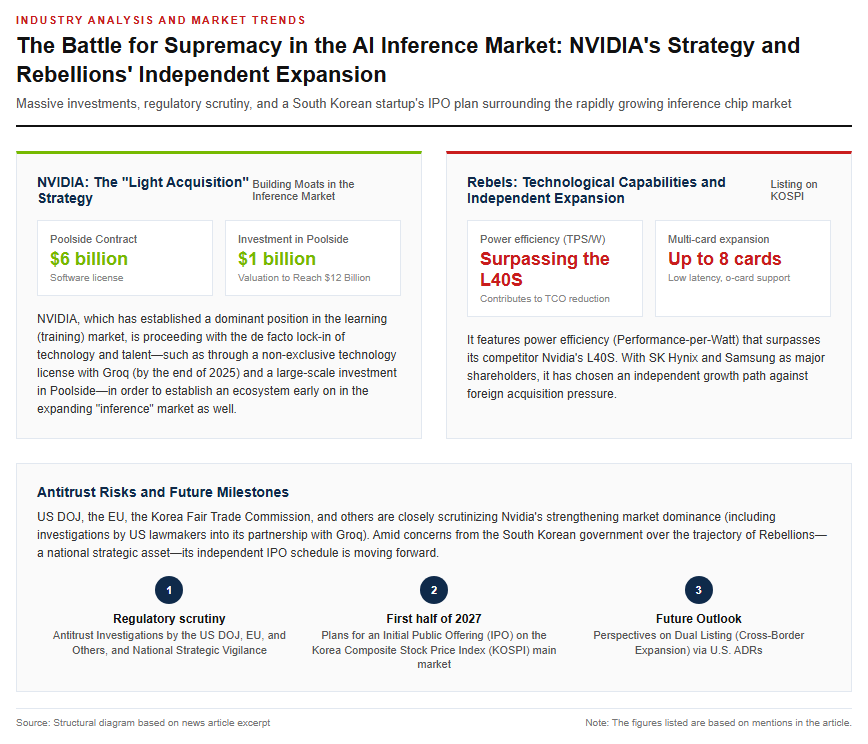
As the AI industry rapidly shifts from model “training” to “practical application (inference),” all eyes will be on how these negotiations unfold going forward, and how NVIDIA will successfully conclude these partnership talks to deeply root itself in South Korea’s AI infrastructure and supply chain.
Reference Page
[#ArtificialIntelligence #AISemiconductors #NVIDIA #Rebellions #NPU #SemiconductorIndustry #ScienceAndTechnology]

コメント