AI company Anthropic has issued a defense against criticism regarding its introduction of invisible watermarks into text generated by Claude. This comes against the backdrop of legal obligations under Article 50 of the EU Artificial Intelligence Act (EU AI Act), which took effect on August 2, 2026, and strong backlash from users concerned about the impact on their everyday writing tasks.
- Compliance with the EU Artificial Intelligence Act and Key Points for Global Expansion
- Backlash and confusion from creators and the tech industry
- The Mechanism of Statistical Watermarking That Replaces Random Numbers with Keys
- Significant Editing and Translation-Induced Vulnerabilities and Detection Uncertainty
- The Boundaries of Compliance Left to Developers
- Standardization to Industry Standards and Outlook for 2027
Compliance with the EU Artificial Intelligence Act and Key Points for Global Expansion
On August 11, 2026, AI company Anthropic officially announced the full-scale implementation of invisible watermarking technology across its Claude series of models. Behind this decision are the transparency obligations set forth in Article 50, Paragraph 2 of the EU Artificial Intelligence Act (EU AI Act), which became applicable on August 2, 2026. The law mandates that content generated by generative AI systems be marked in a machine-readable format and made detectable. Violations of this rule carry severe penalties of up to 15 million euros (approximately 17 million dollars) or 3 percent of global annual turnover from the preceding year. To avoid these massive penalties, approximately 190 organizations, including Anthropic, signed a voluntary code of conduct on transparency. Because it is difficult to reliably restrict application by region, the company made the decision to uniformly apply this invisible watermarking to all products, including the Claude Platform and APIs, across the globe—including Japan—rather than limiting it solely to the EU.
Backlash and confusion from creators and the tech industry
Immediately after the announcement of the watermarking introduction, turmoil and backlash spread among creators and tech industry insiders. The main concerns pointed out were that even in cases where a user simply had Claude make minor grammatical corrections to text they wrote themselves (proofreading and editing assistance) or requested a translation, watermarking data indicating AI involvement would be embedded in that text. Because of this, there are growing anxieties that the fruits of one’s intellectual activities will be entirely flagged as “AI-generated,” making it difficult to protect intellectual property rights or prove originality. Please refer to the figure below.
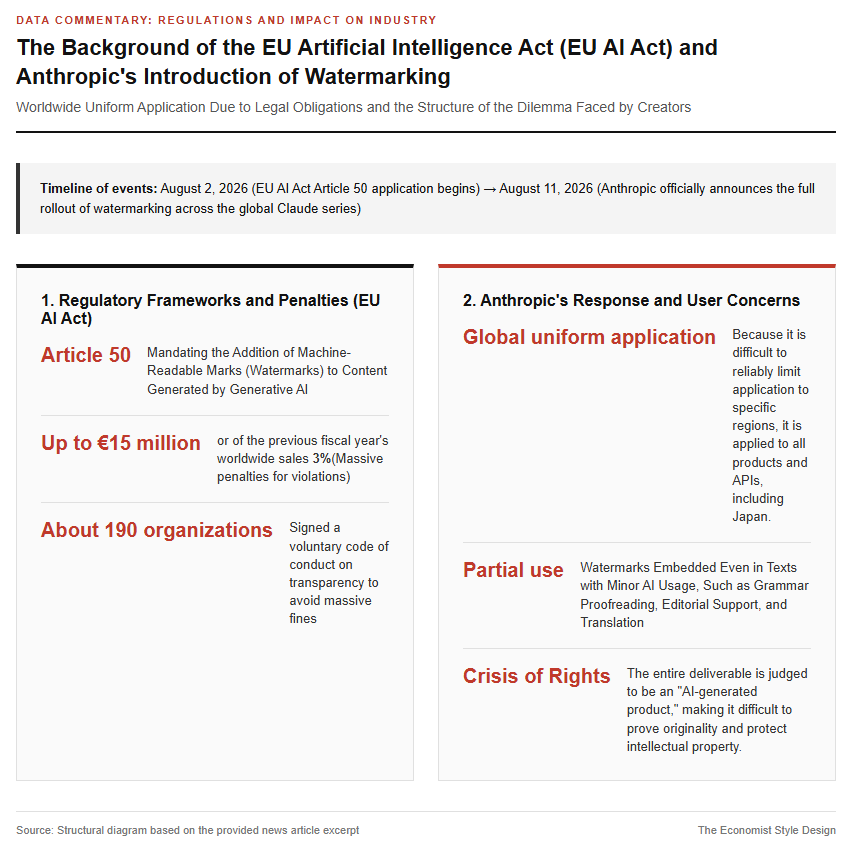
In fact, overseas, this kind of automatic and mandatory watermarking feature has led to a situation where users are canceling their paid Claude subscriptions one after another, stating that it seriously disrupts their daily work. In addition, investors such as Bill Gurley have raised concerns that AI vendors will hold a monopoly on the keys and rights capable of detecting digital watermarks, placing them in a dictatorial position where they can unilaterally control and influence judgments.
The Technical Mechanisms and Limitations of Statistical Digital Watermarking
The Mechanism of Statistical Watermarking That Replaces Random Numbers with Keys
The digital watermark recently introduced in Claude does not insert hidden characters like invisible Unicode; instead, it is a technology that directly weaves statistical patterns into the text’s “word choice.” It is implemented based on the foundational theory published in January 2023 by Kirchenbauer et al. at the University of Maryland, referencing “SynthID-Text,” a technology published by Google DeepMind in Nature in October 2024. By replacing the random number processing normally performed when the AI selects its next word with a value derived from a secret key and the preceding context, it generates a bias inレスレット in the statistical frequency of word occurrences (a probability bias between green and red words) while reading completely naturally to human readers. It is explained that this does not increase the number of characters or tokens, and has no negative impact on Claude’s response quality, generation speed, readability, meaning, or usage fees. Unlike file metadata, because this watermark is woven into the text itself, it is preserved even when copied and pasted.
Significant Editing and Translation-Induced Vulnerabilities and Detection Uncertainty
Unlike robust cryptographic technology, Anthropic itself openly and frankly discloses on its support page the technical limitation that this technology does not serve as definitive evidence. Because watermarks rely on statistical biases in word choice, if a user who receives the generated text rewrites it themselves or rephrases it using another company’s translation or paraphrasing tool, the bias in the statistical probability distribution easily collapses. As a result, a contradiction arises: individuals with malicious intent who attempt to distribute fake news or low-quality mass-produced content (AI slop) can easily evade the watermark, whereas the watermark remains precisely on the writing of general users who diligently use it as an assistive tool. Anthropic itself also clearly states that just because a watermark is successfully detected does not mean Claude is the author, and just because it is not detected does not prove that the content is not AI-generated, thereby acknowledging its technical limitations.
Industry Developments Toward the Future of Provenance Verification
The Boundaries of Compliance Left to Developers
Anthropic is issuing an important warning to external developers and companies that use its API to integrate Claude into their own services. The company has clarified that while it provides technical support to automatically apply watermarks at the model level, it does not shoulder the full compliance obligations for Article 50 of the EU Artificial Intelligence Act in downstream products. This means that developers providing applications incorporating Claude must independently assess whether their own products meet regulatory requirements and build their own compliance flows. For B2B businesses and third-party software developers deploying services utilizing AI, the implementation of watermarking technology is not something that can simply be left to the model provider, presenting a new challenge where companies must proactively determine the boundaries of responsibility for legal compliance.
Standardization to Industry Standards and Outlook for 2027
The issue of how to prove text is AI-generated will further accelerate the trend toward industry standardization involving other companies. Google DeepMind already integrated “SynthID” into Gemini in 2024, and is proceeding with open-sourcing the method and launching a detection portal in May 2025. OpenAI also outlined its policy regarding content provenance in May 2024, responding with measures such as adding metadata via digital signatures called C2PA, but has maintained a cautious stance on introducing watermarks to standard text due to concerns over the impact on speakers of other languages and false positives. However, with the full-scale enforcement of the EU Artificial Intelligence Act, regulatory pressure is intensifying, leaving OpenAI and others with no choice but to follow suit and introduce similar text watermarks. Please refer to the image below.
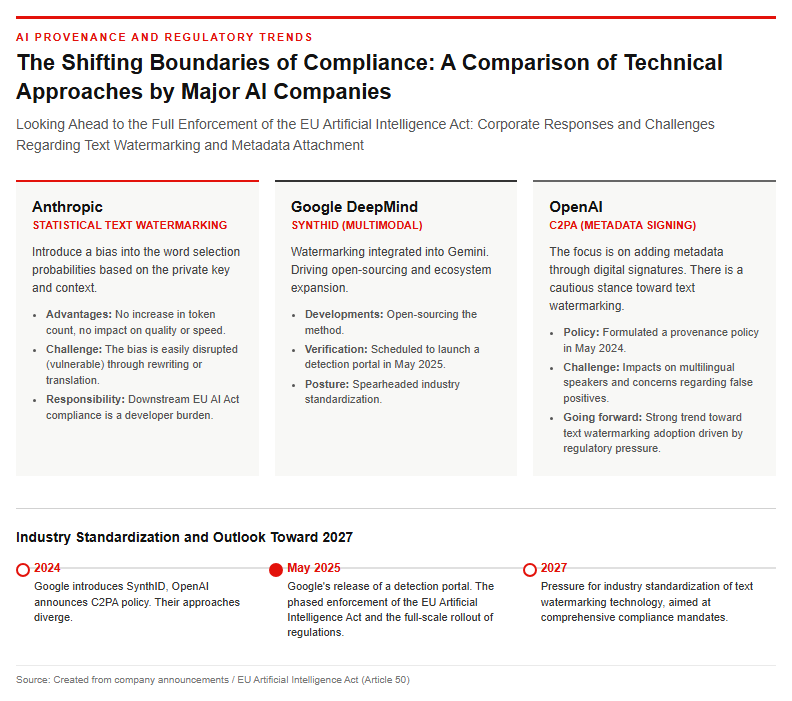
. Looking toward 2027, the primary focus of attention will be how the opaque identification keys, held separately by various companies, will achieve interoperability and be standardized into a third-party-verifiable mechanism.
Reference page
- [Anthropic – How Claude’s text watermark works] https://www.anthropic.com/news/claude-text-watermark
- Anthropic Help Center – How Claude marks AI-generated content
- 【European Union – AI Act, Article 50】https://artificialintelligenceact.eu/article/50/
- 【Google DeepMind – Scalable watermarking for identifying large language model outputs】https://doi.org/10.1038/s41586-024-08025-4
- 【Kirchenbauer et al. – A Watermark for Large Language Models】https://arxiv.org/abs/2301.10226
[#AIWatermark #Claude #Anthropic #EUAIAct #InformationSpace #ContentProvenance #CopyrightProtection]


コメント