On August 25, 2026, the Japanese government finalized its basic guidelines, known as the “Principle Code,” aimed at protecting intellectual property rights regarding generative AI. These guidelines are designed as a non-legally binding soft law to promote transparency by disclosing the types of training data and crawler information.
- Official Decision and Key Points of the New Guidelines
- Background of Formulation and the Significance of Soft Law
- Information Disclosure and Comply or Explain in Principle 1
- The ex-post inquiry system brought by Principle 2 and Principle 3
- Governance Required for AI Developers and Adopting Enterprises
- Future Points of Contention Regarding Effectiveness and Trade Secret Protection
Official Decision and Key Points of the New Guidelines
On August 25, 2026, the government formally finalized the “Principle Code,” a basic guideline regarding the protection of intellectual property rights for generative AI businesses. This guideline aims to ensure transparency in the development process and training data for rapidly spreading generative AI, while balancing technological innovation with the protection of rights. Kimi Onoda, Minister for Intellectual Property Strategy, announced the guideline at a press conference on the same day. Implementation is scheduled to begin in the fall of 2026, and the government will start accepting notifications from businesses.
This guideline was largely approved at the 13th meeting of the Cabinet Office’s expert panel, the “Committee on Intellectual Property Rights in the AI Era,” held on August 18, 2026, and was officially finalized after being entrusted to Chair Toshiya Watanabe (Vice President of Institute of Science Tokyo). Regarding the formulation schedule up to this point, please refer to the figure below.
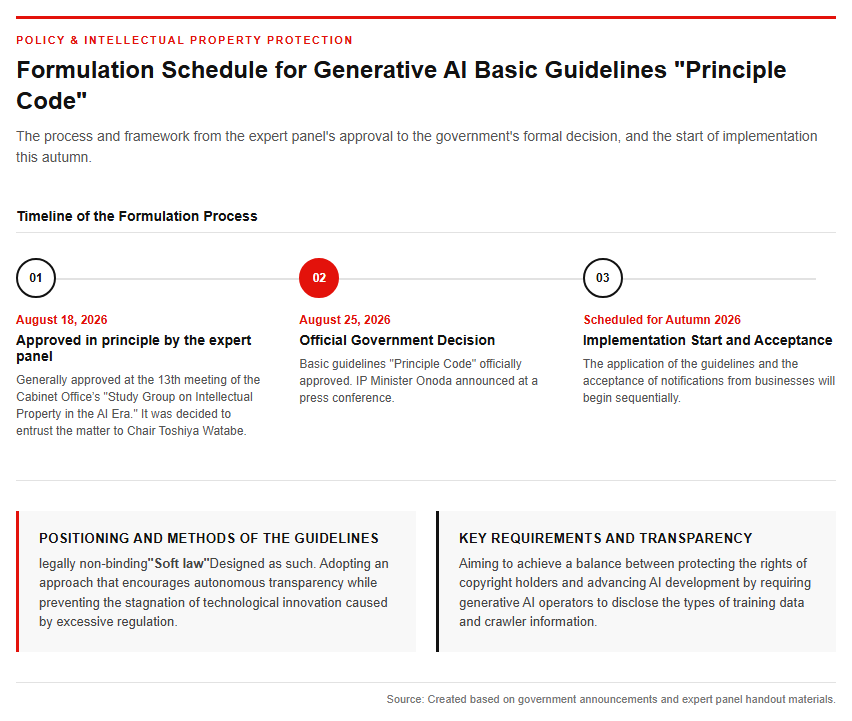
While the guidelines do not carry mandatory legal binding force or penalties, they aim to address social concerns regarding unauthorized AI training and copyright infringement by encouraging voluntary information disclosure and consideration by businesses. The scope of application covers “generative AI businesses,” which include system developers and service providers that generate text, images, and audio. It was explicitly clarified that even overseas businesses without a base in Japan are equally included in the scope if they provide services targeted at Japan.
Background of Formulation and the Significance of Soft Law
In Japan, Article 30-4 of the Copyright Act, amended in 2018, has in principle permitted the electromagnetic use of copyrighted works for the purpose of information analysis without permission. For this reason, the country has been evaluated internationally as having a legal framework that is exceptionally permissive toward AI development. However, amid the rapid evolution of generative AI, there has been a frequent occurrence of cases where massive amounts of content strikingly similar to existing copyrighted works are output. Furthermore, concerns over unauthorized crawling from paywalled sites and pirate sites have rapidly escalated, leading to strong demands for the reconstruction of frameworks to protect the rights of copyright holders and creators.
In response to these social demands, the government has been deliberating on specific intellectual property protection rules based on the “Act on the Promotion of Research, Development, and Utilization of Artificial Intelligence-Related Technologies” (AI Act), which was enacted in 2025. The “soft law” approach adopted by this code is flexibly designed to overcome the difficulty of keeping up with rapidly changing AI technological advancements through rigid legal amendments. Rather than uniformly binding businesses with legal penalties, it aims to co-create a healthy ecosystem through the autonomous governance of businesses themselves and market discipline.
The Mechanism of the Three Core Principles Constituting the Principle Code
Information Disclosure and Comply or Explain in Principle 1
The Principle Code is structured around three major principles centered on ensuring transparency and supporting remedies for rights holders and users. Its first principle is the “disclosure of an overview” at the preliminary stage. Applicable generative AI business operators are recommended to constantly disclose information to the general public on their corporate websites and other platforms, such as the names and versions of the AI models they use, an overview of the architecture, the types of training datasets, and the names or identifiers of crawlers.
An extremely important approach in this mechanism is “comply or explain.” Businesses submit a notification indicating their acceptance of the guidelines, but if they do not implement certain principles, they are required to explain their reasonable grounds and publish them on the website. It is explicitly specified that mandatory disclosure is not required for “sensitive information” concerning trade secrets and national security, eliminating excessive burdens such as forcing the unilateral disclosure of algorithms and proprietary know-how that serve as the source of a company’s competitiveness. The government’s policy is to widely publicize the businesses that have submitted notifications and leave their evaluation up to the market and investors.
The ex-post inquiry system brought by Principle 2 and Principle 3
The Second and Third Principles are inquiry systems that support post-incident relief after troubles or questions arise associated with AI learning and usage.
First, Principle 2 is a disclosure request aimed at “rights holders” who believe that copyright infringement or the like has occurred. If an inquiry is made by a rights holder—or their legal representative—who is currently pursuing, or objectively preparing for, litigation, mediation, or ADR, the business operator will answer whether the creative work at the designated URL or similar location is included in its training data. This supports the substantiation of “the fact that one’s own work was used for training,” which has historically been difficult due to the process being a black box. However, such inquiries are subject to strict requirements, such as providing prima facie evidence of rights ownership and pledging not to use the information for other purposes.
Next, Principle 3 is a disclosure request targeted at “AI users” who are concerned about the unintentional infringement of others’ rights. If users discover an existing work that closely resembles content they have generated, they can inquire with the business operator whether its URL was used to train the model. This ensures a safe environment for using generative AI by making it a condition that users pledge not to use the response in legal proceedings such as lawsuits.
Impact on Practical Operations and Concerns of Conflicting Stakeholders
Governance Required for AI Developers and Adopting Enterprises
The formulation of these basic guidelines forces all companies involved in generative AI to fundamentally review their governance structures. AI developers and providers, who are directly targeted, must urgently implement systems that accurately recognize and comply with crawling refusal intentions set in robots.txt during web crawling, filtering to prevent collection from known piracy sites, and a “data provenance” (lineage management) system to long-term store logs of data collection dates and source URLs. In addition, they will need to establish a dedicated contact point to handle disclosure requests from outside sources.
Meanwhile, this is not irrelevant to general user companies that adopt generative AI for internal operations or external content creation. It is necessary to incorporate into procurement standards a checking flow to verify and evaluate whether the AI tools to be adopted comply with this code, or what explanations are provided if they do not. Selecting reliable models trained on clean data is the key to minimizing the risk of future copyright infringement lawsuits and damage to brand image in a company’s own outputs.
Future Points of Contention Regarding Effectiveness and Trade Secret Protection
Now that the Principle Code has been officially finalized, the primary focus moving forward will be on to what extent this penalty-free “soft law” will prove effective for both domestic and international businesses. A total of 2,161 diverse opinions were submitted during the public comment period.
The Japan Newspaper Publishers and Editors Association and other representatives of rights holders such as copyright owners point out that compliance under voluntary rules remains opaque, and are demanding stronger engagement with major overseas IT companies as well as swift legislation if effectiveness fails to improve. On the other hand, business operators such as the AI Governance Association and major IT companies argue for a narrower scope and clearer disclosure criteria, citing concerns that disclosing dataset details would directly lead to the leakage of trade secrets and know-how to competitors, alongside the excessive practical burden of responding to a massive volume of inquiries.
Following the start of accepting notifications from businesses and the rollout scheduled for this autumn, the success or failure of future regulatory design will depend on what kind of incentives the government will provide to compliant businesses, and how sincerely overseas mega-tech companies, which hold a large share of the Japanese market, will respond to the notification requirements and the operation of inquiry desks.
Reference page
- 【Intellectual Property Strategy Headquarters: Working Group on Intellectual Property Rights in the AI Era】https://www.cas.go.jp/jp/seisakukaigi/titeki2/ai_kentoukai/kaisai/index.html
- 【e-Gov Public Comment: “Draft Principle and Code Concerning the Protection of Intellectual Property and Transparency for the Appropriate Utilization, etc., of Generative AI (Tentative Name) (Draft)”】https://public-comment.e-gov.go.jp/pcm/detail?CLASSNAME=PCMMSTDETAIL&Mode=0&id=095251270
- [Intellectual Property Promotion Plan 2026] https://www.cas.go.jp/jp/seisakukaigi/titeki2/260612/keikaku_all.pdf
【#GenerativeAI #IntellectualProperty #PrincipleCode #Governance #SoftLaw #ScienceAndTechnology】
コメント