The Kanazawa River and National Highway Office of the Hokuriku Regional Development Bureau, Ministry of Land, Infrastructure, Transport and Tourism, has begun the forced removal of stranded vehicles on National Route 159 between Hakui City and Hodatsushimizu Town in Ishikawa Prefecture, following the heavy rainfall on August 27, 2026. This measure is implemented based on the Basic Act on Disaster Countermeasures, with the aim of rapidly securing emergency traffic routes for ambulances and the transport of relief supplies.
- 1.1 Vehicles Stranded on National Route 159 Due to Heavy Rain and the Start of Road Clearance Operations
- 1.2 Record-Breaking Heavy Rain Strikes the Hokuriku Region and the Situation in Disaster-Stricken Areas
- 2.1 Institutional Role of Forced Evacuation under the Disaster Countermeasures Basic Act
- 2.2 Comparison with Past Judicial Precedents Concerning Defects in Road Management
- 3.1 Medium-Term Plan for National Resilience Implementation Launching in FY2026 and Road Development
- 3.2 Future Outlook for Building a Disaster-Resilient Transportation Network
1.1 Vehicles Stranded on National Route 159 Due to Heavy Rain and the Start of Road Clearance Operations
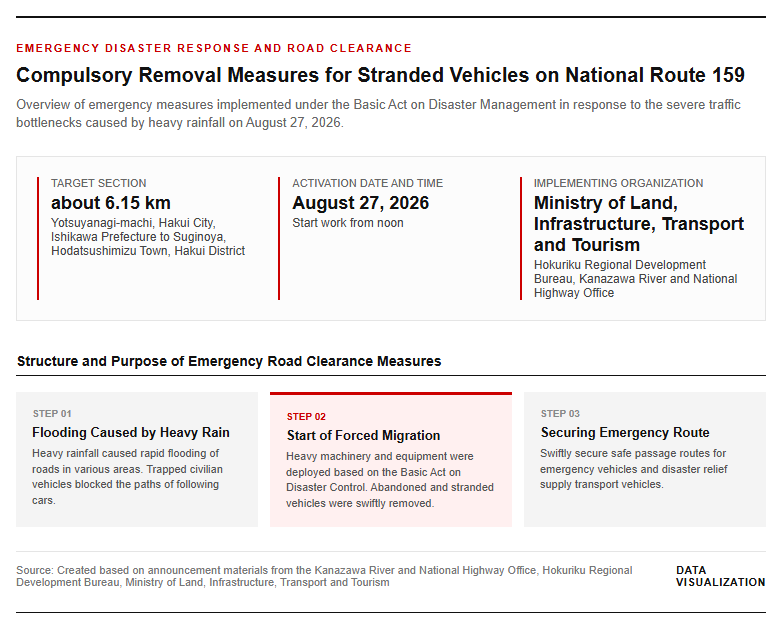
On August 27, 2026, the Kanazawa River and National Highway Office of the Hokuriku Regional Development Bureau, Ministry of Land, Infrastructure, Transport and Tourism, announced that it has begun operations to move stranded vehicles and other obstructions on National Route 159 in Ishikawa Prefecture, based on the Basic Act on Disaster Control. The affected section spans approximately 6.15 km from Yotsuyanagi-machi, Hakui City, to Suginoya, Hodatsushimizu-cho, Hakui District. The operations began at noon on the same day. This road-clearing operation involves the forcible removal of abandoned vehicles and general vehicles stranded and unable to move amid heavy rain, with the primary objective of swiftly securing safe passage routes for emergency vehicles such as ambulances and relief supply transport vehicles for disaster recovery. In the recent heavy rains, roads in various areas rapidly flooded, and immobile general vehicles blocked the paths of following cars, creating serious traffic bottlenecks. To prevent the worst-case scenario where transport routes—which serve as a lifeline to the disaster-stricken areas—are completely severed, the Kanazawa River and National Highway Office promptly deployed heavy machinery and other equipment to forcibly move the disabled vehicles left on the road. Please refer to the figure below.
1.2 Record-Breaking Heavy Rain Strikes the Hokuriku Region and the Situation in Disaster-Stricken Areas
On the morning of August 27, 2026, the Hokuriku region was struck by localized torrential rain, prompting the Japan Meteorological Agency (JMA) to issue a Level 5 Heavy Rain Emergency Warning—the highest level of alert—indicating that imminent and severe danger was approaching the Noto region in Ishikawa Prefecture and the western part of Toyama Prefecture. This heavy downpour was primarily attributed to the continuous inflow of extremely warm and humid air toward a front, which generated linear precipitation zones (senjo kosuitai) that successively developed rain clouds. In particular, Hakui City in Ishikawa Prefecture recorded unprecedented, record-breaking rainfall, with the 12-hour precipitation up to 8:00 a.m. on the same day reaching 313.0 millimeters, the highest in observation history. Due to this extraordinary rainfall, the Sakai River flowing through Sakai-machi, Hakui City, overflowed its banks, and massive amounts of sediment poured onto the nearby National Route 159, instantly plunging the affected area into a critical situation. On flooded roads, water rapidly surged up to the bottom of car windows, causing engines to stall and leading to a succession of stranded vehicles in various locations, putting many drivers in mortal danger. Furthermore, the severe disaster dealt a double blow to a region that had been steadily recovering from the 2024 Noto Peninsula Earthquake, resulting in the destruction of multiple homes due to landslides and an adult day-care facility being temporarily isolated by flooding.
2. Legal Measures Based on the Basic Act on Disaster Countermeasures and the Background of Rapid Response
2.1 Institutional Role of Forced Evacuation under the Disaster Countermeasures Basic Act
The forced removal of vehicles based on the Basic Act on Disaster Management grants road administrators the special legal authority to designate specific sections and rapidly clear roads when a large-scale natural disaster occurs. Normally, moving another person’s automobile without their consent is restricted from the perspective of protecting property rights, but this exceptional measure has been established for life-saving activities of extremely high public utility, namely securing emergency response operations and the transport of emergency supplies. The emergency measures taken this time on National Route 159 are also a concrete example of the Kanazawa River and National Highway Office, acting as the road administrator, exercising its legal authority. By promptly moving stranded, abandoned vehicles to the roadside or nearby safe spaces using tow trucks, heavy machinery, and the like, arterial roads severed by heavy rain are restored to a state passable by emergency vehicles. This enables emergency units such as the fire department, police, and Self-Defense Forces to rapidly access disaster-stricken sites and evacuation centers, playing an extremely effective role in disaster prevention and mitigation by maintaining initial rescue operations for affected local residents and delivery routes for necessary supplies.
2.2 Comparison with Past Judicial Precedents Concerning Defects in Road Management
Rapid removal of stranded vehicles and ensuring traffic flow during disasters is an issue that heavily involves the significant legal responsibilities of road administrators. An important precedent in the Japanese judiciary is the Supreme Court ruling of July 25, 1975 (Supreme Court, July 25, 1950 [Showa 50]). In this case, a disabled large freight vehicle parked near the center line of a national highway was left unattended for approximately 87 hours. Despite this, the civil engineering branch office responsible for road management failed to recognize the situation through patrols and did not take any necessary safety measures, such as setting up barricades or closing the road to traffic. The court ruled that there was a defect in the road’s management, establishing state liability for damages. This Supreme Court decision demonstrates how leaving dangerous road conditions unattended can constitute severe negligence. In modern disaster response, keeping in mind the heavy legal responsibility represented by this precedent, systems have been established to remove road obstacles more proactively and immediately by utilizing legal frameworks such as the Basic Act on Disaster Management. To prevent further secondary accidents caused by abandoned vehicles and to maintain public safety on roads, it is essential for administrators to execute mandatory and prompt removal operations.
3. National Resilience and the Future Direction of Infrastructure Development
3.1 Medium-Term Plan for National Resilience Implementation Launching in FY2026 and Road Development
To address increasingly frequent and severe heavy rain and earthquake disasters, the Japanese government is promoting the creation of resilient and robust communities that can recover quickly even when struck by disaster. At the core of this effort is the First Medium-Term Plan for the Implementation of National Resilience, which was approved by the Cabinet on June 6, 2025, and will officially launch in fiscal 2026. This plan covers a five-year period through fiscal 2030, and the overall project scale for measures requiring particularly urgent promotion is expected to exceed 20 trillion yen in total. Among these, approximately 10.6 trillion yen—accounting for more than half of the total—is planned to be invested in the lifeline resilience policy group, which aims to strengthen roads and lifelines. This includes targets such as raising the seismic retrofitting rate for bridges on emergency transportation routes from 82% in fiscal 2023 to 88% by fiscal 2030, as well as measures to address the aging of road facilities. As made clear by the recent situation on National Route 159, where numerous vehicles were stranded due to flooding from heavy rain, the operation, management, and preventive maintenance of emergency transportation routes—which must never be allowed to be severed even during a disaster—are positioned with extremely high importance within the Medium-Term Plan for the Implementation of National Resilience.
3.2 Future Outlook for Building a Disaster-Resilient Transportation Network
As natural disasters become more diverse and severe, building a disaster-resilient transportation network requires a more comprehensive approach that integrates both hardware and software aspects. In peninsula regions and other areas with significant topographical constraints, past disasters such as the Noto Peninsula Earthquake have once again highlighted the challenge that once a main road is severed, grasping the damage situation and conducting emergency operations become remarkably difficult. To address this highly uncertain road infrastructure challenge, efforts are underway to clarify prerequisites for evaluating collapse risks caused by catchment topography and specific ground materials starting from the design and planning stage of earthwork structures. Furthermore, looking toward the future, autonomous driving technology is being viewed as an element of social infrastructure, and research and institutional development concerning infrastructure design are also progressing to support evacuation assistance during disasters, the transportation of vulnerable populations such as the elderly, and unmanned relief supply delivery. Alongside rapid road-clearing measures for stranded vehicles in emergencies, the realization of a comprehensive disaster prevention network that fuses the latest technologies with institutional design—such as the utilization of such autonomous vehicles and preventive road closures using high-precision forecasting technology—is becoming the future focus.
Reference page
- [Ministry of Land, Infrastructure, Transport and Tourism, Hokuriku Regional Development Bureau Press Release] https://www.hrr.mlit.go.jp/press/2026/8/260827kanazawa3.pdf
- [Ministry of Land, Infrastructure, Transport and Tourism, Hokuriku Regional Development Bureau Website] https://www.hrr.mlit.go.jp/index.html
- [Cabinet Secretariat: The 1st Medium-Term Plan for National Resilience Implementation (Overview)] https://www.cas.go.jp/jp/seisaku/kokudo_kyoujinka/dai1_chuukikeikaku/gaiyou.pdf
[#HeavyRainEmergencyWarning #EmergencyRoadClearance #BasicActonDisasterControl #MinistryofLandInfrastructureTransportandTourism #IshikawaPrefecture #NationalRoute159 #NationalResilience #EvacuationRoute]


コメント