GoPro, a pioneer in action cameras, has agreed to a $285 million merger with Starman Optical, a U.S. optics and photonics company. Driven by a severe financial crisis stemming from intense competition with Chinese rivals and soaring memory prices, the company now plans a major business pivot to transform into a technology firm targeting AI data centers and the defense and security markets.
- 5 Million Merger Agreement and Transfer of Management Control
- The Sudden Surge of the Stock Market and the Entry of Major YouTubers
- The Plunge from a Billion Market Cap and the Rise of Chinese Players
- The Surge in Memory Prices and the Debt Default Trap
- Pivot to Optical Photonics for AI Data Centers
- Expansion into the Defense and Aerospace Market and the Future of the Consumer Business
5 Million Merger Agreement and Transfer of Management Control
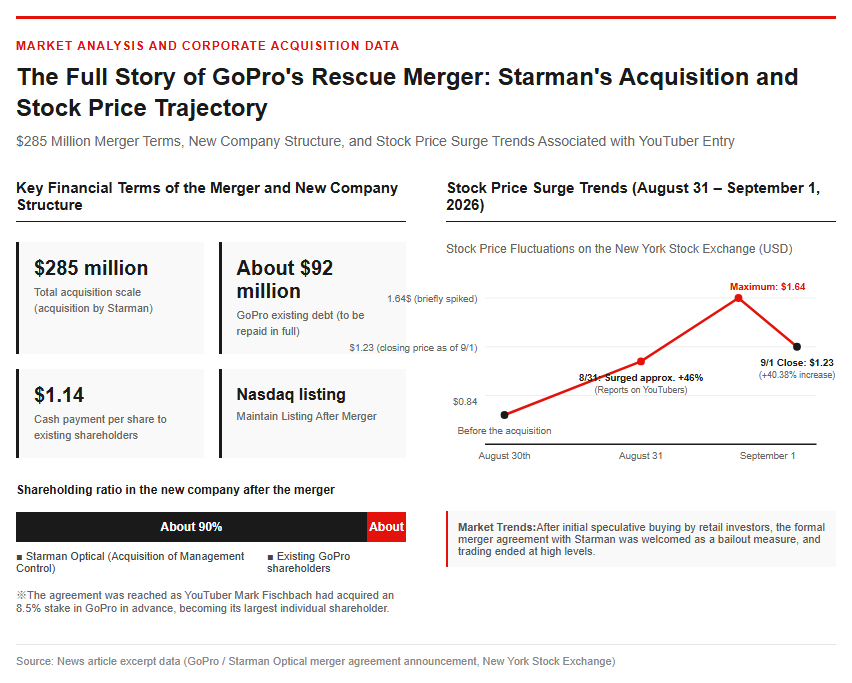
On September 1, 2026, GoPro, known as a synonym for action cameras, announced that it has entered into a definitive merger agreement with Starman Optical, a privately held U.S. optics and photonics company. The total value of the transaction amounts to $285 million, effectively functioning as an acquisition of GoPro by Starman. Upon completion of the merger, Starman will secure approximately 90% of the shares in the newly combined company and take complete control of its management. Meanwhile, existing GoPro shareholders will receive approximately $1.14 in cash per share, along with an allocation of about 10% of the shares in the merged entity. Furthermore, GoPro’s approximately $92 million in debt is planned to be repaid in full upon the closing of the transaction. The merger is expected to be formally completed by the end of 2026, pending approval at a shareholder meeting and clearance from relevant regulatory authorities. It has also been decided that the new company will maintain its listing on the Nasdaq market following the merger.
The Sudden Surge of the Stock Market and the Entry of Major YouTubers
Immediately after this historic acquisition drama was announced, the stock market reacted sensitively. On the New York Stock Exchange on September 1, 2026, GoPro’s stock closed up 40.38% from the previous trading day at $1.23, at one point surging as high as $1.64. In fact, prior to this sharp rise, significant movement had already taken place on the internet. It had been revealed the previous day, August 31, that major popular YouTuber Markiplier had secured an 8.5% stake in GoPro, becoming its largest individual shareholder. Upon this news, the stock price had surged by approximately 46% in the regular market that same day. The acquisition agreement by Starman was accepted by the market as a definitive bailout amid speculative buying led by such individual investors and the online community. The following graph captures the volatility of the stock price and the surge in trading volume.
The Fall from Glory and the Truth Behind the Financial Crisis
The Plunge from a Billion Market Cap and the Rise of Chinese Players
GoPro’s journey is a history of glory and setbacks. After going public (IPO) in June 2014 at $24 per share, the company was valued at approximately $4 billion on its first day of trading. Just four months later, in October 2014, its stock price hit $98.47, with its market capitalization briefly approaching $12 billion, as it reigned supreme as the undisputed king of the action camera market. However, it subsequently faced dramatic improvements in smartphone camera performance alongside a fierce onslaught from powerful competitors like China’s DJI and Insta360. These rivals expanded their market share by leveraging 360-degree capture, AI-powered editing software, and efficient supply chains. As a result, GoPro’s market share—which once accounted for over 75% of the global market—plummeted to just 18% as of November 2025, resulting in a complete loss of its leadership in the market.
The Surge in Memory Prices and the Debt Default Trap
Adding to the decline in market share was the extraordinary surge in memory semiconductor prices driven by the recent AI boom. Procurement costs for the storage memory components required for GoPro’s flagship products skyrocketed by 80% to 115% year-over-year, fatally crippling hardware manufacturing profitability. As a result, GoPro’s 2025 revenue dropped 19% year-on-year to $651 million, posting a net loss of $83.3 million and bringing its accumulated losses to $775 million. The struggles continued into the second quarter of 2026, with revenue tumbling 31% year-on-year to $104.9 million. With its cash reserves cut in half, the company faced the risk of breaching financial covenants set in multiple loan agreements. In July 2026, as a condition for securing a temporary covenant waiver from its creditors, the company was required to “refinance or sell the company within 180 days,” making the current merger with Starman practically its only option to avoid bankruptcy.
Transformation and Outlook Toward a New Defense and AI Company
Pivot to Optical Photonics for AI Data Centers
Starman Optical, which holds management control of GoPro, is an emerging optics and photonics company that develops and manufactures optical transceivers essential for AI data center infrastructure. The company’s technology, which converts electrical signals into high-speed optical signals to exchange large volumes of data via optical fibers, is experiencing extremely high demand against the backdrop of rapidly expanding AI investments by Big Tech companies. Its parent company, Starman Holdings, unveiled state-of-the-art 800G and 1.6T optical transceivers in March 2026. Through this merger, Starman will acquire more than 2,500 U.S. patents, as well as miniaturized imaging technologies and image processing technologies, that GoPro has accumulated over its 24-year history. This is aimed at going beyond merely manufacturing communication components to enable the development of highly ruggedized optical modules, thereby establishing its position as a next-generation AI infrastructure supplier.
Expansion into the Defense and Aerospace Market and the Future of the Consumer Business
The most notable aspect of this merger is its entry into the highly restricted government and defense sectors through domestic manufacturing (onshoring) in the United States. Starman is currently investing $150 million to build its own production facility in Warren, New Jersey, making it one of the few domestic optical equipment manufacturers to clear regulations such as the U.S. National Defense Authorization Act (NDAA), which bars the procurement of foreign-made hardware. Through this, the company outlines its strategy to apply GoPro’s compact, rugged camera technology and image processing IP to defense drones, autonomous robots, and aerospace sensor modules. Meanwhile, regarding the consumer business that existing GoPro users are concerned about, the company plans to continue supporting existing camera lineups such as the HERO and MAX series, as well as cloud subscription services, for the foreseeable future. While preserving its traditional consumer brand, the new company will step into entirely new frontiers: national security and AI infrastructure.
Reference page
- 【SEC.gov – GoPro, Inc. Form 8-K (September 1, 2026)】https://www.sec.gov/Archives/edgar/data/1500435/000162828026059839/gpro-20260901.htm
- 【GoPro Investor Relations】https://investor.gopro.com/
【#GoPro #Starman #M&A #AIDataCenters #DefenseIndustry #Business #Economy】


コメント