Chinese AI pioneer DeepSeek plans to deploy at least 160,000 high-end artificial intelligence accelerators from Huawei Technologies in a massive data center under construction in Inner Mongolia. This strategic move highlights growing political and commercial pressures inside China to build an autonomous hardware ecosystem amidst tightening U.S. export controls on advanced semiconductor technology.
- 1-1. The Scale of DeepSeek’s 160,000-Chip Domestic Deployment
- 1-2. Strategically Dividing Workloads Between Training and Inference
- 2-1. Overcoming the Hardware and Software Hurdles of 2025
- 2-2. Software-Hardware Co-Optimization as a Breakthrough Catalyst
- 3-1. How U.S. Sanctions Sparked a Commercial Rush for Domestic Silicon
- 3-2. Production Bottlenecks and the Horizon of Sovereign Compute
1-1. The Scale of DeepSeek’s 160,000-Chip Domestic Deployment
In September 2026, Chinese AI startup DeepSeek announced plans to deploy at least 160,000 of Huawei Technologies’ next-generation “Ascend 950DT” AI accelerators at its massive, under-construction data center in the Inner Mongolia Autonomous Region. Once completed, this project is set to become the largest known cluster powered by Huawei AI chips, serving as a landmark transition for China’s AI industry as it shifts away from its historical reliance on U.S. hardware. Previously, leading Chinese AI firms—including DeepSeek—heavily favored Nvidia’s “A100” and “H100” GPUs to train their frontier models. However, Washington’s successive rounds of export controls have systematically choked off the supply of advanced silicon to China. Facing this reality, securing a dependable domestic supply chain has evolved from a long-term goal to an immediate commercial necessity. This colossal 160,000-chip deployment will serve as a definitive litmus test for whether domestic hardware can sustain ultra-large-scale AI operations.
1-2. Strategically Dividing Workloads Between Training and Inference
The massive volume of Ascend 950DT chips headed to the Inner Mongolia facility will not be used to train models from scratch; instead, they are earmarked almost exclusively for running “inference” workloads. While Huawei markets and designs these next-generation processors to handle highly demanding training operations, DeepSeek is taking a more cautious, multi-phased approach. Coordinating tens of thousands of chips to run unified training sessions over several continuous weeks remains a highly delicate technical challenge, requiring flawless hardware stability and deeply integrated software orchestration. To minimize operational risks, DeepSeek continues to rely on previously secured Nvidia accelerators for the computationally intense training phase, while utilizing the new Huawei cluster to run inference at a massive scale and a fraction of the cost. This pragmatic partitioning strategy allows DeepSeek to balance political alignment with strict engineering requirements.
2. Technical Setbacks and the Evolution of Co-Optimization
2-1. Overcoming the Hardware and Software Hurdles of 2025
DeepSeek’s decision to specialize Huawei chips for inference is the direct result of a grueling technical setback experienced in 2025. In August 2025, under intense government pressure to utilize domestic hardware, DeepSeek attempted to train its next-generation “R2” model using Huawei’s “Ascend 910C” chips. Despite Huawei dispatching an entire dedicated engineering team to work on-site at DeepSeek’s offices, the effort stalled. The project struggled with physical hardware instability, sluggish interconnect speeds between nodes, and an immature software ecosystem, failing to complete a single stable training run. A major technical bottleneck was precision format compatibility: DeepSeek had meticulously optimized its training stack for Nvidia’s “FP8” (8-bit floating-point) format to run V3 models, but the Ascend 910C did not support FP8. This forced engineers to fall back on the memory-heavy “BF16” (16-bit) format, causing severe memory deficits. To avoid catastrophic product delays, DeepSeek ultimately abandoned the attempt and restarted the R2 training from scratch using Nvidia’s “H20” GPUs.
2-2. Software-Hardware Co-Optimization as a Breakthrough Catalyst
Rather than stalling progress, this 2025 setback catalyzed a profound evolution in how both companies approach system design, shifting the focus from raw hardware specs to deep software-hardware co-optimization. When DeepSeek launched its frontier “DeepSeek V4” model in April 2026, it demonstrated native compatibility with Huawei’s proprietary “CANN” (CANN-Next) heterogeneous computing architecture. This breakthrough dramatically lowered the engineering barrier for developers migrating CUDA-optimized kernels over to Huawei’s platform. Architecturally, DeepSeek V4 achieved a massive 3.7x to 9.8x improvement in inference FLOPS efficiency compared to the older V3.2 model, while reducing the required KV cache size by a staggering 9.5x to 13.7x. By writing highly sophisticated algorithms tailored specifically to bypass physical hardware bottlenecks, DeepSeek successfully bridged the performance gap, transforming underpowered domestic chips into highly competitive inference engines.
3. Geopolitical Friction and the Scramble for Domestic Silicon
3-1. How U.S. Sanctions Sparked a Commercial Rush for Domestic Silicon
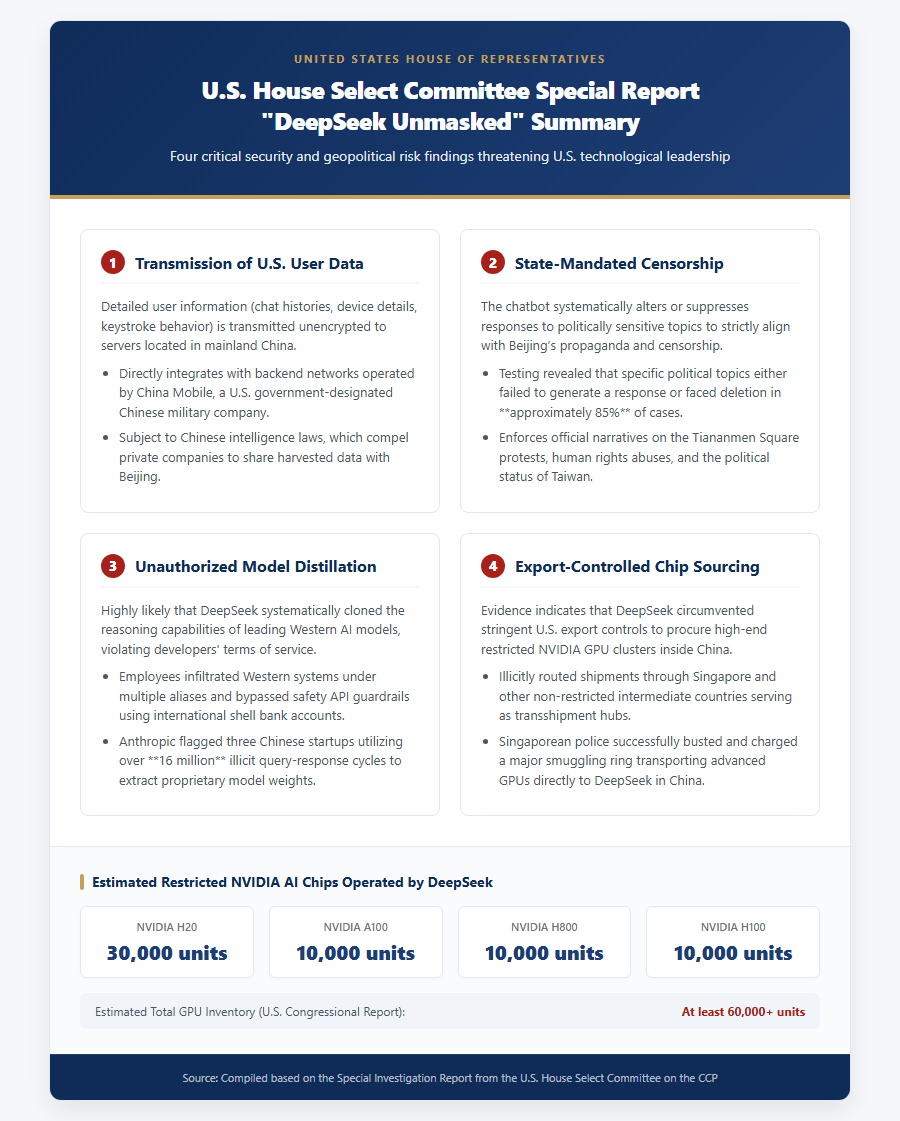
Instead of crippling China’s AI progress, Washington’s escalating tech sanctions have inadvertently acted as a powerful commercial accelerant for the domestic semiconductor market. In early 2026, the U.S. government tightened export restrictions, effectively blocking shipments of Nvidia’s “H20″—a chip specifically scaled down to comply with previous regulatory thresholds. Nvidia’s more advanced “H200” remains gridlocked in regulatory reviews. The following image illustrates the findings of a U.S. congressional report investigating DeepSeek’s data transmission, sanction evasion, and potential distillation of U.S. models.
With Nvidia’s high-end silicon effectively off the table, domestic alternatives transitioned from a subsidized experiment to the only viable path forward. DeepSeek’s successful optimization of V4 on the Ascend 950 sparked an unprecedented buying scramble among China’s tech titans. Hyperscalers like ByteDance, Tencent, and Alibaba rushed to place massive orders for Huawei’s new processors, while share prices for SMIC—the contract manufacturer producing Huawei’s chips—surged nearly 10% in Hong Kong trading.
3-2. Production Bottlenecks and the Horizon of Sovereign Compute
The primary hurdle facing this domestic transition is no longer software compatibility, but rather supply-side manufacturing constraints. Blocked from importing state-of-the-art Extreme Ultraviolet (EUV) lithography systems due to export controls, Chinese foundries face incredibly steep challenges in scaling up yield rates and mass-producing high-end chips like the Ascend 950 series. Nonetheless, DeepSeek remains highly optimistic. The company projects that as Huawei successfully scales its “Ascend 950” supernodes in the second half of 2026, the cost of running frontier models (such as V4 Pro) will plummet. If this dramatic cost compression is realized, Chinese AI firms will be positioned to offer inference tokens at some of the lowest prices globally. Even if Chinese hardware remains a generation behind Western chips in absolute peak performance, a highly optimized, low-cost domestic ecosystem backed by robust state mandates could soon allow China to export a fully sovereign AI stack to non-aligned markets across Southeast Asia, the Middle East, and beyond.
References
- 【GitHub – deepseek-ai/DeepSeek-V3】https://github.com/deepseek-ai/DeepSeek-V3
【#DeepSeek #Huawei #AIChips #DataCenters #USChinaRivalry #Semiconductors】

コメント