The University of Idaho Hiroshima Campus, a joint initiative with Hiroshima University, officially opened its doors in August 2026. This groundbreaking partnership marks a major step forward in addressing the global shortage of semiconductor talent through advanced engineering education conducted entirely in English.
- A New Hub for Japan-U.S. Academic Collaboration Opened in August 2026
- A Unique Four-Year Curriculum with Direct Degree Conferral
- Addressing the Global Engineering Deficit and the Program’s Strategic Value
- Universal Tuition Reductions and an Inclusive International Academic Environment
- Hiroshima’s Semiconductor Ecosystem and Micron’s Massive Capital Investment
- Regional Expansion and a Ten-Year Vision for Academic Integration
A New Hub for Japan-U.S. Academic Collaboration Opened in August 2026
On August 21, 2026, the official opening ceremony for the University of Idaho Hiroshima Campus was held at the Hiroshima University Faculty Club Reception Hall. Having received designation as a Foreign University Branch Campus in Japan from the Minister of Education, Culture, Sports, Science and Technology on November 11, 2025, this new campus represents the first U.S. branch campus in Japan dedicated specifically to the field of engineering. The ceremony was attended by prominent delegates from the University of Idaho, including Professor Suzanna Long, Dean of the College of Engineering, and Professor Ginger E. Carney, Dean of the College of Science, alongside academic and administrative partners. They were joined by the inaugural cohort of 18 pioneering students and their families to celebrate this historic milestone. These 18 students bring a diverse range of international backgrounds, arriving from Japan, Vietnam, the United States, South Korea, and Nepal. Moving forward, the program is designed to recruit globally with a maximum capacity of 100 students per year. The establishment of this campus is highly anticipated as a landmark for international education and a testament to the strengthening of higher education partnerships between the United States and Japan.
A Unique Four-Year Curriculum with Direct Degree Conferral
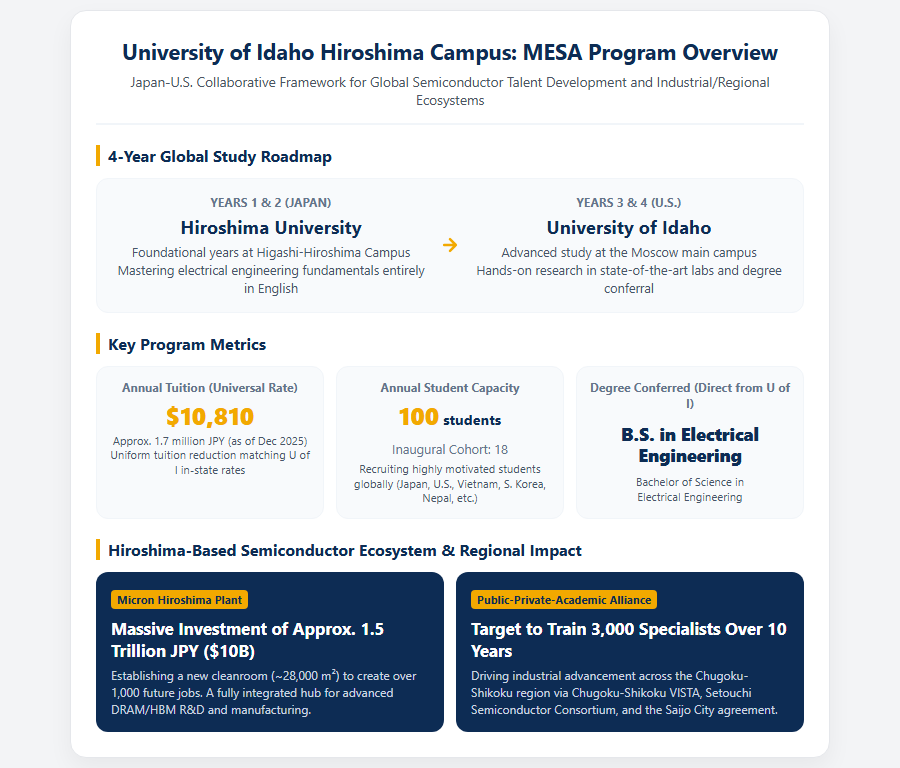
The Hiroshima Campus hosts the Microchip Engineering and Security Alliance (MESA) program, an intensive four-year undergraduate curriculum specializing in semiconductors. A key highlight of MESA is that all classes are conducted entirely in English over the four-year period. Under this structure, students spend their first two years at Hiroshima University’s Higashi-Hiroshima Campus establishing a solid foundation in core subjects such as electrical engineering. For the final two years, they transition to the University of Idaho’s main campus in Moscow, Idaho, where they engage in hands-on research and practical training in advanced fabrication and artificial intelligence laboratories. Upon successfully completing the four-year curriculum, graduates receive a Bachelor of Science in Electrical Engineering directly from the University of Idaho. Furthermore, Hiroshima University grants MESA students special auditor status, allowing them to access the same campus facilities and student services as local students. Through this integration of academic strengths from both institutions, the program provides a highly structured pathway to cultivate world-class engineers.
The Drive Behind Global Semiconductor Talent Cultivation
Addressing the Global Engineering Deficit and the Program’s Strategic Value
In today’s highly digitalized society, semiconductors serve as the critical foundation for artificial intelligence (AI), advanced communications, autonomous driving, and energy systems. However, the rapid expansion of these industries has created a severe global shortage of specialized engineers. Industry projections indicate that more than 1 million semiconductor-related jobs will need to be filled worldwide by 2030. Developed as a direct response to this urgent global workforce gap, the MESA program represents the very first Japan-U.S. collaborative undergraduate initiative focused entirely on semiconductor talent. By fusing Japan’s world-leading expertise in materials and device engineering with America’s cutting-edge systems and security technologies, the curriculum aims to train innovative leaders capable of driving the future of tech. Cultivating highly skilled, English-proficient semiconductor engineers within Japan through this collaborative structure is of immense strategic and economic value to both nations.
Universal Tuition Reductions and an Inclusive International Academic Environment
The University of Idaho is a premier public research university, classified as an “R1” institution (Very High Research Activity) under the Carnegie Classification of Institutions of Higher Education—a prestigious designation held by only a select group of top-tier universities in the United States. To make this world-class education accessible to a diverse student body, the university has implemented an unprecedented financial support mechanism. All students enrolled in the MESA program, regardless of their nationality, receive a substantial tuition discount that aligns their tuition fees with in-state rates. As of December 2025, the annual tuition is set at \$10,810 (equivalent to approximately 1.7 million Japanese yen). This marks the first time a designated foreign branch campus in Japan has offered such a uniform tuition reduction to its entire student body. Supported by supplementary scholarship opportunities established in collaboration with donor networks and governments, the campus is successfully creating a vibrant educational environment that attracts elite talents from across Asia and the globe.
Expanding Public-Private-Academic Synergies and Future Outlook
Hiroshima’s Semiconductor Ecosystem and Micron’s Massive Capital Investment
The opening of the Hiroshima Campus is deeply integrated with the region’s robust industrial ecosystem rather than functioning as an isolated academic venture. Hiroshima is home to a world-class manufacturing and development facility operated by Micron Technology, a leading global memory manufacturer. To meet the soaring demand for memory chips in the generative AI era, Micron is undertaking a massive investment of up to 1.5 trillion yen (approximately 10 billion USD) to expand its Hiroshima operations. On July 4, 2026, a groundbreaking ceremony was held for a new, state-of-the-art cleanroom spanning approximately 28,000 square meters. The event was attended by top industry leaders and prominent government officials from both nations, including Minister of Economy, Trade and Industry Ryosei Akazawa and former Prime Minister Fumio Kishida. This expansion is projected to generate over 1,000 new jobs. Micron is also a founding sponsor of “UPWARDS for the Future,” an 11-university semiconductor alliance established during the G7 Hiroshima Summit. The alignment of world-class academic training and multi-billion-dollar industrial expansion in a single locality lays the foundation for a highly resilient regional semiconductor supply chain.
Regional Expansion and a Ten-Year Vision for Academic Integration
Hiroshima University aims to extend the benefits of this specialized semiconductor education across the Chugoku-Shikoku region and beyond through extensive academic networks. In August 2025, the university’s “Chugoku-Shikoku Semiconductor Talent Development Acceleration Program” (Chugoku VISTA) was selected by the Ministry of Education, Culture, Sports, Science and Technology, setting a target to train 3,000 semiconductor specialists over the next ten years. Building on this momentum, on October 29, 2025, Hiroshima University signed a comprehensive partnership agreement with Saijo City in Ehime Prefecture, a region known for its high concentration of semiconductor-related enterprises. This agreement focuses on expanding student internship opportunities and promoting joint research initiatives. The dedication of Hiroshima University to regional educational development is illustrated by its corporate identity
, and it continues to materialize in collaborative milestones such as the official Saijo City agreement
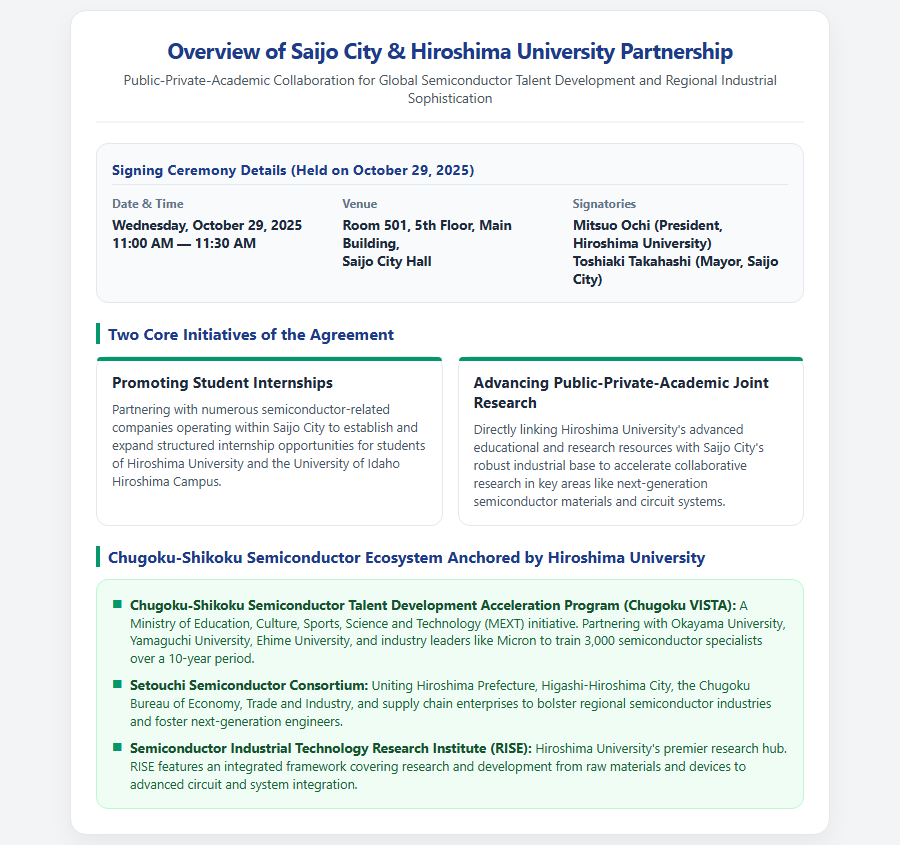
. Looking ahead to the next decade, this regional network centered around the University of Idaho Hiroshima Campus is set to attract key suppliers, elevate regional industry standards, and provide students with world-class international career pathways.
References
- 【Hiroshima University】U of I, Hiroshima University launch global engineering pathway https://www.hiroshima-u.ac.jp/en/international/news/92409
- 【Hiroshima University】”University of Idaho Hiroshima Campus” Opening Ceremony Held https://www.hiroshima-u.ac.jp/en/international/news/99559
- 【Hiroshima University】MEXT designates the University of Idaho Hiroshima Campus as a Foreign University Branch Campus https://www.hiroshima-u.ac.jp/en/international/news/94990
- 【University of Idaho】Engineering partnership between U of I, Hiroshima University aims to fill semiconductor workforce gap https://www.uidaho.edu/newsroom/hiroshima-engineering-partnership
【#Semiconductors #TalentDevelopment #HiroshimaUniversity #UniversityofIdaho #USJapanAlliance #MESA #GlobalEducation】
コメント