The Government Pension Fund Global (GPFG), Norway’s sovereign wealth fund and one of the largest in the world, has proposed increasing its allocation of Japanese Government Bonds (JGBs) from 4.6% to 7.4%. This shift reflects a historic recalibration of its fixed-income strategy, aiming to reduce dependency on U.S. Treasuries while diversifying assets and improving returns.
- The Core News: A Historic Allocation Shift to Japanese Government Bonds
- Background on the Bond Strategy Review: A Sharp Reduction in Government Debt Exposure
- Promoting Diversification and Shifting to Agency MBS
- Transitioning from GDP Weighting to Market Capitalization Weighting
- Stabilizing Effect on Japan’s Long-Term Yields and Currency
- Pressure on U.S. Treasuries and the Echoes of Capital Repatriation
- A Gradual Transition Process with Final Approval in 2027
The Core News: A Historic Allocation Shift to Japanese Government Bonds
Norway’s sovereign wealth fund, the Government Pension Fund Global (GPFG), manages the nation’s surplus petroleum revenues with a long-term perspective. Unlike Japan’s Government Pension Investment Fund (GPIF), which manages public pension reserves directly, the GPFG operates as a sovereign wealth fund (SWF) investing national capital globally. As of June 2026, the fund’s total assets under management reached approximately 2.1 trillion dollars, making it the second-largest sovereign investment entity in the world, surpassed only by the People’s Bank of China at 3.9 trillion dollars. Please refer to the diagram below.
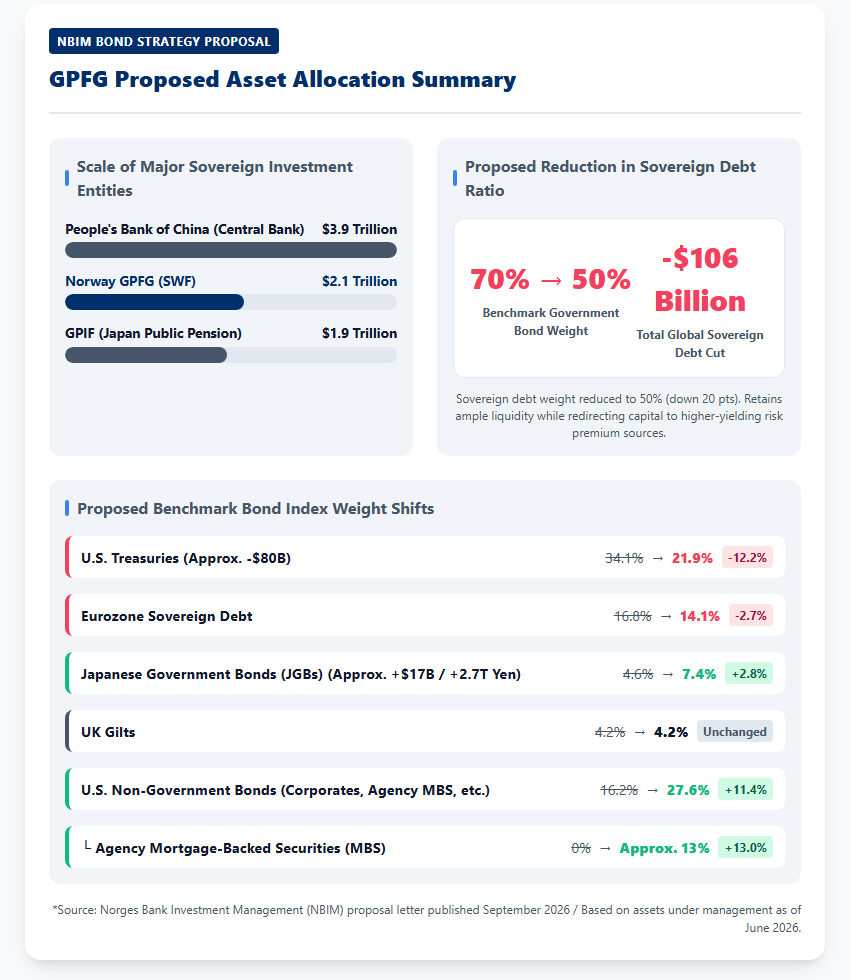
Norges Bank Investment Management (NBIM), which manages this global giant, has proposed increasing the fund’s allocation of JGBs from 4.6% to 7.4%, representing a substantial 2.8 percentage point increase. Revealed in a letter dated September 1, 2026, to the Norwegian Ministry of Finance, this move is estimated to inject approximately 17 billion dollars (around 2.7 trillion yen) of new capital into the Japanese bond market. As Japan transitions back to a positive interest rate environment after decades of ultra-low yields, this move marks a highly symbolic and substantial return of massive foreign capital to Japanese debt.
Background on the Bond Strategy Review: A Sharp Reduction in Government Debt Exposure
The proposed increase in JGB holdings is closely tied to a broader, comprehensive restructuring of the fund’s fixed-income portfolio. NBIM recommended that the Ministry of Finance reduce the sovereign debt weight within its benchmark bond index from 70% to 50%, a 20 percentage point drop. This adjustment will reduce the fund’s global government bond exposure by roughly 106 billion dollars (about 16.6 trillion yen). U.S. Treasuries are slated to bear the brunt of this reduction, with their allocation within the index proposed to drop from 34.1% to 21.9%, equivalent to a reduction of approximately 80 billion dollars (about 12.5 trillion yen). Similarly, Eurozone sovereign debt allocations will decline from 16.8% to 14.1%. NBIM emphasized that reducing the government bond ratio to 50% remains more than sufficient to meet the fund’s liquidity requirements, even during periods of extreme financial market distress. The proposal signals a clear shift away from a sovereign-heavy approach toward capturing a wider range of risk premiums.
【Investment Strategy: Background and Objectives】
Promoting Diversification and Shifting to Agency MBS
The capital freed up from government bonds is slated to be reallocated primarily to U.S. non-government bonds, specifically government-backed agency mortgage-backed securities (MBS). NBIM intends to scale up investments in MBS guaranteed by government-sponsored enterprises such as Fannie Mae, Freddie Mac, and Ginnie Mae. The proposed allocation for these agency MBS will rise from 0% to approximately 13%, bringing the total share of U.S. non-government bonds from 16.2% to 27.6%. Due to government guarantees, their credit risk is extremely close to that of U.S. Treasuries, while offering higher yields to compensate for prepayment risks. This structural adjustment also helps dampen overall portfolio volatility under stressed conditions. Crucially, this internal realignment means the fund’s overall exposure to the U.S. dollar remains virtually unchanged, shifting only marginally from 52.9% to 52.5%.
Transitioning from GDP Weighting to Market Capitalization Weighting
Furthermore, NBIM has proposed replacing the GDP-weighted allocation model for sovereign debt with a market capitalization-weighted model based on outstanding debt. Historically, GDP-based weighting was designed to automatically curb exposure to countries with ballooning fiscal deficits, shielding the fund from sovereign debt risks. However, NBIM’s analysis suggests that in the wake of prolonged low interest rates and widespread government debt expansion across advanced economies, the GDP method no longer effectively serves its original purpose. Shifting to a market capitalization-based model brings the index closer to the actual composition of the investable global market, and this technical adjustment serves as the direct driver behind the 2.8 percentage point boost to JGBs. Designing a benchmark that more accurately reflects the supply-and-demand dynamics of the sovereign bond market represents an essential optimization of risk and return for the index-oriented fund.
【Impact on Global Markets and Future Outlook】
Stabilizing Effect on Japan’s Long-Term Yields and Currency
An increased allocation by the GPFG is expected to bolster demand in the Japanese debt market, helping to stabilize yields and alleviate downward pressure on the yen. As Japan’s 10-year government bond yields touched a 30-year high of 3% in 2026 amid the Bank of Japan’s monetary policy normalization, a steady influx of around 2.7 trillion yen in stable buying from one of the world’s largest institutional investors provides significant psychological support. This aligns with a broader resurgence of foreign interest in Japanese debt; in January 2026, overseas investors net-purchased 6.04 trillion yen of JGBs, the second-highest monthly total since 2004. Amundi, Europe’s largest asset manager, recently went overweight on JGBs for the first time in 30 years, while UK-based Jupiter Asset Management has also established long positions, demonstrating that attractive yields are beginning to overshadow fiscal worries.
Pressure on U.S. Treasuries and the Echoes of Capital Repatriation
Conversely, a potential 80 billion dollar withdrawal from U.S. Treasuries could put further upward pressure on yields in a market already experiencing persistent headwinds. With the 10-year U.S. Treasury yield hovering around 4.7% and approaching the critical 5% mark, economists view the proposal as a major signal that traditional official and sovereign buyers, including Japan, China, and Gulf nations, are scaling back their demand. This trend is mirrored inside Japan, where a survey of corporate pension funds showed that intentions to increase domestic bond allocations reached an all-time high, driven by high currency-hedging costs that discourage holding unhedged foreign debt. The retreat of massive pools of capital from Japan and Europe away from foreign markets is pushing global term premiums higher, accelerating a broader reverse flow where capital is returning home to take advantage of rising domestic interest rates.
A Gradual Transition Process with Final Approval in 2027
The focus now shifts to the political and legislative process in Norway. The proposal is currently a recommendation from NBIM to the Ministry of Finance, and a final decision will take time. An expert committee is scheduled to submit a comprehensive review of the fund’s strategy by January 2027, after which the Ministry of Finance will present its final recommendations to Parliament in the spring of 2027. To minimize market disruption and tightly control transaction costs, NBIM has explicitly stated that any approved adjustments will be implemented gradually over several years. Although the physical reallocation of assets will take time, the psychological impact is immediate: the world’s largest sovereign wealth fund has signaled a strategic pivot away from U.S. Treasuries toward JGBs and agency MBS, reshaping global capital flows.
【Reference Pages】
- 【Dai-ichi Life Research Institute】https://www.dlri.co.jp/
- 【Japan Research Institute of Finance and Economy】https://jrife.or.jp/
【#SovereignWealthFund #Norway #JGBs #USTreasuries #RisingInterestRates #AssetAllocation #CurrencyHedging】

コメント