SBI Group is issuing Japan’s first trust-type Japanese yen stablecoin, “JPYSC.” The background is the aim of building next-generation financial infrastructure, placing “on-chain” management, which manages and transacts existing financial assets on the blockchain, at the core of the national and group strategies.
- The birth of Japan’s first trust-type stablecoin, JPYSC
- A legal scheme enabling unrestricted large payments
- The SBI Group’s Concept of “On-Chain” Assets
- Strong partnerships with Circle and Startail
- Competition with Megabanks and the Transformation of B-Branch Payments
- Global Payment Infrastructure and Progress of the ‘Second SBI Initiative’
The birth of Japan’s first trust-type stablecoin, JPYSC
SBI Holdings and Startale Group decided in February 2026 to name the Japanese yen stablecoin they are jointly developing as “JPYSC” and unveiled its logo. JPYSC is expected to become the first stablecoin in Japan issued by SBI Shinsei Trust Bank as a “Type 3 electronic payment method (trust-type)” based on the framework of the revised Payment Services Act enforced in June 2023. In this project, the technology development is led by Startail Group, known for the development of Astar Network, while SBI VC Trade is primarily responsible for distribution and sales.
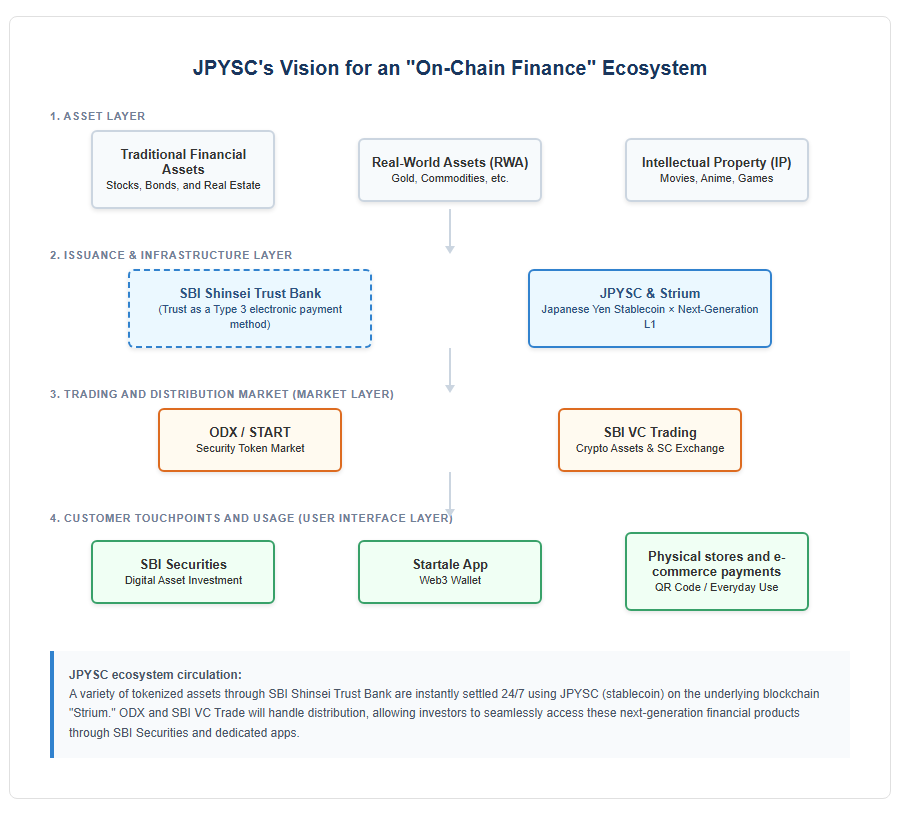
SBI Group’s aim is to seamlessly connect the existing traditional financial system with the latest blockchain networks, establishing an internationally trusted “digital circle” infrastructure. The issued JPYSC is intended to address a wide range of use cases, including not only practical settlements but also asset tokenization and fund management. The “Blue Mark” logo symbolizes the role of connecting the solidity of traditional finance with the innovation of blockchain, expressing values such as “trust,” “stability,” “safety,” and “global connections.” Aiming for an official launch in the first quarter of fiscal year 2026, it is attracting attention as a major milestone in Japan’s digital finance sector. The diagram below shows the overall ecosystem that JPYSC aims for.
A legal scheme enabling unrestricted large payments
JPYSC’s greatest strength lies in the absence of transfer and retention limits found in stablecoins issued by money transfer operators. For example, JPYC, which was first issued domestically in October 2025, uses a fund transfer scheme, so there are regulatory restrictions limiting the single transfer amount to 1 million yen. In contrast, JPYSC, which adopts a trust-type scheme, does not apply this cap, enabling large-scale institutional trading, large corporate settlements, and even instant settlements of tokenized assets.
Specifically, it has the following three characteristics.
-
Regulatory design: As a trust-type Type 3 electronic payment method with high legal stability, it complies with relevant laws and financial regulations.
-
Enterprise payment features: optimized for large-scale fund management and cross-border payments (international remittances).
-
Global Interoperability: Crossing digital ecosystems, integrating traditional financial systems with diverse blockchain infrastructures.
In this way, JPYSC is expected to become a next-generation payment infrastructure that delivers overwhelmingly low fees and instant settlement (T+0) 24/7 compared to traditional bank transfers and credit card payments.
Background of Management and Strategy
The SBI Group’s Concept of “On-Chain” Assets
Looking ahead to its 30th anniversary in the fiscal year ending March 2029, the SBI Group is strongly promoting the “on-chain” transformation of its organization and assets as part of its digital asset strategy. Chairman and President Yoshitaka Kitao has asserted, “The token market is growing rapidly. We will bring all assets on-chain,” aiming to make all financial assets—including stocks, bonds, real estate, and intellectual property (IP)—manageable and tradable on the blockchain. Behind this strategy lie major benefits such as 24/7 operation, instant settlement, enabling small transactions, and dramatically improving the efficiency of middle and back office operations.
Of particular note are the following three major strategic goals.
-
Implementing organizational transformation toward on-chain adoption to deliver next-generation financial services ahead of the rest of the world.
-
Promoting the group’s full AI-driven transformation under rapid decision-making.
-
By integrating the financial ecosystem, digital space ecosystem, and neo-media ecosystem, we will dramatically expand our customer base.
Under this vision, SBI is transforming beyond being a mere securities company or bank into a world-leading “next-generation comprehensive asset platformer.” While U.S. companies like Robinhood and the New York Stock Exchange (NYSE) have announced their entry into tokenized equity, Japan is also accelerating the construction of a new financial ecosystem centered on stablecoins in line with legal progress.
Strong partnerships with Circle and Startail
Supporting the stablecoin strategy is strategic partnerships with leading domestic and international companies. SBI Group has entered into a comprehensive business partnership with Circle, the company that issues USDC, one of the world’s largest US dollar-denominated stablecoins. In March 2025, a basic agreement was reached to establish a joint venture company SBI Circle Holdings, and for Circle’s NYSE listing, Circle acquired shares worth $50 million as a strategic investor, deepening their relationship both in capital and operations. SBI VC Trade, a subsidiary, will be the first in the country to handle USDC in March 2025, providing domestic investors access to the digital US dollar.
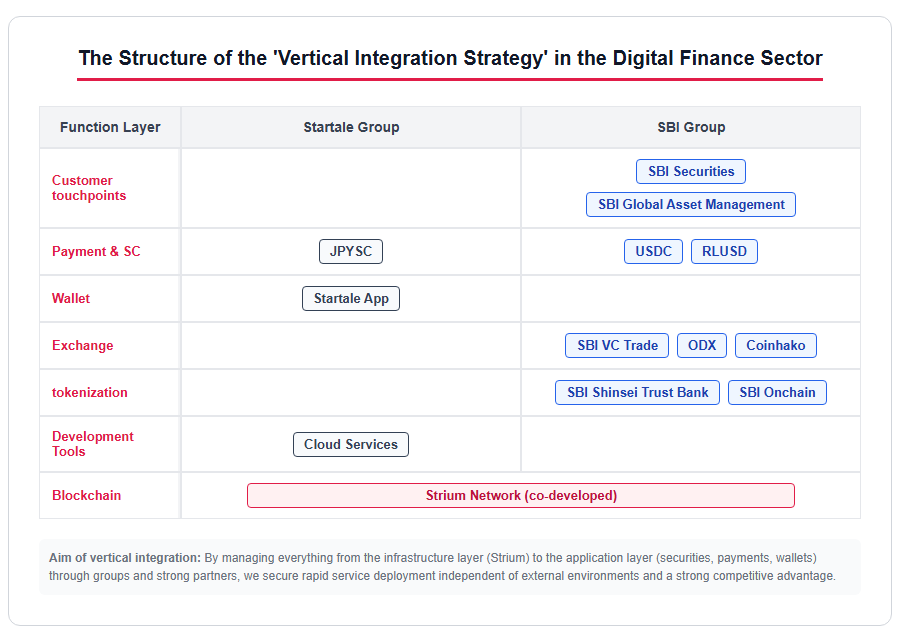
Additionally, with Startail Group, a core partner of JPYSC, a third-party allotment of shares of approximately 8 billion yen was conducted with SBI Group as the underwriter, making the company an equity-method affiliate. We invited Sota Watanabe, the representative of Startail, as an outside director of SBI Holdings, incorporating the company’s deep expertise into the group’s management. The two companies are not only developing stablecoins but also jointly developing their own layer-1 blockchain “Strium Network (Strium),” specialized for trading all financial assets, adopting a vertically integrated strategy that seamlessly covers everything from infrastructure to application layers. The diagram below shows the structure of the vertically integrated digital finance domain that SBI is building.
Future Developments and Highlights
Competition with Megabanks and the Transformation of B-Branch Payments
The issuance of JPYSC intensifies the battle for leadership of stablecoins in the domestic financial industry. Currently, the three major banks—Mitsubishi UFJ Bank, Sumitomo Mitsui Banking Corporation, and Mizuho Bank—are also considering joint issuance within fiscal 2026, but by taking the lead in issuing a “trust-type” model, the competitive landscape has become clearer. In particular, as the SBI Group promotes its ‘Fourth Mega Bank Initiative’ to deepen partnerships with regional banks, stablecoins are becoming a powerful tool for supporting DX for regional financial institutions and improving the efficiency of business-to-business payments.
The widespread adoption of stablecoins could fundamentally disrupt the existing business-to-business payment structure, which relies on bank transfers. According to a report by NTT Data Management Research Institute, stablecoins enable settlements to be directly integrated into a series of business processes such as billing, payment, accounting, and auditing, rather than just moving funds. This will bring about the following transformations.
-
Simultaneous execution of fund transfers and asset handovers (DvP settlements).
-
Significant compression of exchange rate spreads and intermediary margins.
-
Cash flow optimization with instant liquidation 24/7, 365 days a year.
Financial institutions unable to adapt to these transformations may face risks of losing deposits and customer bases, and SBI’s issuance of JPYSC serves as a powerful stimulus for digitalization across the industry.
Global Payment Infrastructure and Progress of the ‘Second SBI Initiative’
The SBI Group is accelerating the establishment of a global stablecoin payment system based not only in Japan but also in Singapore. This is called the “Second SBI Initiative,” positioning it as a strategic hub for the early deployment of next-generation financial services, taking into account differences in regulatory environments between countries. Specifically, through joining the group of the digital asset exchange “Coinhako,” which holds a local license, and through joint ventures with “DigiFT,” which holds licenses from the Monetary Authority of Singapore, the company aims to issue RWA (real-world asset) tokens and build global payment infrastructure.
Additionally, collaboration within the group, starting with JPYSC, will be strengthened. Among the three companies—SBI Shinsei Bank, SBI Securities, and SBI VC Trade—the development of a ‘Triangle Scheme’ is underway to enable rapid financial product transactions using stablecoins. Users will be able to earn interest by lending their JPYSC to SBI, and in the future, they will also be able to use everyday payments at stores using QR codes.
-
Rapid asset management 24/7, 365 days a year.
-
Purchase of RWA tokens such as physical gold (gold).
-
A demonstration experiment of in-store payments such as USDC targeting inbound customers.
In this way, the SBI Group is accelerating the completion of a world-leading on-chain financial ecosystem by integrating the exchange (ODX), the underlying blockchain (Strium), and the global payment network, centered around the “currency” JPYSC.
[#SBI #ステーブルコイン #JPYSC #ブロックチェーン #フィンテック #デジタル円 #Web3 #暗号資産]
」_en.png)
コメント