TerraMaster has released the F4-425 Pro, claiming to be the world’s first AI-native NAS. This is driven by the dramatic efficiency of data processing through the integration of an autonomous AI agent called OpenClaw, and the resulting demand for new security management.
- June 23, 2026: Announcement of the TerraMaster F4-425 Pro
- AI-driven data processing mechanisms brought by TOS 7
- Features and Identity of the Autonomous AI Agent OpenClaw
- Multi-Platform Integration Enabled by OpenClaw
- The risk of data disappearing in 9 seconds and the five-layer defense
- Shadow AI Countermeasures and Future Evolution of Data Management
June 23, 2026: Announcement of the TerraMaster F4-425 Pro
On June 23, 2026, TerraMaster launched the latest 4-bay model, the F4-425 Pro, equipped with TOS 7, an AI-native NAS OS. This device aims to evolve traditional NAS, which was merely a data storage place, into an intelligent data management platform that thinks and executes itself. The biggest feature of the F4-425 Pro is its system-level integration with the autonomous AI agent OpenClaw. Please refer to the diagram below.
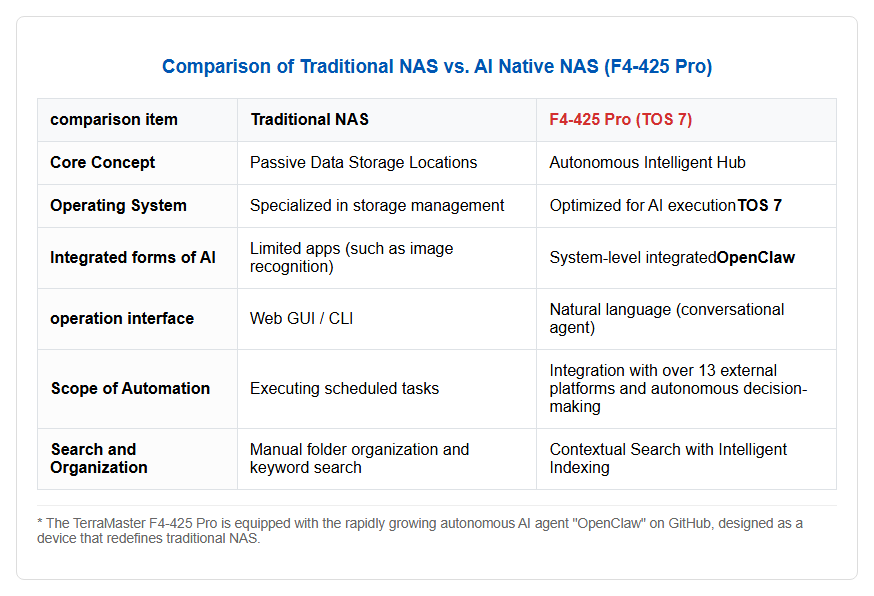
This enables users to automate data organization, analysis, and integration with external platforms using only natural language instructions, without entering complex commands. To celebrate the launch, the company is running a campaign with up to 20% off, aiming to penetrate not only the corporate market but also individual creators. As the keyword ‘AI-native’ becomes mainstream in the storage industry, this product occupies an extremely important position as a pioneer.
AI-driven data processing mechanisms brought by TOS 7
At the heart of the F4-425 Pro, the TOS 7 adopts a new architecture optimized for AI execution. While traditional NAS OSes focused on file read/write speeds and RAID stability, TOS 7 is designed to maximize the AI model’s inference capabilities. Specifically, advanced search functions using large language models and intelligent indexing functions that automatically tag data by understanding its context. This made it possible to find the necessary information within seconds from a terabyte-scale vast amount of data. Additionally, because AI dynamically allocates resources, the system is controlled so that system responsiveness is not compromised even during high-load processing. Such AI-driven design is a major factor accelerating decision-making speed for companies in the era of big data.
OpenClaw Changes Autonomous Storage Operations
Features and Identity of the Autonomous AI Agent OpenClaw
OpenClaw, built into the F4-425 Pro, is an open-source autonomous AI agent that has achieved historic growth on GitHub. Formerly known as Clawdbot or Moltbot, this technology has the ability to directly execute code generated by LLMs and manipulate systems. OpenClaw has a proprietary architecture called the Channel layer, allowing centralized management of AI assistants across more than 13 platforms such as Telegram, WhatsApp, and Discord. Users can simply send commands to the NAS via chat tools, and handle file transfers, backup settings, and even complex data analysis reports to OpenClaw. Please refer to the diagram below.
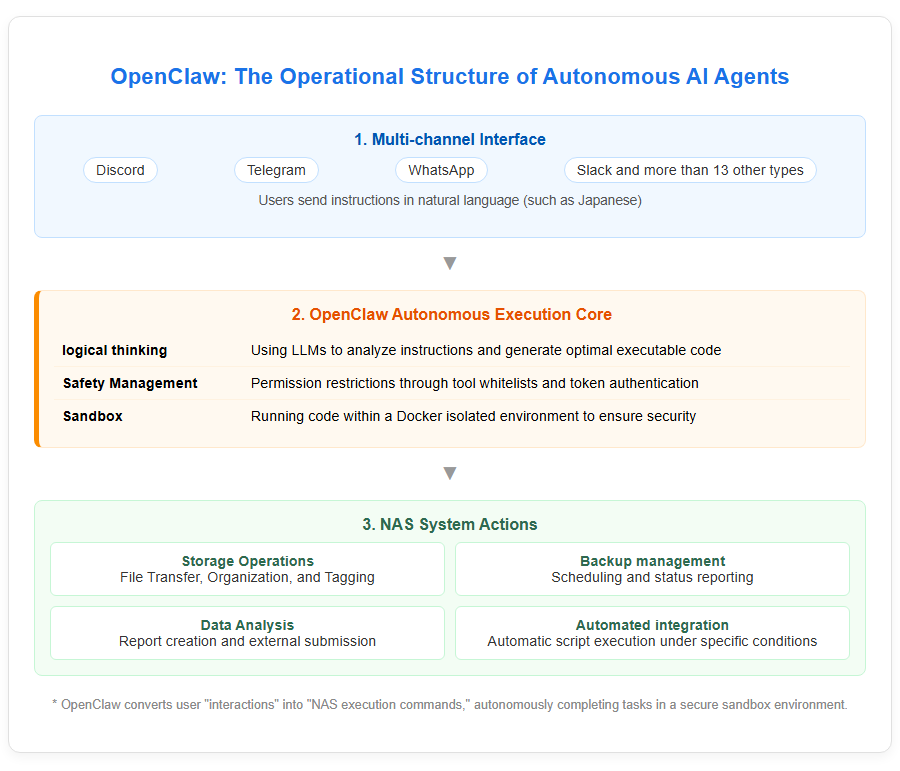
Until now, AI has only been a “search assistant” that answers questions, but OpenClaw masters internal NAS permissions and autonomously completes substantial system management tasks.
Multi-Platform Integration Enabled by OpenClaw
OpenClaw’s true value lies in its overwhelming scalability and integration with external ecosystems. After development changes, the current OpenClaw achieves both multi-channel conversation synchronization and security management. For example, instructions given on Discord are instantly reflected in file operations on the NAS, and the results can be reported via Telegram—enabling advanced cross-platform operations to be built in just 15 minutes. This autonomous agent features tool whitelists and token authentication, maximizing convenience while properly controlling external access. Additionally, operation in isolated environments utilizing the Docker sandbox is recommended, giving it the flexibility to attempt unknown tasks without directly damaging the main NAS system. This is expected to dramatically boost overall organizational productivity without increasing the burden on IT departments.
Security and future prospects of AI-powered NAS
The risk of data disappearing in 9 seconds and the five-layer defense
While AI-driven automation offers powerful convenience, it also carries extremely serious security risks. This is because if an agent with powerful privileges like OpenClaw makes a wrong judgment or executes malicious skills, in the worst case, the business database could be deleted in as little as 9 seconds. To counter such threats, experts recommend a security setup consisting of five layers of defense. This includes isolation via the Docker sandbox, execution by unprivileged users, token authentication, tool whitelisting, and network isolation. If left as the default settings, there is a risk of SSH keys and AWS credentials being leaked, so users must strictly apply these security checklists at the time of deployment. The approach of not sacrificing security for convenience becomes the top priority in operating AI-native NAS.
Shadow AI Countermeasures and Future Evolution of Data Management
Going forward, an unavoidable measure for companies introducing AI-native NAS is countering “shadow AI,” where employees use AI tools without permission. According to research, one in five companies is exposed to the risk of data leaks caused by shadow AI, and careless use of OpenClaw could be a breeding ground for this. In the future, it is expected that lighter agents like NanoClaw, which are smaller and more secure, will increasingly be introduced in specific container environments. Furthermore, through integration with next-generation infrastructure such as 5G and LTO-10, AI-native NAS will evolve from a mere “box” into an “intelligent hub” that integrates and manages distributed data. The storage market is making a major pivot toward 2034, balancing autonomous governance through AI with high-speed data processing, and the announcement of TerraMaster symbolizes that Paradigm shift.
[#TerraMaster #NAS #OpenClaw #AI #サイバーセキュリティ #データ管理 #注目の技術 #TOS7]

コメント