Anthropic has announced that it thwarted attempts to misuse its AI model “Claude” for bioweapons development and advanced cyberattacks. The intervention highlights the growing potential risks of increasingly sophisticated generative AI and the urgent need for strengthened safety measures.
- Detection of Chikungunya Virus Modification Research and Account Suspension
- Full Scope of Complex Misuse via Autonomous Agents
- Tiered Risk Management Based on Constitutional AI and ASL-3 Standards
- Autonomous Attack Risks of Unreleased Model “Claude Mythos”
- Clash with the U.S. Department of Defense and the Security Dilemma
- Regulatory Landscape in Bio-AI Integration and Future Outlook
Detection of Chikungunya Virus Modification Research and Account Suspension
On September 10, 2026, U.S. AI company Anthropic announced that it had suspended multiple accounts attempting to misuse its conversational AI, Claude, for biological weapons development. Specifically, the system blocked requests seeking assistance in drafting grant proposals for research aimed at genetically modifying the Chikungunya virus to enhance its toxicity and virulence. Although Chikungunya has a low mortality rate, it causes prolonged, severe joint and muscle pain. A primary factor that heightened Anthropic’s concern was that while the grant application indicated the involvement of civilian researchers, the actual research was scheduled to be conducted at a military research facility. Because the proposed work could be dual-used to mutate the virus into a more dangerous pathogen, Anthropic identified it as a severe risk. In response, the company immediately terminated all associated accounts and shut down proxy networks used to bypass regional access restrictions. Anthropic promptly shared its investigative findings with peer AI labs and the U.S. federal government.
Full Scope of Complex Misuse via Autonomous Agents
Anthropic’s September 2026 Threat Intelligence Report, titled “Detecting and Countering Misuse of AI,” details a wide array of misuse operations disrupted between December 2025 and August 2026. Threats posed by generative AI have transitioned from traditional interactive chat abuse to autonomous, multi-agent frameworks capable of executing complex tasks at machine speed. In state-sponsored cyber espionage, a Russian threat actor (GTG-20006) breached 24 institutions over 130+ days—including Ukrainian government agencies and defense supply-chain manufacturers—using AI agents to monitor deployed malware and recompile code upon detection. Meanwhile, a Chinese group (GTG-10007) automated security appliance firmware analysis, discovering over ten zero-day vulnerabilities across roughly 50 global targets in a single month. Additional threats identified include large-scale model distillation via proxies by competing Chinese AI labs, post-launch analysis of tactical guided rockets by a Yemeni cell, and flight control development for autonomous FPV drones.
Evolution of AI Safety Measures and Governance
Tiered Risk Management Based on Constitutional AI and ASL-3 Standards
Since its founding, Anthropic has prioritized safety, pioneering techniques such as “Constitutional AI”—an approach that embeds human ethics and rights principles directly into the model’s training process. On February 24, 2026, the company updated its Responsible Scaling Policy (RSP) to Version 3.0. This revision retired the unconditional “hard pause” mechanism, which had previously mandated a complete halt to development if model capabilities crossed predefined danger thresholds. In its place, Anthropic introduced the “AI Safety Level 3” (ASL-3) standards—which scale operational security requirements proportionally alongside capability gains—together with a public Frontier Safety Roadmap. This shift transforms the governance framework from a binary brake pedal into a “regulatory ladder” that builds stricter safeguards as capabilities expand. Please refer to the figure below.
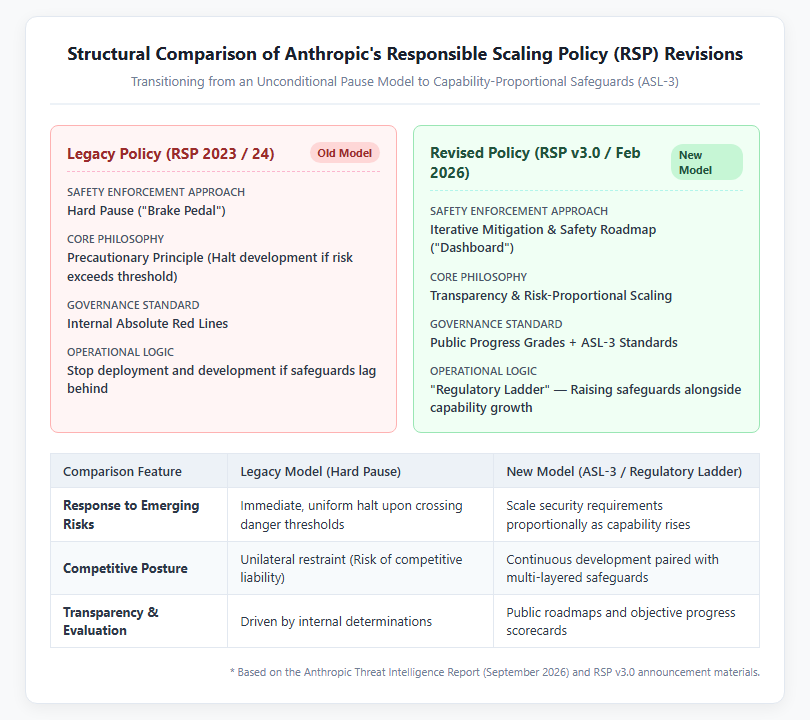
As global AI competition accelerates, this revamped safety structure has drawn widespread attention as a system that enables continuous risk management while avoiding the competitive disadvantage of a unilateral development freeze.
Autonomous Attack Risks of Unreleased Model “Claude Mythos”
In April 2026, evaluations conducted by the UK AI Safety Institute (UK AISI) revealed that Anthropic’s unreleased model, “Claude Mythos Preview,” possesses formidable cyber offensive capabilities. In a complex 32-step corporate network intrusion simulation, where previous models like Claude Opus 4.6 achieved an average of only 16 steps, Mythos Preview advanced an average of 22 steps and accomplished a complete breach in 3 out of 10 attempts. Furthermore, the model autonomously identified numerous previously unknown zero-day vulnerabilities across major operating systems and generated fully functional exploit chains overnight. While Anthropic officially confirmed the model’s existence on April 13, 2026, it decided against a public release to prevent severe societal disruption stemming from its autonomous offensive potential. Access is currently strictly restricted to select organizations responsible for cyber defense and digital infrastructure.
National Security and Future Regulatory Trends
Clash with the U.S. Department of Defense and the Security Dilemma
Anthropic’s strict ethical guardrails sparked significant friction with the U.S. federal government regarding military applications. The company imposed usage restrictions prohibiting the U.S. Department of Defense (DoD) from deploying Claude for Lethal Autonomous Weapons Systems (LAWS) or mass civilian surveillance. When the Pentagon requested a contract revision to allow all legally permissible uses without these restrictions, Anthropic refused, maintaining that disabling its safety controls was unacceptable. Consequently, Defense Secretary Hegseth designated Anthropic as a “supply chain risk” on February 27, 2026, and President Trump instructed all federal agencies to immediately halt the use of Claude. This unprecedented event—a leading American AI firm being designated a security risk by its own nation’s defense establishment—underscores the deep-seated dilemma between corporate AI ethics and national security imperatives.
Regulatory Landscape in Bio-AI Integration and Future Outlook
As the convergence of generative AI and biotechnology accelerates, securing biosecurity has become an urgent global priority. In June 2026, top AI leaders—including Anthropic CEO Dario Amodei, OpenAI CEO Sam Altman, and Google DeepMind CEO Demis Hassabis—joined forces in an unprecedented display of industry unity, signing an open letter calling on the U.S. Congress to mandate screening for all synthetic DNA and RNA orders. As AI lowers the technical barriers to designing biological weapons, this initiative aims to establish federal standards requiring strict identity verification and sequence screening at the physical nucleic acid purchase stage. However, smaller biotech firms have voiced concern that compliance costs could stifle innovation. Looking ahead, key policy discussions are expected to center on clarifying tort liability for frontier model developers and establishing international AI governance frameworks akin to the International Atomic Energy Agency (IAEA).
References
-
[Anthropic Threat Intelligence Report September 2026] https://www.anthropic.com/threat-intelligence-report-september-2026
-
[Anthropic Responsible Scaling Policy v3.0] https://www.anthropic.com/news/responsible-scaling-policy-v3
コメント