The Ministry of Land, Infrastructure, Transport and Tourism (MLIT) has finalized plans to significantly strengthen torrential rain disaster countermeasures in its FY2027 budget request, incorporating new initiatives to reinforce critical river infrastructure and safeguard regional industries. This move comes in response to the growing necessity for proactive disaster prevention amid increasingly severe water disasters driven by climate change and the rapid aging of public infrastructure.
- Enhancing Critical Infrastructure Functions and Expanding Budget Allocations
- Transitioning from Supplementary Budgets to the “Strong and Prosperous Japan” Investment Framework
- Reinforcing Critical River Structures and Supporting Next-Gen Sewerage Technologies
- Landslide Mitigation for Local Industry Preservation and Extending Emergency Response Periods
- Lessons from the 2018 Heavy Rain Event and Risks Posed by Aging Infrastructure
- Potential Budget Additions via Unspecified Requests and the Upcoming Timeline
Enhancing Critical Infrastructure Functions and Expanding Budget Allocations
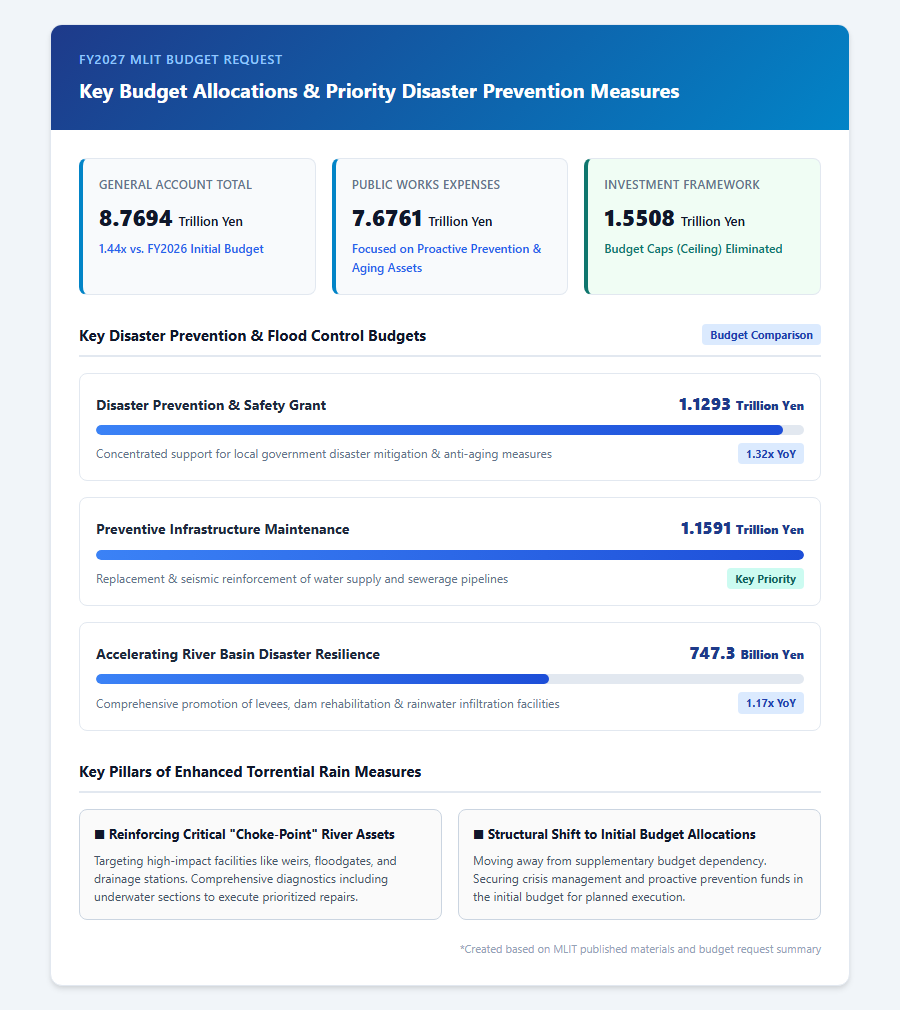
On August 27, 2026, the Ministry of Land, Infrastructure, Transport and Tourism (MLIT) released an overview of its budget request for fiscal year 2027 (FY2027 / Reiwa 9). The general account request reached a total of 8.7694 trillion yen, representing a 1.44-fold increase compared to the initial budget for FY2026—making it the largest budget request on record. Of this amount, public works expenses account for 7.6761 trillion yen, with the core pillar focused on strengthening responses to torrential rain and landslide disasters, which have become increasingly severe and frequent due to climate change.
In this budget request, a new program was established to prevent the loss of function in critical river facilities where replacement or recovery would be extremely difficult if damaged during severe rainstorms. Specifically, the initiative identifies vulnerable “choke-point” river infrastructure—such as aging weirs, floodgates, and drainage pumping stations—and conducts comprehensive diagnostics, including submerged or difficult-to-inspect sections, before systematically executing prioritized countermeasures. Additionally, 747.3 billion yen (a 1.17-fold increase year-on-year) was allocated toward accelerating and deepening “River Basin Disaster Resilience and Sustainability” initiatives aimed at reducing flood risks across entire river basins. This includes comprehensive efforts such as levee construction, dam rehabilitation, and the installation of rainwater storage and infiltration facilities. Please also refer to the illustration below.
In the sewerage sector, efforts to maintain facility functions and prevent secondary disasters have been expanded substantially, including the creation of a new subsidy program for private enterprises that adopt advanced disaster prevention technologies for inspections and surveys.
Transitioning from Supplementary Budgets to the “Strong and Prosperous Japan” Investment Framework
A key feature of this budget request is the shift away from reliance on supplementary budgets toward a fundamental overhaul of the expenditure structure. In line with government policy, recurring expenses for crisis management and infrastructure development, which were previously funded through mid-year supplementary budgets, are now requested in advance as part of the initial budget.
Furthermore, the 20% cap on increases over the previous year’s budget (budget ceiling) was eliminated, and the “Strong and Prosperous Japan” Investment Framework was established, allowing necessary measures to be proposed without capped limits. MLIT utilized this investment framework to request 1.5508 trillion yen, focusing allocations on proactive disaster prevention, aging infrastructure countermeasures, and growth investment areas.
The Disaster Prevention and Safety Grant, which provides concentrated support for local government disaster prevention, mitigation, and anti-aging measures, was allocated 1.1293 trillion yen—a 1.32-fold increase over the previous fiscal year. In addition, 1.1591 trillion yen was designated for preventive maintenance of infrastructure, promoting the replacement and earthquake resistance of water supply and sewerage pipelines.
Amid ongoing surges in material prices and labor unit costs, the government’s stance clearly emphasizes securing sufficient financial resources at the initial budget stage to ensure planned and sustainable execution of public works projects.
Specific Countermeasures and New Initiatives for Intensifying Storm and Flood Hazards
Reinforcing Critical River Structures and Supporting Next-Gen Sewerage Technologies
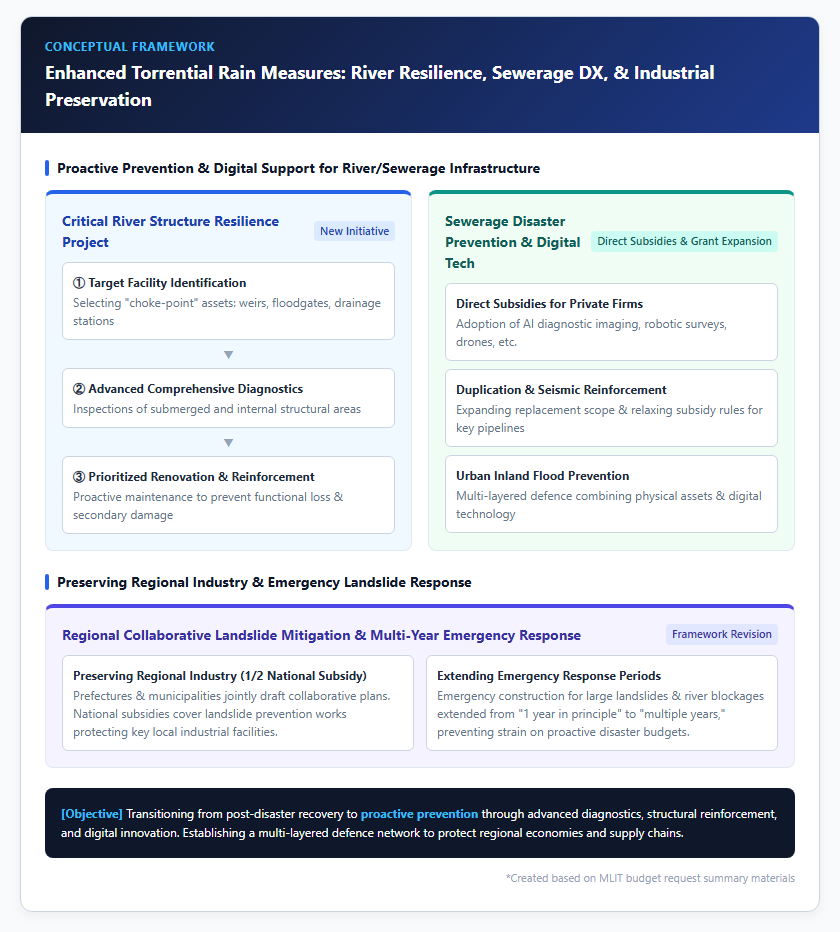
Under the newly established “Critical River Structure Resilience Project”—a key component of the enhanced torrential rain measures—strategic facilities that dictate regional safety during flood events will be reinforced on a priority basis. Because river weirs, floodgates, and drainage pumping stations risk causing widespread inundation if they fail, advanced comprehensive diagnostics covering underwater and internal structural areas will be conducted beyond conventional visual inspections. Based on these diagnostic findings, intensive renovation and reinforcement work will be carried out starting with facilities identified as highest priority.
In the sewerage sector, reflecting the lessons of the 2026 Kumamoto Earthquake and the principles of the revised Sewerage Act, support measures will be introduced for adopting new technologies that contribute to disaster prevention and mitigation. A mechanism will be put in place for the national government to provide direct subsidies to private companies introducing new technologies, such as diagnostic imaging for early detection of pipe cracks and deterioration, robotic inspection systems, and drone utilization.
Concurrently, the grant system will be expanded by promoting the duplication of critical pipelines, broadening the scope of pipe replacement candidates, and relaxing subsidy eligibility requirements for seismic reinforcement works. As the risk of urban inland flooding escalates, the goal is to construct a multi-layered disaster prevention network that combines physical infrastructure development with soft measures like digital technologies. Please refer to the figure below for an overview.
Landslide Mitigation for Local Industry Preservation and Extending Emergency Response Periods
In the field of landslide disaster mitigation, a new framework is being established that extends beyond protecting residential homes and public facilities to safeguarding industrial facilities that support regional economies and employment. Under the proposed “Regional Collaborative Landslide Countermeasure Plan” (tentative name), formulated jointly by prefectures and municipalities, the national government will subsidize in principle up to one-half of facility construction costs when landslide prevention works are carried out around key industrial facilities designated in government regional future strategies. This measure aims to prevent corporate operational shutdowns and supply chain disruptions caused by large-scale landslides.
Additionally, the subsidy framework for emergency response work in disaster-stricken areas experiencing large-scale landslides or river channel blockages will be revised. Previously, the eligible period for emergency response measures was generally capped at one year; projects uncompleted within a year had to be transferred to general public works budgets, putting pressure on proactive disaster prevention funding.
Under the new system, the application period for emergency measures can be extended across multiple years for locations with high public necessity, such as areas along arterial roads. This policy adjustment enables stable and continuous emergency construction work aimed at preventing secondary disasters.
Climate Change Risks and Key Factors for Upcoming Budget Approval
Lessons from the 2018 Heavy Rain Event and Risks Posed by Aging Infrastructure
Driving MLIT’s urgency in accelerating torrential rain disaster measures are recent shifts in precipitation patterns caused by climate change and lessons learned from past catastrophic flood events. During the July 2018 Heavy Rain Event in Western Japan, linear precipitation zones formed 68 times, resulting in unprecedented devastation with 304 fatalities, primarily in the Chugoku and Shikoku regions. During this disaster, widespread flooding from river breaches and simultaneous landslides occurred in numerous locations, creating major obstacles to evacuation and rescue efforts due to infrastructure paralysis.
In recent years, “guerrilla rainstorms” delivering intense rainfall over localized areas in short durations and concentrated heavy rains exceeding 75 to 100 mm per hour have become increasingly routine, repeatedly exceeding the designed capacity of conventional drainage systems and flood control facilities. Furthermore, social infrastructure built during Japan’s period of high economic growth—including roads, bridges, levees, water supply, and sewerage systems—is aging simultaneously, elevating the risk of functional failure.
Because post-disaster recovery alone cannot prevent damage from expanding, the concepts of “proactive disaster prevention” (reinforcing structural vulnerabilities before disasters strike) and “pre-disaster reconstruction planning” (preparing for rapid recovery) have become indispensable.
Potential Budget Additions via Unspecified Requests and the Upcoming Timeline
The process leading to the enactment of the FY2027 budget proposal is entering a period of full-scale deliberations. Following the announcement of the budget request outline on August 27, 2026, and the end-of-August submission deadline, assessment and negotiations with the Ministry of Finance will take place between September and November. Subsequently, the government budget draft is expected to be approved by the Cabinet around December 2026, undergo deliberations in the ordinary session of the Diet opening in January 2027, and achieve final passage by the end of March 2027.
A noteworthy aspect of this budget request is the inclusion of numerous “unspecified requests” (item requests without specified dollar amounts). These include second-year project expenses under the 1st Medium-Term Plan for National Resilience, cost increases due to rising labor and material prices, and infrastructure development costs for establishing strategic industrial clusters.
Considering that 1.2346 trillion yen in national funds was allocated in the FY2025 supplementary budget for the first year of national resilience, a similar or larger amount is likely to be added during the year-end budget formulation process. This makes it highly probable that the final total for public works expenses will expand further beyond 8.7694 trillion yen. Local governments and the construction industry are closely monitoring these upcoming budget determinations.
Reference Pages
- [MLIT Overview of FY2027 Budget Request] https://www.mlit.go.jp/page/kanbo05_hy_003926.html
- [MLIT Disaster and Disaster Prevention Information] https://www.mlit.go.jp/saigai/
【#MLIT #BudgetRequest #TorrentialRainCountermeasures #DisasterPreventionAndMitigation #NationalResilience #ProactiveDisasterPrevention】


コメント