Preliminary figures for the US University of Michigan Consumer Sentiment Index for September 2026 dropped to 47.8, falling significantly short of market expectations of 51.0. This sharp decline stems from growing pressure on household budgets caused by a rebound in fuel prices following the Iran conflict and heightened trade tensions.
- September Michigan Index Preliminary Release and the Full Scope of the Decline
- Resurgence of Inflation Expectations and Squeezed Purchasing Power
- Retrenchment Across Income Groups and Shifts in Corporate Data
- Impact on Financial Markets and Federal Reserve Rate Outlook
- Labor Market Deceleration and Heightened Uncertainty
- Future Economic Scenarios and Key Watch Indicators
September Michigan Index Preliminary Release and the Full Scope of the Decline
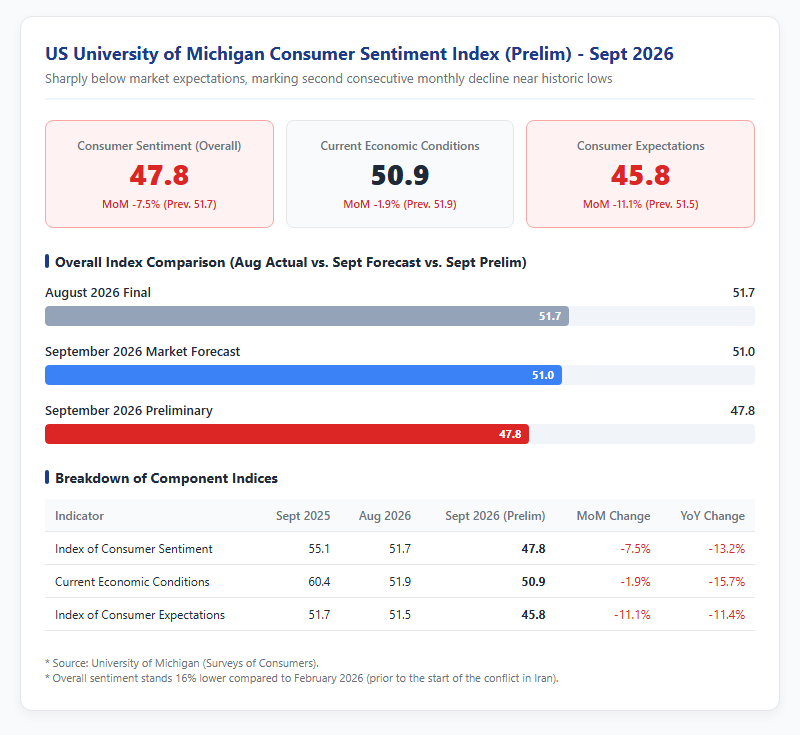
The preliminary release of the University of Michigan Consumer Sentiment Index for early September 2026 dropped sharply to 47.8 from 51.7 in the previous month. Falling 3.2 points below market expectations of 51.0, this marks the second consecutive month of decline. This figure matches the historical low recorded in May 2026, highlighting extreme weakness in consumer sentiment. Looking closer at the components, the Current Economic Conditions Index decreased by 1.9% from 51.9 to 50.9, while the Index of Consumer Expectations plunged 11.1% from 51.5 to 45.8. Compared to February 2026, before the escalation of the conflict in Iran, overall sentiment is down by 16%, and it stands 13.2% lower than the same period last year. Please refer to the following diagram.
This steep drop spans political affiliations, with substantial declines observed among both Democratic and Republican voters. While sentiment among independent voters remained largely flat compared to the previous month, expectations for personal finances and business conditions over the coming year have cooled rapidly. The deterioration is particularly pronounced among older adults, lower- to middle-income households, and those without stock holdings, as rising costs for daily necessities weigh directly on family budgets.
Resurgence of Inflation Expectations and Squeezed Purchasing Power
The primary driver behind deteriorating consumer sentiment is intense anxiety over renewed price pressures. According to the preliminary September data, year-ahead inflation expectations jumped 0.6 percentage points from 4.0% to 4.6%, reaching the highest level since June 2026. This reading substantially exceeds the 3.4% recorded in February 2026 prior to the Iran conflict, as well as levels seen throughout 2024. Long-run 5-year inflation expectations also edged up to 3.4% after holding steady at 3.3% for three consecutive months.
This resurgence in inflation expectations is anchored in a sharp rebound in gasoline and fuel prices, alongside escalating international trade tensions. Retail pump prices turned upward again after August 2026, placing direct strain on daily household management. In fact, only about 8% of consumers currently expect their income to grow faster than inflation, representing a steep drop from 18% in December 2024. As growth in real disposable income remains sluggish while prices for everyday staples like groceries and energy remain elevated, consumers harbour deep concerns about maintaining their future purchasing power.
Spillovers to Consumer Spending and Corporate Performance
Retrenchment Across Income Groups and Shifts in Corporate Data
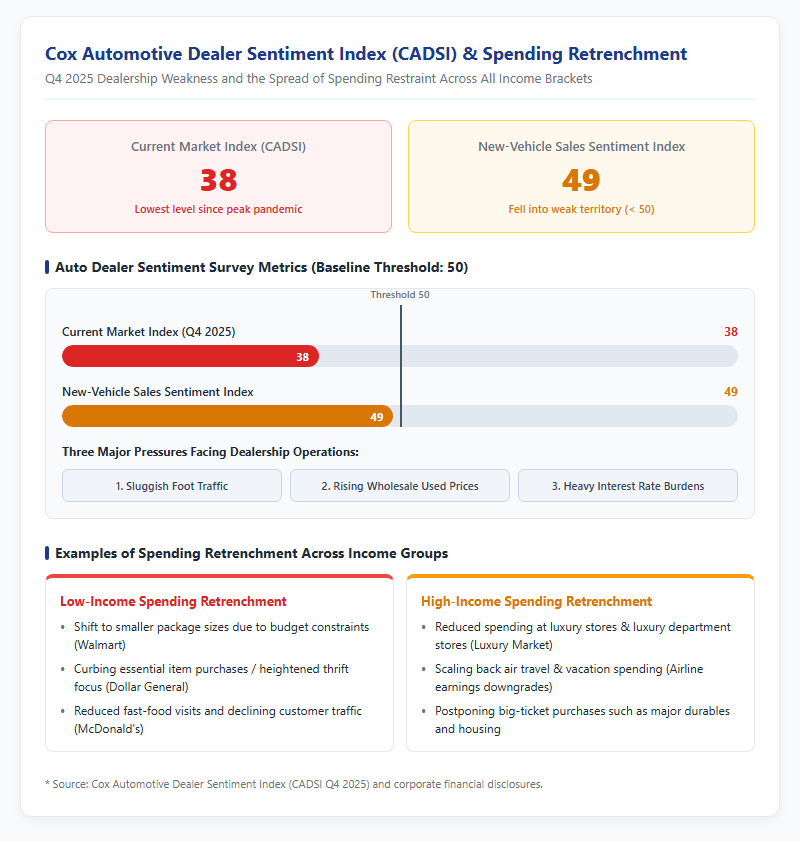
The drop in consumer sentiment is already casting a clear shadow on actual purchasing behavior and corporate business data. At retail giants such as Walmart and Dollar General, low-income customers are choosing smaller package sizes due to budget constraints or curbing purchases of essential grocery items altogether. Major fast-food chains including McDonald’s have also reported declining foot traffic and sales among lower-income consumers. This pullback is no longer confined to lower-income brackets; it is extending to higher-income shoppers who are curbing spending at luxury department stores and scaling back air travel, exerting downward pressure on overall spending for travel and durable goods.
The Cox Automotive Dealer Sentiment Index (CADSI), which measures sentiment among auto dealers, also saw its current market index plunge to 38 in Q4 2025, reaching its lowest level since the peak of the pandemic. The new-vehicle sales sentiment index dropped to 49, falling into negative territory as sluggish foot traffic, rising wholesale prices for used vehicles, and heavy interest rate burdens weigh on dealership operations. Please refer to the following diagram.
Faced with escalating living costs, consumers are increasingly postponing big-ticket purchases such as major durables and housing.
Impact on Financial Markets and Federal Reserve Rate Outlook
The jump in 1-year inflation expectations to 4.6% in the University of Michigan survey has major implications for Federal Reserve policy decisions. Coupled with the August Consumer Price Index (CPI) report released on the same day—which showed core CPI rising 0.3% month-over-month, exceeding expectations—concerns have intensified that higher energy costs are spilling into underlying inflation. Consequently, market probabilities derived from CME FedWatch for a 25 basis point rate hike at the September 16 FOMC meeting surged from 85% to nearly 90%.
In bond markets, the US 10-year Treasury yield rose to 4.974%, nearing the 5% threshold, while WTI crude oil futures continue to trade above \$100 per barrel. Under normal circumstances, rising rate hike expectations and elevated long-term yields would hit equity valuations directly; however, stock markets have fluctuated sideways as investors weigh whether corporate earnings can absorb the burden. Nevertheless, a stagflationary environment marked by persistent inflation, elevated interest rates, and chilling consumer sentiment significantly elevates risks to corporate profit margins and stock market valuations.
Macroeconomic Challenges and Structural Risks
Labor Market Deceleration and Heightened Uncertainty
Underpinning the drop in consumer sentiment is a subtle shift and growing uncertainty in the US labor market, which had previously remained resilient. While the national unemployment rate remains historically low at around 4.1% to 4.3%, data indicating a slowdown in labor demand—such as declining job openings, lower hiring rates, and reduced quit rates—continues to accumulate. Furthermore, longer average job search durations and an increase in the population outside the labor force are making job hunting more difficult, fueling consumer anxiety.
Federal spending cuts, government workforce reduction plans, tighter immigration enforcement, and mass deportation policies are also casting a complex shadow over labor supply and employment conditions. Amid cost pressures from tariffs and uncertainty surrounding trade friction, businesses are adjusting labor expenses by freezing hiring or cutting hours. Added to these pressures are concerns over entry-level job displacement due to artificial intelligence (AI) adoption and automation, leading to a rapid deterioration in consumer expectations for future job security.
Future Economic Scenarios and Key Watch Indicators
Looking ahead, the most critical focus for the direction of the US economy is the Federal Reserve policy decision and updated dot plot (interest rate projections) at the FOMC meeting on September 15-16, 2026. How the Fed, led by Chair Kevin Warsh, interprets rising oil prices and surging inflation expectations—and whether it commits to a broader tightening cycle—will mark a pivotal turning point for markets. Whether a rate hike proves to be a single adjustment or the start of sustained tightening will heavily dictate household loan rates and corporate borrowing costs.
Additionally, the final release of the September Michigan Consumer Sentiment Index on September 25, as well as the August Personal Consumption Expenditures (PCE) price index and the Bureau of Economic Analysis (BEA) methodology revisions scheduled for September 30, will be critical moments. Market participants must carefully gauge the transmission mechanism: whether rising energy costs will pass through supply chains into product prices and corporate margins, or whether companies will absorb costs at the expense of profitability. Whether deteriorating household sentiment triggers a sharp deceleration in the real economy remains the central question going forward.
Reference Pages
- [Surveys of Consumers – University of Michigan] https://www.sca.isr.umich.edu/
[#MichiganConsumerSentiment #USEconomy #InflationExpectations #FederalReserve #ConsumerSpending #FinancialMarkets #Macroeconomics]


コメント