Anthropic has expanded its generative AI platform “Claude” with new specialized features for financial institutions, releasing ten pre-built AI agent templates designed to automate core workflows. This roll-out addresses urgent demands for greater operational efficiency in complex financial analysis while fulfilling a crucial need for safe, secure, and governed AI deployment across the financial sector.
- Key Highlights: Claude’s Financial Expansion and 10 Dedicated AI Agents
- Specialized Automation Capabilities Spanning Research, Client Coverage, and Operations
- Overhauling Analytical Infrastructure via External Data and Microsoft 365 Integrations
- Stock Market Reaction and Ripples Across Financial Terminals and the SaaS Industry
- Secure AI Implementation Initiatives by Major Japanese Financial Groups, NEC, and SBI
- Future Outlook and Key Considerations: Human Oversight and Governance Shaping the AI Era
Key Highlights: Claude’s Financial Expansion and 10 Dedicated AI Agents
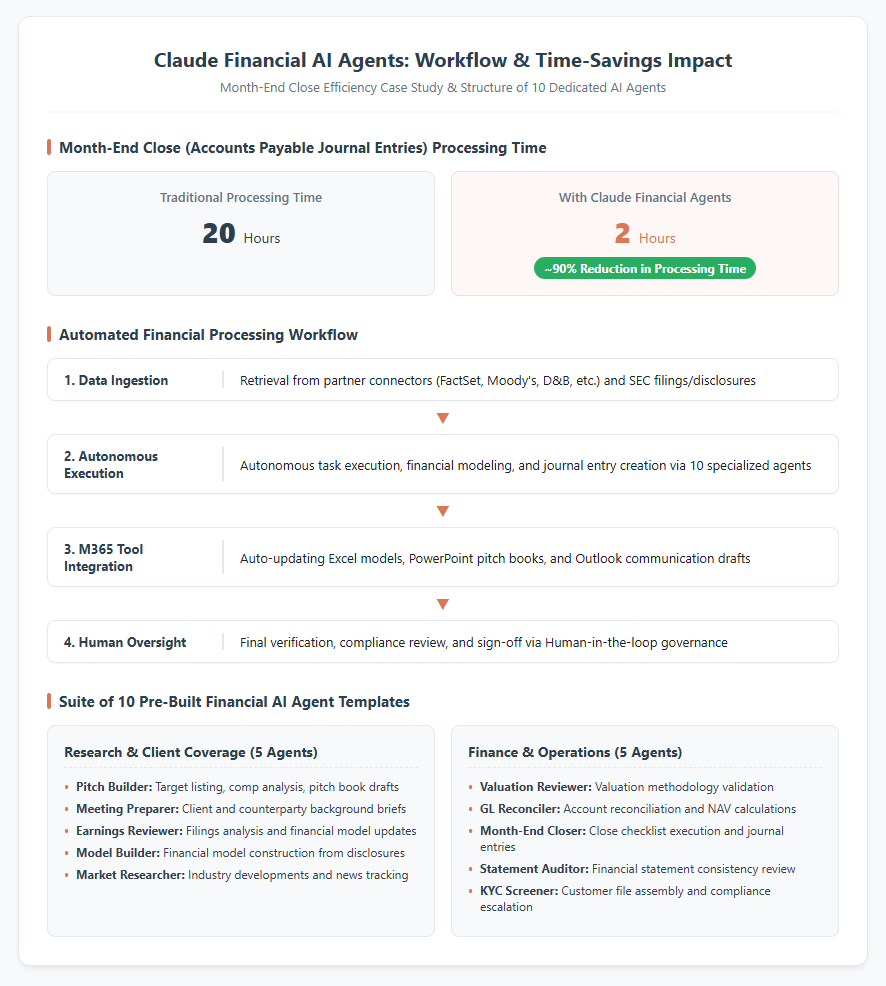
On May 5, 2026, Anthropic officially announced new financial capabilities and a suite of ten AI agent templates for its AI assistant, Claude, tailored for banks, asset managers, insurers, and fintech companies. Open-sourced on GitHub, these templates bundle domain-specific workflow definitions, governed data connectors, and interconnected sub-agents designed to automate sophisticated financial operations. Users can deploy them through desktop applications via Claude Cowork, developer tools via Claude Code plugins, or as Claude Managed Agents—which run autonomously in cloud environments to process overnight batches and long-running tasks. Furthermore, robust Microsoft 365 integrations launched on the same day, enabling seamless automated financial modeling and presentation creation directly inside Excel, PowerPoint, Word, and Outlook. This suite has drawn significant industry attention as a transformative technical foundation to dramatically alleviate routine analytical burdens for junior financial analysts.
Please refer to the diagram below illustrating the workflow of automated financial processing.
Specialized Automation Capabilities Spanning Research, Client Coverage, and Operations
The ten newly released agent templates fall into two main categories: research and client coverage, and finance and operations. The research and client coverage category includes the Pitch Builder for target listing and comparable company analysis, the Meeting Preparer for client background briefs, the Earnings Reviewer for analyzing filings and updating financial models, the Model Builder for constructing models from disclosures, and the Market Researcher for tracking industry trends and news. Meanwhile, the finance and operations category features the Valuation Reviewer for validating valuation methodologies, the General Ledger Reconciler for account reconciliation and NAV calculations, the Month-End Closer for executing close checklists and journal entries, the Statement Auditor for checking financial statement consistency, and the KYC Screener for compiling customer files and compliance escalations. For instance, in month-end close procedures, preparing accounts payable journal entries—which previously took 20 hours—was reduced to just 2 hours, demonstrating a remarkable 90% reduction in processing time.
Financial Data Integration, Ecosystem, and Market Impact
Overhauling Analytical Infrastructure via External Data and Microsoft 365 Integrations
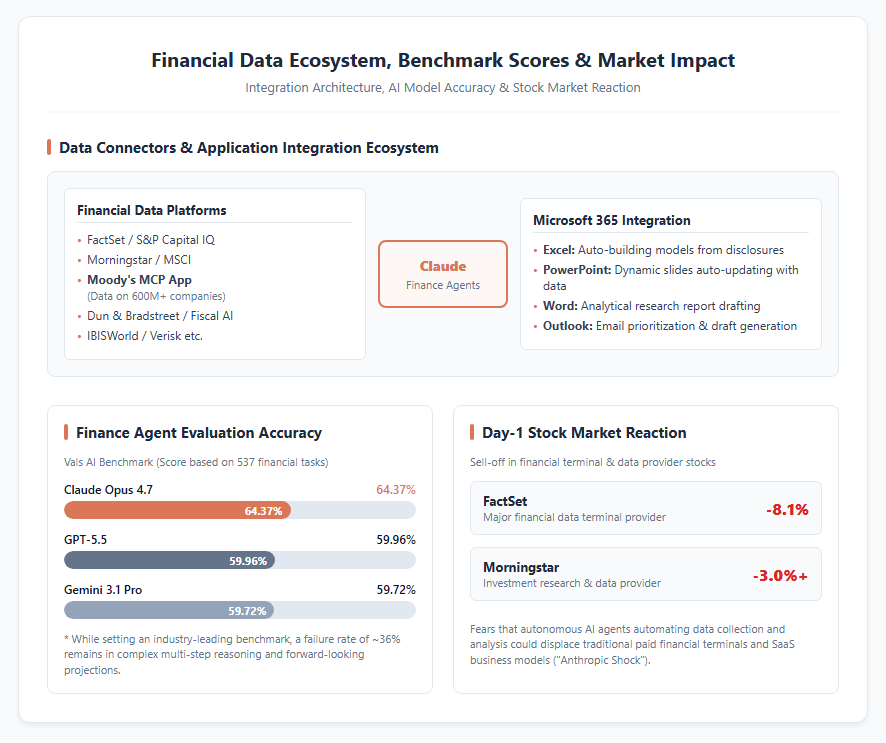
Alongside the expansion of financial features, Anthropic significantly enhanced direct integration capabilities with specialized financial data platforms. In addition to existing connections like FactSet, S&P Capital IQ, and Morningstar, new connectors were added for Dun & Bradstreet, Fiscal AI, and IBISWorld. Furthermore, Moody’s launched an MCP application granting Claude direct access to data covering over 600 million companies, establishing an infrastructure that streams comprehensive corporate and credit data directly into Claude. This eliminates the traditional, labor-intensive process where analysts manually extract data from financial terminals and copy it into spreadsheets. Moreover, seamless Microsoft 365 integration allows automated financial model construction from disclosures in Excel, while PowerPoint presentation charts and summary tables automatically update in real time whenever underlying reference numbers change, delivering substantial productivity gains through tool unification.
Please refer to the diagram below illustrating data integrations and the supporting ecosystem.
Stock Market Reaction and Ripples Across Financial Terminals and the SaaS Industry
The announcement had an immediate and major impact on stock prices for established financial data and software vendors. On the day of the release, shares of FactSet, a major financial data terminal provider, fell 8.1% in a single trading session in the US market, while Morningstar dropped over 3%. Markets reacted with concern—dubbed the “Anthropic Shock”—that autonomous AI agents capable of gathering and analyzing data could rapidly displace traditional high-cost financial terminals and existing Software-as-a-Service (SaaS) business models. On Vals AI’s Finance Agent benchmark, a financial industry evaluation metric, Claude Opus 4.7 achieved an industry-leading score of 64.37%, surpassing competing models such as GPT-5.5 at 59.96% and Gemini 3.1 Pro at 59.72%. However, given a failure rate of approximately 36% in complex multi-step reasoning and forward-looking projections, analysts note that the sharp drop in stock prices may be a short-term overreaction, presenting an opportunity for legacy SaaS firms to upgrade their services by integrating AI.
Co-Creation with Japanese Financial Institutions and Future Outlook
Secure AI Implementation Initiatives by Major Japanese Financial Groups, NEC, and SBI
AI transformation leveraging Anthropic’s state-of-the-art technology is also accelerating rapidly in the Japanese market. On June 2, 2026, SBI Holdings became the first financial group in Japan to partner with Anthropic to drive group-wide AI transformation across all officers and employees. Alongside Ridge-i and SBI Securities, SBI initiated early testing of Claude Security—a cutting-edge cybersecurity feature—and began developing customer-facing AI agents. Shortly after, on June 11, 2026, NEC, Anthropic, and eight major financial institutions—including MS&AD Insurance Group, Sumitomo Life, Daiwa Securities Group, Sumitomo Mitsui Trust, SMBC Group, and Meiji Yasuda Life—launched a cross-industry co-creation initiative. Furthermore, Japan’s three megabanks, led by MUFG Bank, are utilizing frontier AI to proactively identify vulnerabilities in their own systems and strengthen cyber defense capabilities, marking the full-scale commercial adoption of AI in Japan’s safety-critical financial sector.
Future Outlook and Key Considerations: Human Oversight and Governance Shaping the AI Era
While the adoption of AI agents in financial operations expands, the necessity for final human approval remains universal from legal, regulatory, and governance perspectives. Legal responsibilities—such as personal financial statement certifications by CEOs and CFOs under Sarbanes-Oxley Act (SOX) Sections 302 and 906, CPA signatures on audit opinion letters, and approvals for Suspicious Activity Reports (SARs) under the Bank Secrecy Act—cannot be delegated to AI and must reside with humans. With 70% of financial institutions and regulators citing model hallucinations and output unreliability as top risks, maintaining a “Human-in-the-loop” framework is essential: AI acts as a copilot for research and drafting, while humans perform final verification. Moving forward, the key factor for success in financial AI adoption lies in whether institutions can establish operational governance that minimizes errors in live environments while cleaning data models and re-architecting permission structures.
References
-
[Anthropic Official News: Agents for financial services] https://www.anthropic.com/news/finance-agents
-
[Anthropic GitHub Repository: financial-services] https://github.com/anthropics/financial-services
-
[NEC Press Release: NEC, Anthropic, and 8 Financial Institutions Collaborate] https://jpn.nec.com/press/202606/20260611_01.html
-
[SBI Holdings Press Release: Full-Scale AI Transformation in Partnership with Anthropic] https://www.sbigroup.co.jp/news/2026/0602_16373.html
[#FinancialAI #Anthropic #Claude #GenerativeAI #FinTech #AIAgents]
コメント