The 30,000-line codebase of “Nadeshiko 3,” a Japanese-based programming language, was ported and rebuilt in Go in virtually a single day using AI coding agents. This milestone was made possible by leveraging nine years of accumulated documentation alongside clear human specifications and rigorous verification processes.
- Porting 9-Year-Old “Nadeshiko 3” to Go: The Impact of an Instant Release
- From Bedside Brainstorming to Multi-Model Prompt Orchestration
- Zero Node.js Dependency: Single Portable Executables and Simplified Distribution
- Dramatic Execution Speedups and Embedded SQLite Capabilities
- Turning Legacy Documentation into AI Context to Unearth Hidden Bugs
- The Limitations of AI-Generated Code: Why Human Architecture and Quality Assurance Matter Most
Porting 9-Year-Old “Nadeshiko 3” to Go: The Impact of an Instant Release
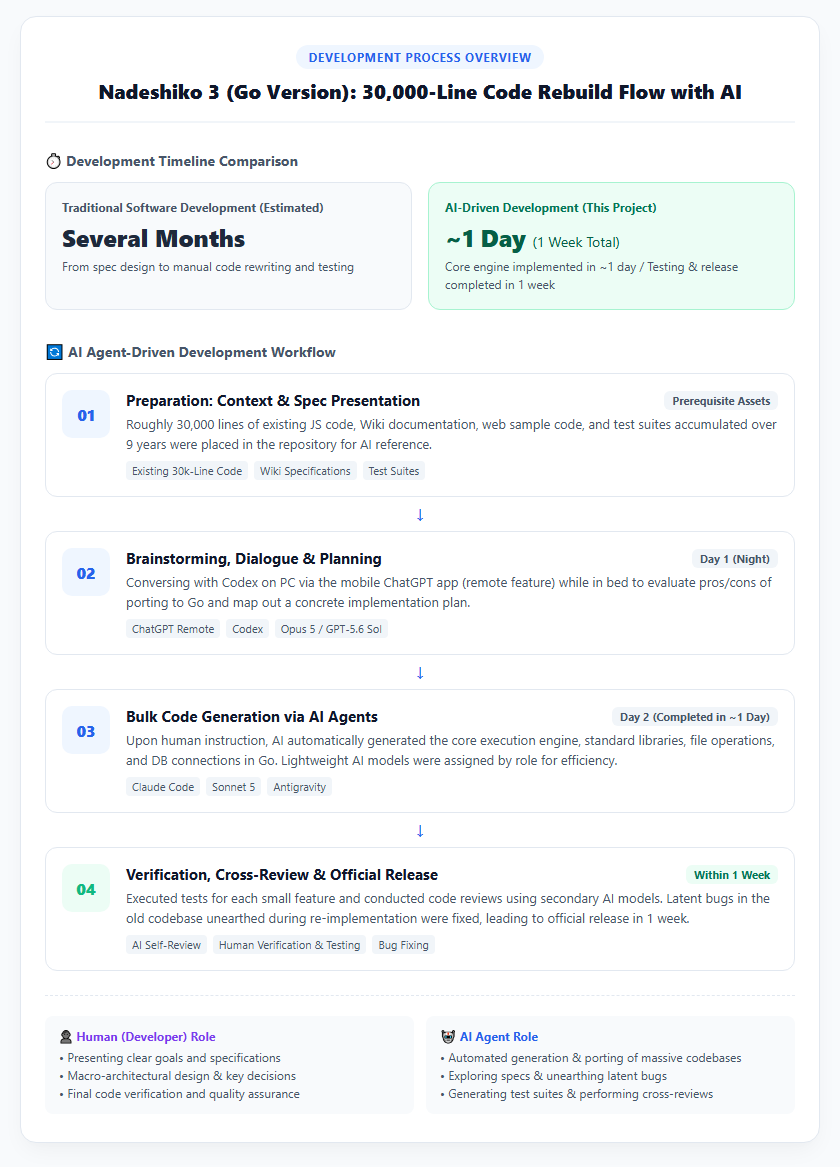
Launched in 2004 with the mission of making “anyone an easy programmer,” the Japanese programming language “Nadeshiko” has long been embraced across education and business process automation. In 2017, the language transitioned to a JavaScript-based architecture with “Nadeshiko 3,” building a vibrant ecosystem that runs in web browsers and Node.js environments while maintaining a codebase of roughly 30,000 lines. On September 7, 2026, creator Kujirahand officially released “Nadeshiko 3 (Go Version),” having completely rewritten the 30,000-line core functionality in Go from scratch. Remarkably, the entire project took just one week from initial planning to final release, with the primary execution engine and standard libraries implemented in essentially a single day. This rapid development was achieved by seamlessly integrating state-of-the-art AI coding agents into every phase of the workflow. Serving as a striking case study, it demonstrates how massive code rewrites—tasks that traditionally take several months—can now be accomplished in record time with AI assistance. The diagram below illustrates the complete AI agent-driven development workflow.
From Bedside Brainstorming to Multi-Model Prompt Orchestration
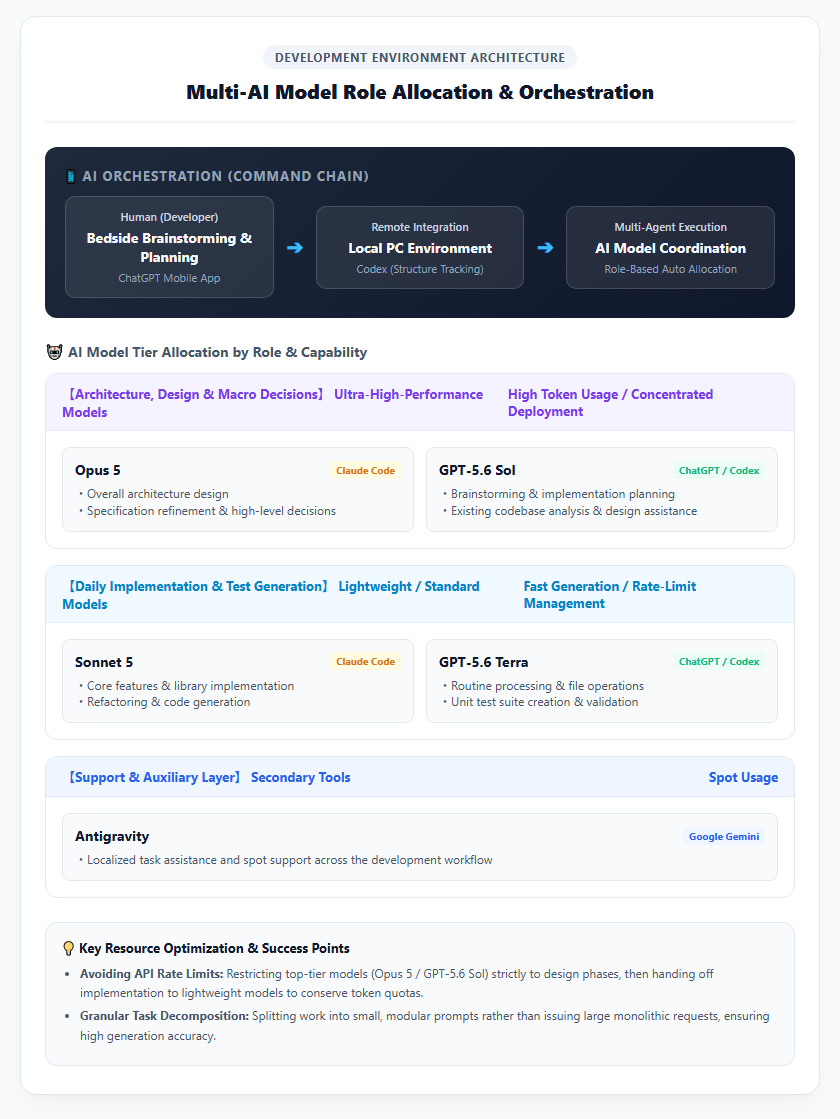
The rewrite project originated late one night with a casual thought typed into the remote interface of the mobile ChatGPT app while resting in bed. By conversing with the AI through a remote session that allowed it to inspect local code and environment files, the developer quickly evaluated the pros, cons, and risks of rebuilding Nadeshiko in Go, culminating in a concrete implementation plan. When the developer instructed the system to execute the plan the following morning, the core language features—including FizzBuzz logic, file operations, and database connectivity—were fully functional by that evening. A key driver of success was the strategic division of labor among multiple AI models rather than relying on a single tool. Ultra-high-performance models such as Opus 5 via Claude Code and GPT-5.6 Sol via ChatGPT/Codex handled macro-architectural design and complex decisions, while lightweight models like Sonnet 5 and GPT-5.6 Terra managed routine code generation and unit testing to optimize token consumption and rate limits. Google’s Antigravity (Gemini) was also leveraged for supplementary tasks, showcasing the power of “AI orchestration” where multiple AI agents are directed like musicians in a conductor’s orchestra. The image below depicts how these various AI models collaborated within the development environment.
Technical Evolution and Key Benefits of Nadeshiko 3 (Go Version)
Zero Node.js Dependency: Single Portable Executables and Simplified Distribution
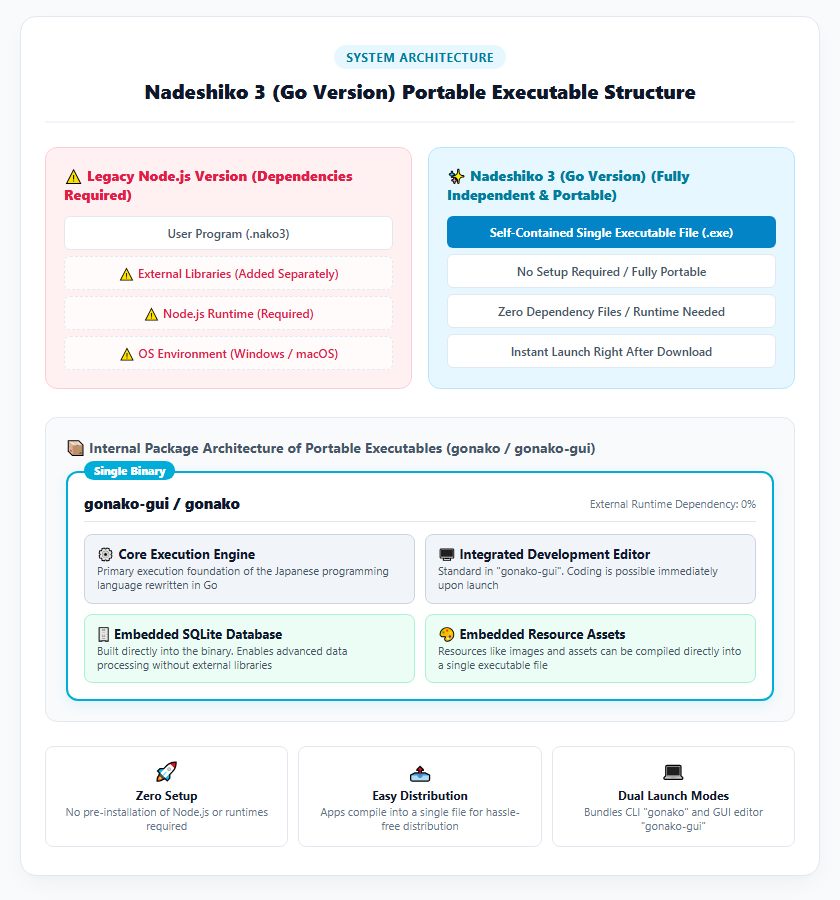
Running the original JavaScript version of Nadeshiko 3 on a desktop required users to pre-install external runtime environments such as Node.js, posing a significant onboarding hurdle for beginners and non-IT staff. The platform also suffered from the lack of an intuitive, fully integrated GUI development environment. In contrast, the newly released “Nadeshiko 3 (Go Version)” eliminates external dependencies entirely, delivering standalone portable executables that run out of the box without any setup. The release bundles both “gonako”—a command-line tool—and “gonako-gui,” an application with an integrated development editor, allowing users to start Japanese programming immediately upon downloading. Programs created with Nadeshiko 3 can be compiled alongside embedded assets like images into a single executable, drastically simplifying distribution to end-users and cross-device execution. Furthermore, the SQLite database engine is embedded directly into the binary, enabling developers to build sophisticated data-processing applications without installing third-party libraries. The following diagram illustrates the internal architecture of the portable executable.
Dramatic Execution Speedups and Embedded SQLite Capabilities
Another major advantage of porting Nadeshiko 3 to Go is a dramatic leap in runtime performance. Benchmark data measured on September 3, 2026, across seven representative algorithms on Apple Silicon macOS showed that even the virtual-machine-based “gonako” ran 1.58 times faster on average (and up to 5.45 times faster) than the original Node.js version (cnako3). When natively compiled using the Go toolchain (“gogen”), performance surged to an average speedup of 3.45x and a peak of 5.92x compared to Node.js. String manipulation saw an exceptionally dramatic improvement, plummeting from 80.2 milliseconds under Node.js down to 13.5 milliseconds natively—a roughly sixfold increase in speed. These performance gains, combined with reduced memory overhead, ensure smooth and responsive execution for heavy data processing tasks and high-frequency automation scripts.
Human Roles and Software Engineering in the AI Era: Lessons from the Re-implementation
Turning Legacy Documentation into AI Context to Unearth Hidden Bugs
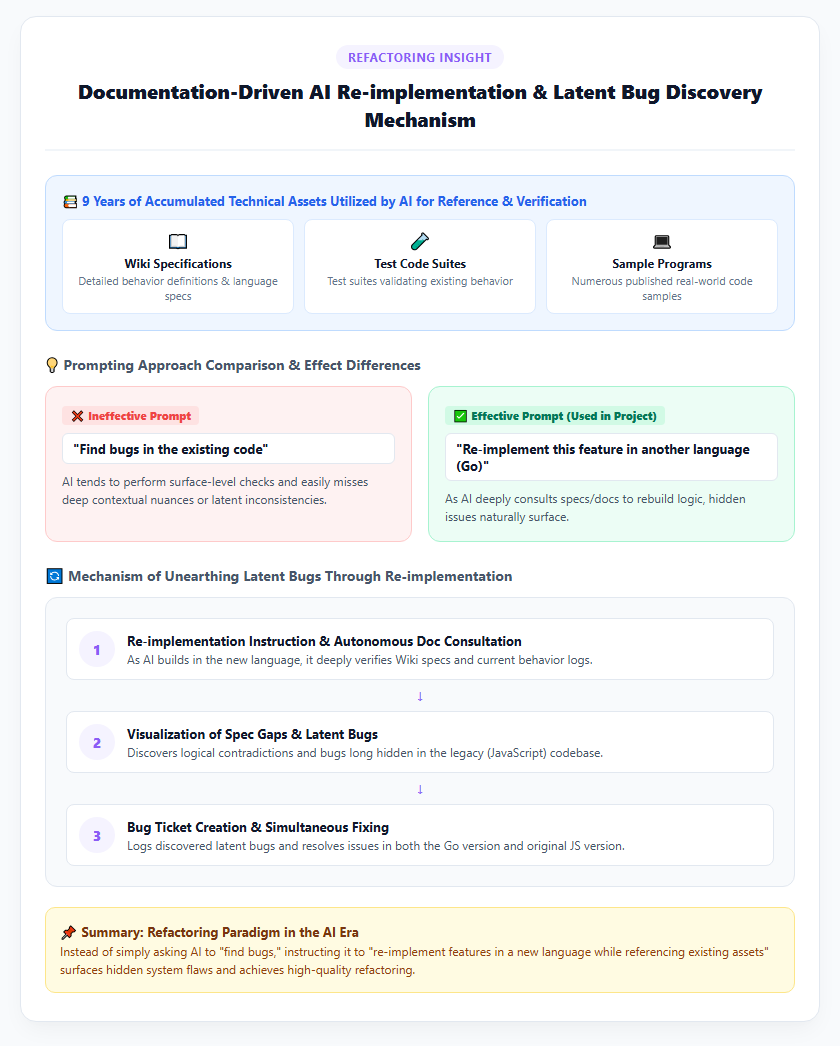
A crucial factor behind the project’s dramatic success was the rich technical context built over the past nine years. By providing AI agents access to existing Wiki specification documents, comprehensive test suites, and online sample programs within the repository, the AI was able to autonomously consult documentation and verify existing behavior whenever implementation questions arose. Interestingly, asking the AI to “re-implement existing features in a new language” proved far more effective than prompting it to “find bugs in the existing code.” As the AI dissected the codebase to reconstruct its logic in Go, long-standing latent bugs in the original JavaScript version were systematically unearthed and resolved in tandem. This outcome demonstrates that instructing AI to re-implement existing systems in a modern language serves as a highly effective refactoring strategy for surfacing hidden software defects across a codebase. The diagram below shows the correlation between documentation-driven AI re-implementation and bug discovery.
The Limitations of AI-Generated Code: Why Human Architecture and Quality Assurance Matter Most
While AI agents can now generate tens of thousands of lines of code in a single day, the role of the human developer remains as essential as ever. AI-generated code frequently contains subtle inconsistencies, making traditional quality assurance practices—such as test design, code review, and runtime validation—more critical than before. Throughout the development of Nadeshiko 3 (Go Version), human engineers continuously conducted rigorous testing and cross-reviews for every small module produced by the AI, making frequent course corrections. Core architectural decisions—determining what to build, defining specifications, and verifying correctness—remain firmly in human hands. AI tools serve as powerful superchargers for development velocity, but the ultimate key to software engineering in 2026 and beyond lies in the human architect’s ability to govern these tools and guarantee system quality.
Reference Pages
- [Nadeshiko 3 (Go Version) Repository] https://github.com/kujirahand/nadesiko3go/
- [About Japanese Programming Language “Nadeshiko 3 (Go Version)” Official Manual] https://nadesi.com/v3/doc/index.php?gonako-preview&show
- [Nadeshiko: Japanese Programming Language Official Site] https://nadesi.com/
【#Nadeshiko3 #GoLang #AICoding #ProgrammingLanguages #GenerativeAI #Kujirahand #DevelopmentAutomation #SoftwareEngineering】


コメント