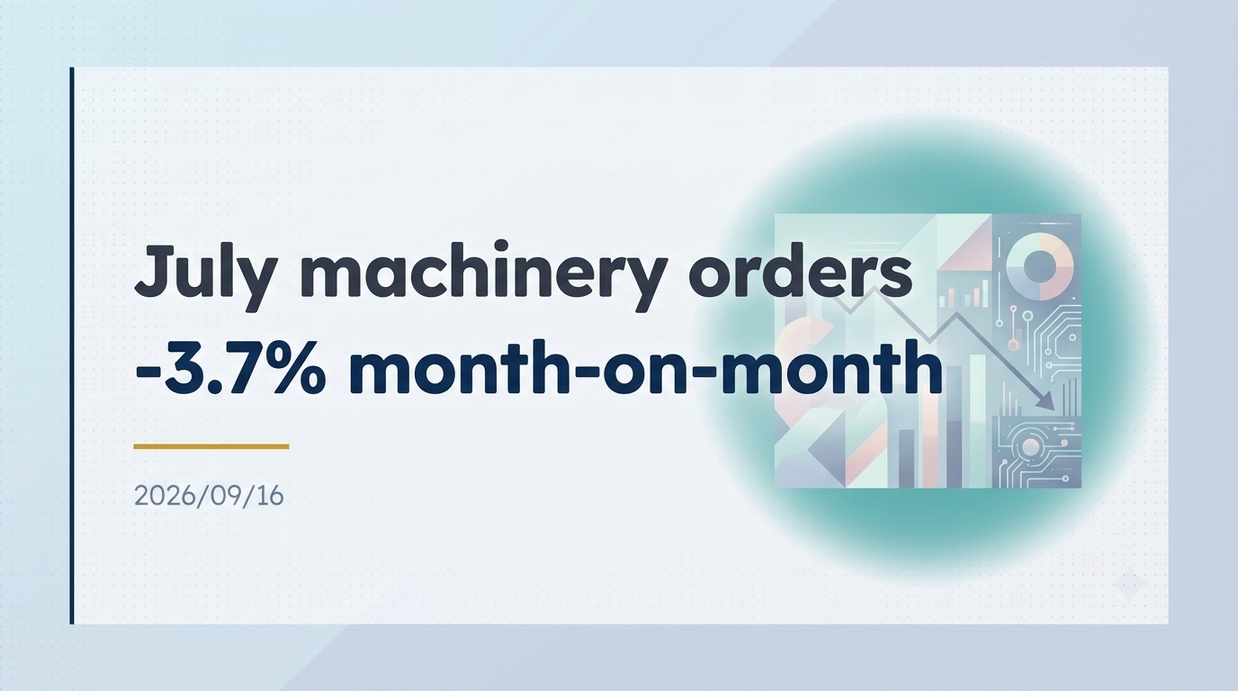
According to the July Machinery Orders statistics released by the Cabinet Office on September 16, 2026, private-sector machinery orders excluding ships and electric power—a key leading indicator of corporate capital expenditure—fell 3.7% month-on-month to 1.0169 trillion yen, marking the first decline in two months. The decrease was primarily driven by a pullback following a sharp increase in June, leading the Cabinet Office to maintain its official economic assessment that machinery orders are “showing signs of picking up.”
- Factors Behind the 3.7% MoM Drop and Assessment Maintenance
- Demand Shifts Across Manufacturing and Non-Manufacturing Sectors
- Volatility of Mega-Projects and the Rationale for Exclusion
- Trend Analysis via Single-Month Figures and 3-Month Moving Averages
- Trends in Cyclical Sectors and FA / Machine Tool Manufacturers
- AI and Semiconductor Expansion Driving Investment Polarization
- Constraints From Soaring Construction Costs and Labor Shortages
- Overseas Market Recovery and H2 2026 Outlook
Factors Behind the 3.7% MoM Drop and Assessment Maintenance
According to the July 2026 Machinery Orders Survey published by the Cabinet Office on September 16, 2026, private-sector orders excluding ships and electric power (seasonally adjusted)—a major leading indicator of corporate capital expenditure—dropped 3.7% month-on-month to 1.0169 trillion yen, entering negative territory for the first time in two months. This decline was largely a pullback following a robust 9.7% increase (1.0558 trillion yen) recorded in June 2026. The Cabinet Office views this monthly drop as within the expected range of short-term volatility and maintained its underlying economic assessment of “showing signs of picking up.” Although the three-month moving average also registered a 2.6% decline month-on-month, a broader view over several months indicates that corporate appetite for capital investment has by no means cooled rapidly. While total orders decreased by 5.5% month-on-month, comparing figures on a year-on-year basis and examining mid-to-long-term equipment renewal momentum suggests that capital expenditure remains on a gradual recovery path. Corporate investment plans inherently exhibit short-term fluctuations due to the irregular timing of large project bookings.
Demand Shifts Across Manufacturing and Non-Manufacturing Sectors
A closer look at the breakdown by sector for July shows that manufacturing orders fell 1.0% month-on-month to 518.6 billion yen. This minor drop reflected a pullback from large-scale orders related to nuclear fuel production equipment booked in the previous month, yet performance varied significantly across sub-industries. Driven by a surge in demand for artificial intelligence (AI) and data centers, electrical machinery—which includes computers and semiconductor manufacturing equipment—soared 46.1% month-on-month. This marked the second-highest growth rate for electrical machinery since December 2006. On the other hand, non-manufacturing orders (excluding ships and power) dropped 2.6% month-on-month to 525.9 billion yen. Despite positive developments such as rocket orders from emerging space startups amidst expanding private space development, overall figures were dragged down as the wave of system-related orders—such as core IT infrastructure overhauls and large-scale software development in information services, finance, and insurance—passed its peak. Please refer to the diagram below.
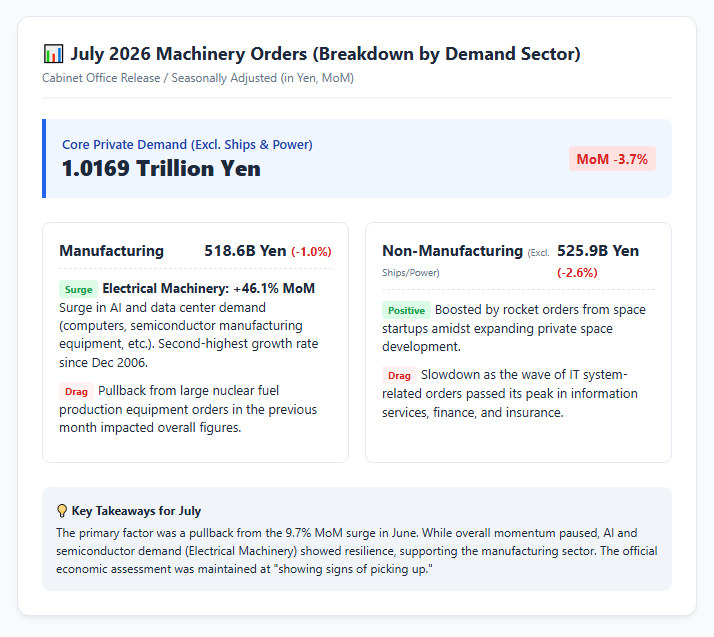
This highlights how investment cycles vary across industries, with strong tech-driven demand in manufacturing partially offsetting the lull in non-manufacturing.
Mechanics and Characteristics of the “Core Private Demand” Metric
Volatility of Mega-Projects and the Rationale for Exclusion
The headline figure and market forecasts for machinery orders focus primarily on “private demand excluding ships and electric power” rather than total private demand. This is because orders from the shipbuilding and electric power sectors involve megaprojects worth tens to hundreds of billions of yen per contract. Furthermore, constructing power generation infrastructure and building large vessels require several years to complete, making them poorly correlated with short-term 1-to-2-month economic cycles or autonomous corporate investment sentiment. In fact, total private demand surged 37.4% month-on-month in May 2026 while the core series fell 12.4%, whereas in June total private demand plunged 26.0% while core demand rose 9.7%—a series of inverse movements. Because concentrated orders for power infrastructure and shipbuilding cause extreme monthly swings, excluding them allows analysts to capture the true underlying momentum of private capex several months ahead. Stripping out these irregular outliers is essential for accurate economic analysis.
Trend Analysis via Single-Month Figures and 3-Month Moving Averages
When interpreting monthly economic indicators, it is vital to look beyond single-month fluctuations and analyze trendlines using moving averages. As highlighted in the Cabinet Office report, the three-month moving average for July 2026 fell 2.6% month-on-month, following a 1.5% increase in June. Machinery orders naturally experience sharp monthly fluctuations depending on when individual industries sign major contracts. Fixing solely on month-on-month gains or losses can lead to misjudging the real direction of capital expenditure. Historically, whenever the three-month moving average remains in positive territory, real corporate capex in GDP statistics also trends solidly. July’s result primarily reflects a reaction to June’s high baseline rather than a fundamental decline in investment intent. When utilizing machinery orders as a leading economic indicator, it is crucial to smooth out monthly noise by monitoring subsequent order flows and moving averages from August onward.
Impact on Stock Markets and Key Industries
Trends in Cyclical Sectors and FA / Machine Tool Manufacturers
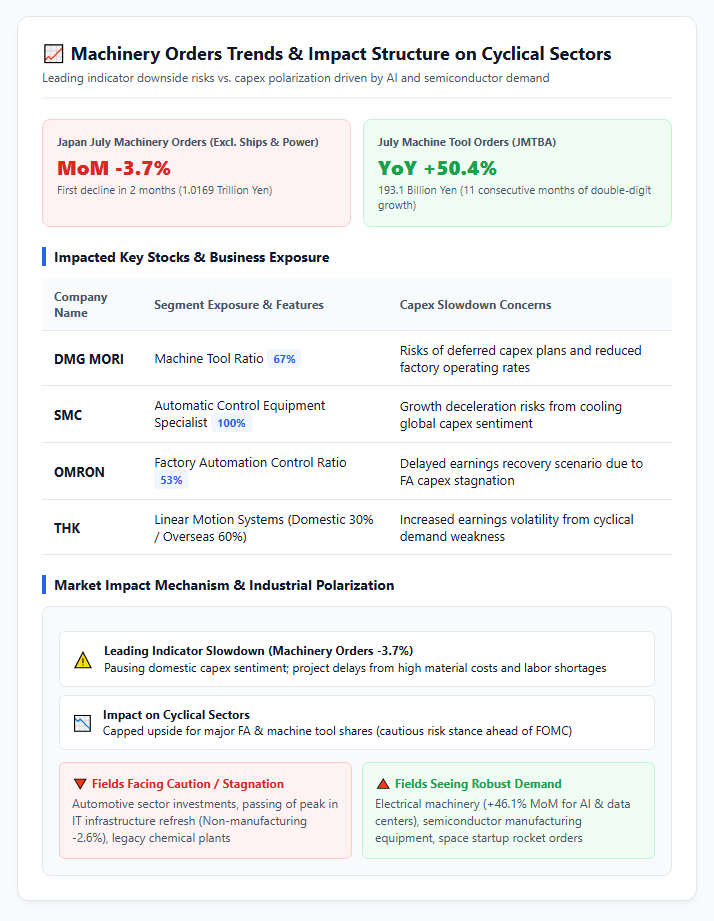
The July drop in machinery orders has exerted a psychological drag on the stock market and cyclical sectors. Stagnant domestic indicators tend to cap upside expectations for earnings among factory automation (FA) equipment, machine tool, and linear motion system manufacturers. Key stocks—such as machine tool leader DMG Mori, automatic control equipment market leader SMC, automation supplier Omron, and linear motion guide specialist THK—are highly sensitive to leading capex indicators. If weakness in machinery orders persists, market participants worry about deferred investment plans and lower factory operating rates among client companies, creating downside pressure on corporate earnings forecasts. Coming ahead of major international financial events like the U.S. Federal Open Market Committee (FOMC) meeting, the softer domestic reading prompted investors to adopt a more cautious risk stance toward related shares. Please refer to the diagram below.
AI and Semiconductor Expansion Driving Investment Polarization
While overall machinery orders appear to be pausing, investment demand in specific AI- and semiconductor-related fields remains exceptionally robust. The 46.1% month-on-month surge in electrical machinery in July—the second-largest on record—demonstrates that the global AI race and data center buildouts are directly benefiting Japanese manufacturers. Similarly, the Japan Machine Tool Builders’ Association (JMTBA) reported that July 2026 machine tool orders surged 50.4% year-on-year to 193.1 billion yen, marking 11 consecutive months of double-digit growth and setting a record high for the month of July. Demand is being powerfully propelled by semiconductor manufacturing equipment, electronic component processing machinery for AI servers, and advanced cooling systems. Conversely, investment sentiment remains hesitant in the automotive industry and legacy chemical plant sectors, creating a sharp polarization between thriving and stagnant industries. Corporate sentiment now varies dramatically depending on the specific sector in which a company operates.
Capital Investment Outlook and Key Points to Watch
Constraints From Soaring Construction Costs and Labor Shortages
Although Japanese corporate appetite for investment remains fundamentally strong—centered on labor-saving, digitalization, and green transformation (GX)—several structural bottlenecks hamper project execution. The primary hurdles are surging raw material prices, elevated construction costs, and severe labor shortages. Even as nominal capex figures expand, rapidly rising construction and labor expenses mean that real investment volume often stagnates. Furthermore, shortages of skilled site workers and prolonged construction schedules have lengthened return on investment (ROI) payback periods, causing corporate decision-makers to hesitate or delay project starts and Final Investment Decisions (FIDs). While government support for the semiconductor and shipbuilding industries provides a tailwind, capital expenditure plans may struggle to proceed smoothly until structural labor and cost constraints are addressed.
Overseas Market Recovery and H2 2026 Outlook
Beyond domestic demand, overseas market dynamics hold the key to the future outlook for Japanese capital investment and the broader economy. Heading into the second half of 2026, external demand is expected to be supported by steady U.S. AI investment and data center construction, alongside major projects in LNG, petrochemicals, and power plants across the Middle East and Asia. Global Manufacturing Purchasing Managers’ Indexes (PMIs) remain above the 50 expansion threshold, indicating that the global manufacturing recovery cycle—led by semiconductors—remains intact. Domestically, strong wage hikes achieved during spring labor negotiations (Shunto) and improving corporate profits will support internal demand, keeping real GDP growth on track for a positive reading in FY2026. Because July’s decline was largely a temporary pullback, capital expenditure is projected to regain momentum in late 2026 as supply constraints ease and foreign demand is captured. The key focus for mid-to-long-term growth will be how effectively companies overcome cost inflation to execute investments in digital and decarbonization initiatives.
Reference Pages
- 【Machinery Orders Survey Results】https://www.esri.cao.go.jp/jp/stat/juchu/menu_juchu.html
【#MachineryOrders #CapitalInvestment #JapaneseEconomy #CabinetOffice #AIDemand #StockMarket #ElectricalMachinery #EconomicIndicators】
コメント