On September 15, 2026, Japan’s Ministry of Land, Infrastructure, Transport and Tourism (MLIT) released its first aggregate report on large-scale land acquisitions by foreign nationals and foreign corporations. This action stems from the government’s broader policy initiative to gain a clearer understanding of actual land ownership for national security and water resource conservation.
- Initial Findings and Overall Figures Announced by MLIT
- Geographic Concentration, Nationality Breakdown, and Stated Intended Uses
- National Land Use Planning Act Revision and Nationality Tracking Mechanism
- Cross-Agency Initiatives Across Forestry, Foreign Exchange, and Property Registration
- Strengthening Important Land Use Act and Decision to Postpone Condominium Restrictions
- Ensuring Real Estate Market Transparency, Future Outlook, and Key Considerations
Initial Findings and Overall Figures Announced by MLIT
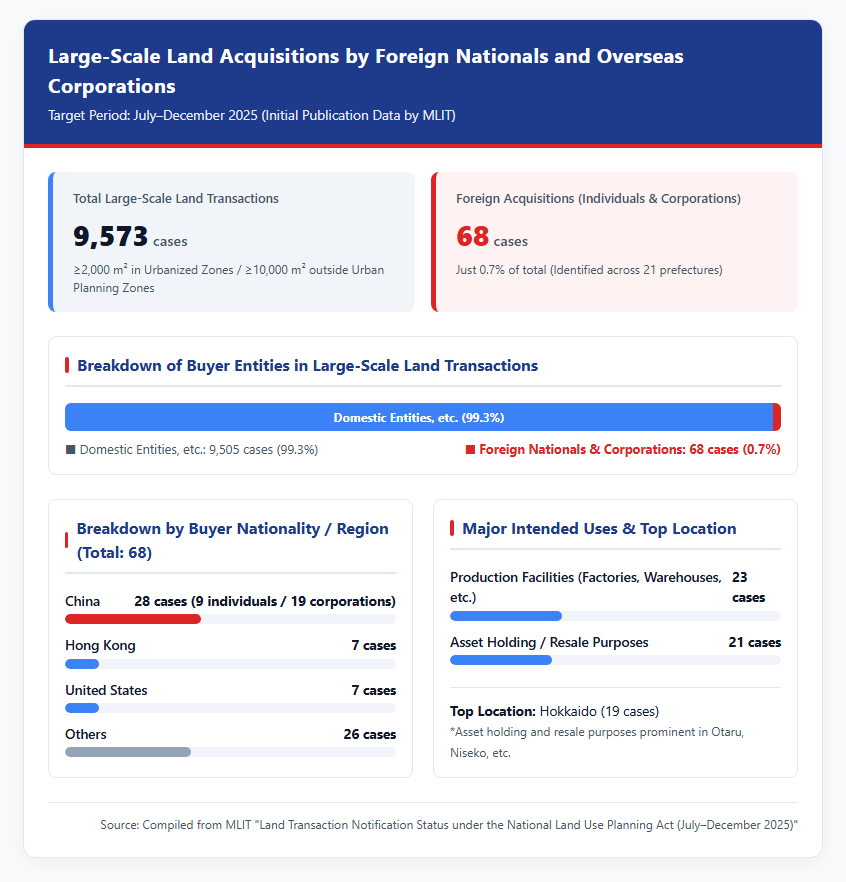
On September 15, 2026, the Ministry of Land, Infrastructure, Transport and Tourism (MLIT) published for the first time aggregate figures on large-scale land acquisitions by foreign individuals and overseas entities under relevant governing laws. The dataset covers land transactions reported to municipal governments during the six-month period from July to December 2025. Nationality reporting is required for transactions involving 2,000 square meters or more in urbanized areas densely populated with commercial or residential properties, and 10,000 square meters or more outside urban planning zones, such as agricultural lands and forests. Out of 9,573 large-scale land transactions reported during this period, acquisitions by foreign nationals and foreign corporations accounted for just 68 cases across 21 prefectures, representing a minor 0.7% of the total. MLIT noted that large-scale land purchases funded by foreign capital remain low in absolute volume. Nevertheless, visualizing the reality of foreign land ownership through official statistical data carries significant weight, shedding light on what had previously been viewed as an opaque market segment. The diagram below shows the breakdown of the published land transaction dataset.
Geographic Concentration, Nationality Breakdown, and Stated Intended Uses
A granular analysis of the transaction data by nationality and region highlights a clear concentration in specific countries and geographical areas. By nationality and region of buyers, China represented the largest group with 28 transactions, comprising 9 individual purchases and 19 corporate acquisitions. Hong Kong and the United States tied for second place with 7 transactions each. By prefecture, Hokkaido recorded the highest number of acquisitions at 19 cases, with transactions particularly prominent in and around resort destinations such as Otaru and Niseko. Regarding intended land use, “production facilities”—such as constructing or operating factories and warehouses—ranked highest with 23 cases, closely followed by “asset holding and resale” with 21 cases. Reports indicate that asset holding and speculative resale aimed at future price appreciation and development are particularly noticeable in Hokkaido.
Background of Land Law Revisions and Multi-Faceted Policy Reforms
National Land Use Planning Act Revision and Nationality Tracking Mechanism
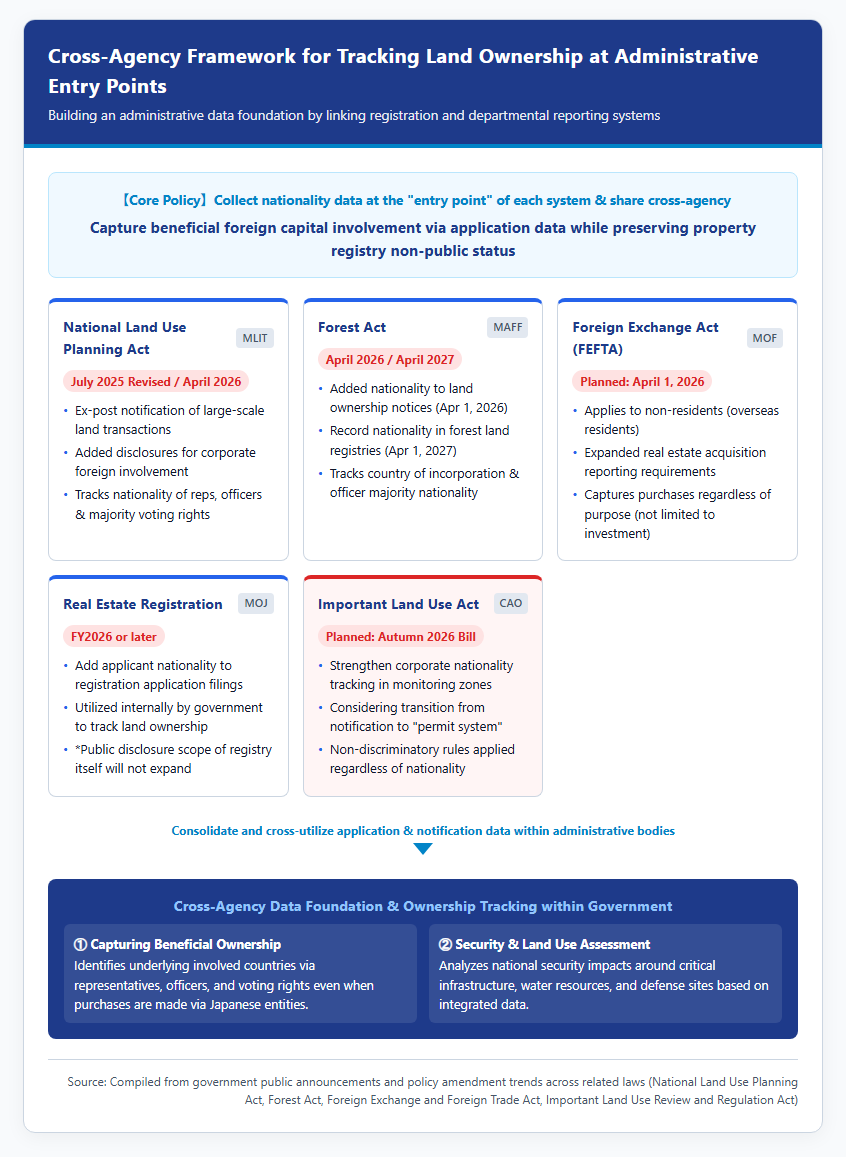
The Japanese government’s move to map foreign land ownership was driven by rapidly rising concerns over national security and environmental conservation, summarized by the question: “Who actually owns Japan’s land?” In response, MLIT amended the enforcement regulations of the National Land Use Planning Act in July 2025, making nationality disclosure mandatory for buyers and sellers when reporting land transactions above specified thresholds. This initiative is not designed to impose an immediate outright prohibition on foreign land acquisitions; rather, its primary objective is to build an administrative data foundation to accurately monitor transaction activities. Crucially, the system design targets not only direct purchases by foreign individuals, but also acquisitions structured through Japanese corporations. When a corporation acquires land, the reporting requirements now extend beyond the country of incorporation and the chief executive’s nationality to include the nationality of any group holding a majority of executive positions or voting rights, thereby establishing a framework to identify the underlying source of foreign capital.
Cross-Agency Initiatives Across Forestry, Foreign Exchange, and Property Registration
Efforts to enhance transparency in land ownership extend beyond the National Land Use Planning Act, encompassing a comprehensive set of legal and administrative frameworks. Under the Forest Act, which regulates land ownership reporting for forested areas, amendments taking effect on April 1, 2026, will require nationality disclosures in initial notifications, followed by inclusion in municipal forest land registries starting April 1, 2027. Under the Ministry of Finance’s Foreign Exchange and Foreign Trade Act (FEFTA), reporting requirements for real estate acquisitions by non-residents will expand on April 1, 2026, to cover all purchase motives rather than being restricted to investment purposes. Furthermore, regarding real estate registration under the Ministry of Justice, while maintaining the non-public nature of property registries, discussions are underway to include applicant nationality in registration application filings starting in FY2026 or later. Together, these regulatory updates establish mechanisms to capture nationality data at the initial “entry point” of administrative procedures, fostering a cross-agency framework for data sharing and analysis. The structural chart below illustrates this cross-agency framework for tracking land ownership.
Security and Market Impacts and Key Points for Future Focus
Strengthening Important Land Use Act and Decision to Postpone Condominium Restrictions
While administrative tracking progresses, legal enforcement measures in areas critical to national security are also taking shape. The government plans to submit amendments to the Important Land Use Review and Regulation Act during the autumn 2026 extraordinary parliamentary session. These amendments will consider transitioning from a prior-notification system to a full “permit system” and expanding survey areas in designated monitoring zones surrounding Self-Defense Forces bases and border islands. To close potential loopholes—such as foreign buyers employing Japanese nominees—the restrictions are expected to be applied on a non-discriminatory basis regardless of nationality. Conversely, proposed restrictions on foreign purchases of residential condominiums, where urban prices continue to surge, have been postponed for the time being. This decision was influenced by the absence of reservation clauses regarding foreign land purchases when Japan joined the WTO General Agreement on Trade in Services (GATS), as well as concerns over imposing excessive constraints on property rights and economic activities. Furthermore, an MLIT survey showing that non-resident foreign buyers accounted for only 3.0% of new condominium sales in Tokyo’s 23 wards between January and June 2025 supported the conclusion that foreign buying is not the primary driver of escalating housing prices.
Ensuring Real Estate Market Transparency, Future Outlook, and Key Considerations
Moving forward, the primary focus will shift to how far authorities utilize this newly constructed database to enact specific land-use restrictions or national security measures. Analysis suggests that the impact on the real estate market will largely depend on the scope of regulations, procedural clarity, and review speed. If clear and swift procedures are applied to limited, well-defined areas—such as vicinity around critical infrastructure and defense sites—market transparency is likely to improve, supporting overall market stability. Conversely, if requirements remain vague or review timelines become prolonged, transaction predictability will decline, raising risks of a “liquidity discount” (price reductions stemming from selling difficulties) in resort regions and luxury property segments. For sellers, buyers, and legal/real estate intermediaries, thorough preparation is becoming increasingly critical—including proper Know Your Customer (KYC) and Anti-Money Laundering (AML) documentation, clear conditions precedent in purchase agreements, and realistic financing contingency deadlines. Because the underlying objective of these policies is not to exclude specific nationalities but to eliminate uncertainty surrounding national security and economic order, establishing fair and transparent procedures remains essential for the healthy development of the broader real estate market.
Reference Pages
- [MLIT Real Estate Price Index and Land Transaction Statistics Information] https://www.mlit.go.jp/totikensangyo/totikensangyo_tk5_000085.html
【#MLIT #ForeignLandOwnership #NationalLandUsePlanningAct #NationalSecurity #RealEstateMarket #ImportantLandUseAct #ForeignInvestmentRegulations】


コメント