Computer Engineering & Consulting Ltd. (CEC) launched “BizAxis IaaS,” a sovereign cloud Infrastructure-as-a-Service operating entirely within domestic Japanese data centers, on September 15, 2026. This deployment addresses escalating geopolitical risks, the imperative to mitigate vendor lock-in with specific virtualization platforms, and the surging demand for secure, AI-driven utilization of sensitive enterprise data.
- Overview and Launch of BizAxis IaaS Operating Entirely in Domestic Data Centers
- Phased Expansion and Revenue Goals for 2030
- Heightened Geopolitical Risks and Compliance with Economic Security
- Moving Away from VMware Dependency and Optimizing Costs
- Applying AI to Confidential Data While Securing Data Sovereignty
- Redundant Architecture and Security Framework Supporting a 99.99% SLA
- Integration with Resolana Data Platform and Strategic Horizons
Overview and Launch of BizAxis IaaS Operating Entirely in Domestic Data Centers
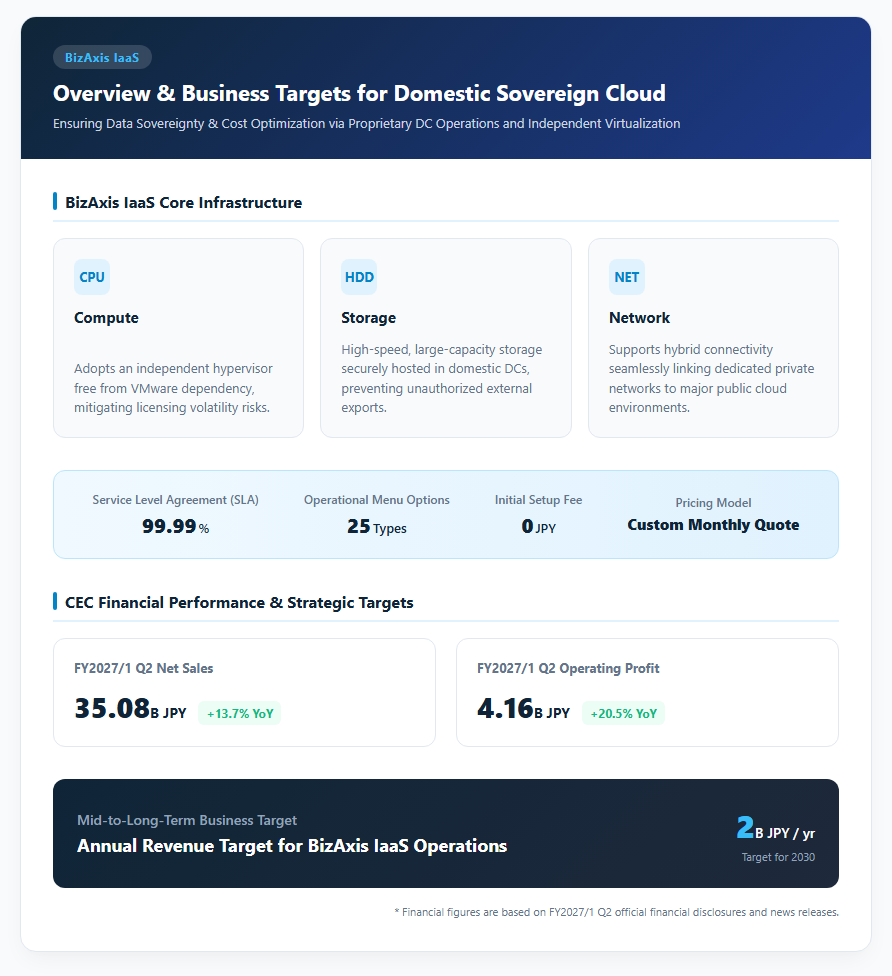
On Tuesday, September 15, 2026, Computer Engineering & Consulting Ltd. (CEC) expanded its integrated cloud platform “BizAxis” by officially launching “BizAxis IaaS,” a standalone, fully domestic Infrastructure-as-a-Service solution. BizAxis IaaS is a sovereign cloud platform where every stage—from system architecture, design, and deployment to daily operational management—is executed exclusively within CEC’s domestic data centers in full compliance with Japanese law.
In recent years, enterprise and public sector organizations have faced growing demands to safeguard sensitive data from foreign regulatory reach and extraterritorial data disclosure requests. BizAxis IaaS is engineered to store and manage confidential client data strictly within Japanese territory, establishing a robust defense against unintended external data transfers or unauthorized jurisdiction.
The service encompasses compute capabilities powered by an independent hypervisor, high-capacity, high-speed storage, and flexible networking that connects closed networks seamlessly to public clouds. Furthermore, it offers a comprehensive suite of 25 operational management options—ranging from hardware health checks and resource monitoring to full server maintenance—delivered as a one-stop solution with zero initial setup fees and customizable monthly pricing.
Phased Expansion and Revenue Goals for 2030
CEC has outlined clear strategic goals to progressively expand the functional capabilities of BizAxis IaaS, aiming to generate 2 billion yen in annual revenue from this service by 2030. The company boasts a long-standing track record of delivering core system integration and IT infrastructure management across diverse sectors, including government agencies, financial institutions, and the automotive industry.
According to CEC’s financial disclosures for the second quarter of the fiscal year ending January 2027, strong growth in system/infrastructure integration and security services propelled corporate performance to historic highs. Net sales rose 13.7% year-over-year to 35.08 billion yen, while operating profit surged 20.5% year-over-year to 4.16 billion yen.
Leveraging this solid business foundation and robust demand for digital transformation (DX), CEC is actively restructuring its data center operations and allocating capital investments toward opening hybrid cloud centers and bolstering facility capacity. The launch of BizAxis IaaS represents a strategic investment to enhance medium- to long-term corporate value. Combined with CEC’s proprietary security suite “SmartSESAME” and data utilization platform “Resolana,” it serves as a foundational enterprise infrastructure designed to power the sustainable growth of Japanese businesses.
Technical and Market Drivers Behind Sovereign Cloud Demand
Heightened Geopolitical Risks and Compliance with Economic Security
The primary driver accelerating the adoption of sovereign cloud platforms is the escalation of global geopolitical uncertainties and the growing emphasis on economic security. As international friction intensifies, relying heavily on foreign-owned public cloud providers for critical domestic data and system operations introduces significant strategic vulnerabilities. Organizations face risks such as forced data disclosure under foreign statutes (such as the U.S. CLOUD Act) without consent, or sudden service disruptions caused by geopolitical sanctions and international conflicts.
From an economic security standpoint, data handled across critical infrastructure—including power grids, telecommunications, financial networks, and healthcare facilities—alongside advanced technological assets and intellectual property in manufacturing, constitute vital digital capital that determines national and industrial competitiveness. Protecting these assets strictly within domestic legal jurisdiction has become an indispensable requirement for ensuring business continuity.
This paradigm requires going beyond basic data residency (physically storing data domestically) to securing complete “data sovereignty,” “system sovereignty,” “operational sovereignty,” and “technological sovereignty”—ensuring law, governance, personnel, and access rights remain under national control. Consequently, market demand is surging for domestic infrastructure like BizAxis IaaS, which operates entirely within Japanese data centers using domestic personnel.
Moving Away from VMware Dependency and Optimizing Costs
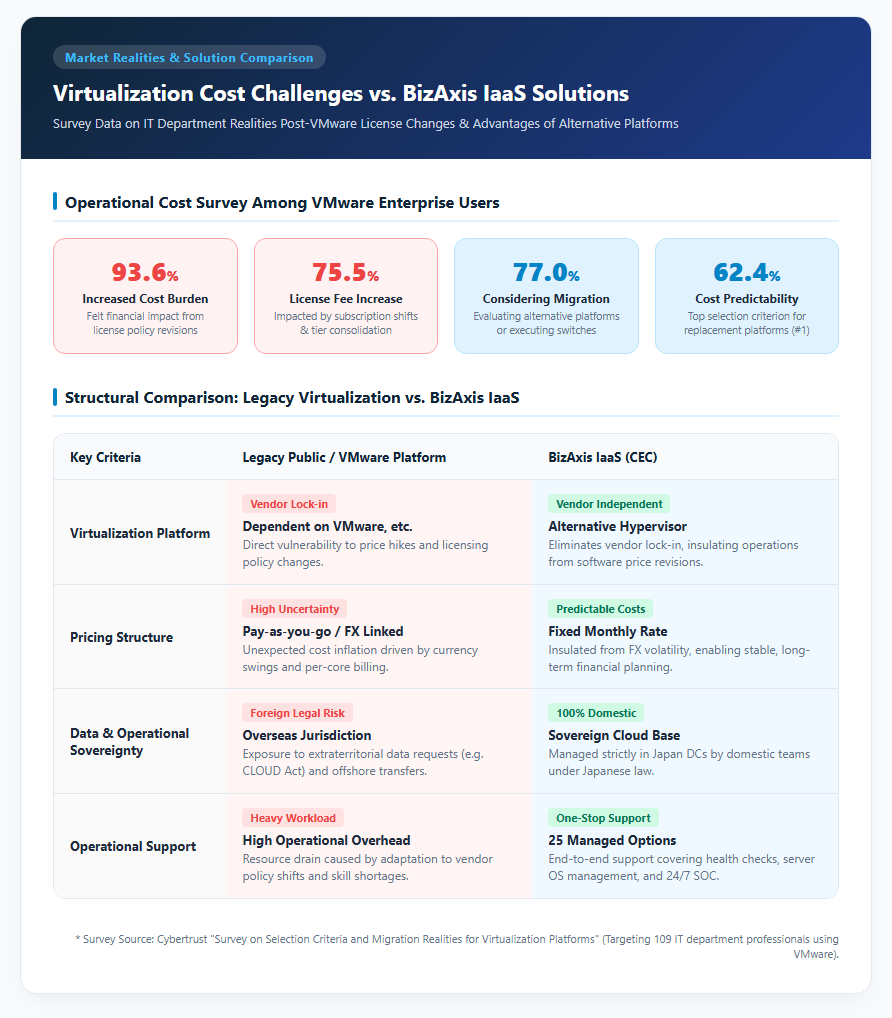
In the IT infrastructure landscape, shifts surrounding VMware have fundamentally altered how enterprises evaluate virtualization platforms. Broadcom’s acquisition of VMware led to the termination of perpetual licenses, a shift toward mandatory subscription models, and the bundling of software into higher-tier editions, resulting in substantial cost increases for many organizations. Industry surveys among IT departments in Japan reveal that over 90% of companies report increased licensing and operational expenses, prompting a widespread movement to explore alternative virtualization foundations and reduce VMware dependency.
Under traditional virtualization paradigms, predicting future IT expenditure became increasingly difficult due to recurring license restructuring and foreign exchange volatility, causing budget planning challenges for enterprises. In contrast, CEC’s BizAxis IaaS adopts an alternative hypervisor that operates independently of VMware software.
By eliminating dependency on specific foreign software vendors, BizAxis IaaS shields organizations from unexpected price hikes and license policy revisions. Furthermore, its predictable monthly fixed-rate pricing structure insulates businesses from currency fluctuations, establishing a stable financial environment for long-term operational planning.
Applying AI to Confidential Data While Securing Data Sovereignty
The rapid proliferation of generative AI and advanced machine learning technologies has introduced complex challenges to enterprise data management strategies. As companies leverage proprietary know-how, customer records, and operational intelligence to train and fine-tune AI models, uploading confidential assets to public cloud environments raises severe security concerns. The imperative to maintain “AI sovereignty” has emerged to prevent inadvertent data leaks and unauthorized secondary processing on overseas servers.
To safely integrate AI into core business workflows, enterprises require an infrastructure where sensitive, non-exportable data can be transferred over closed networks, stored securely, and analyzed within isolated domestic environments. BizAxis IaaS delivers a unified management ecosystem that insulates corporate assets from external vulnerabilities.
When combined with specialized solutions such as the “Resolana” data utilization platform and “SmartSESAME xIDiA” for secure paper and digital document management, BizAxis IaaS empowers organizations to minimize data leakage risks while aggressively driving AI-powered data monetization and workflow automation.
Technical Features and Future Outlook of BizAxis IaaS
Redundant Architecture and Security Framework Supporting a 99.99% SLA
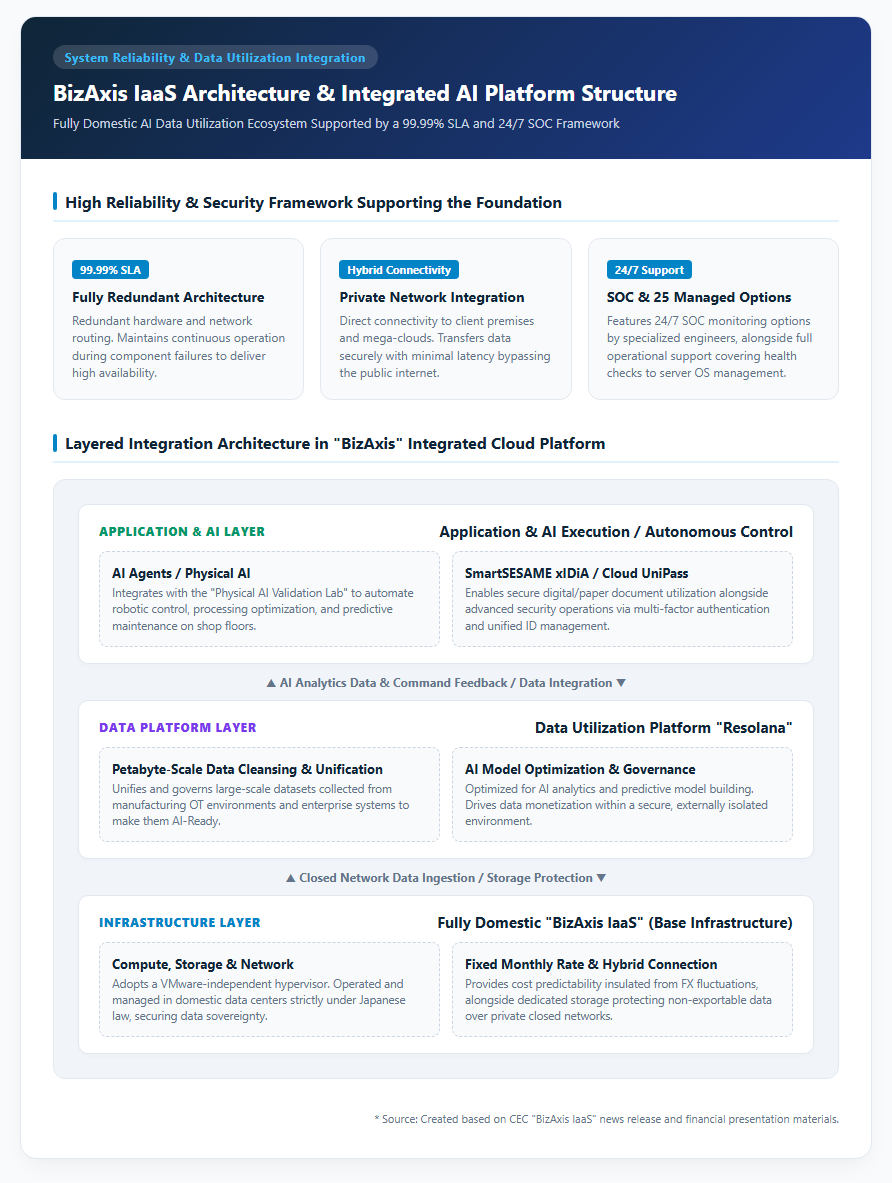
BizAxis IaaS is engineered with exceptional operational reliability and robust security protocols to host mission-critical enterprise workloads with confidence. Built across CEC’s domestic data centers, the underlying infrastructure features thorough redundancy across hardware, power systems, and network paths to eliminate single points of failure. This fault-tolerant architecture guarantees an exceptionally high Service Level Agreement (SLA) of 99.99% availability.
On the networking front, the platform supports hybrid cloud architectures that establish direct, highly secure connections between client premises and major public cloud environments. By leveraging dedicated private networks, enterprise data can be transferred with minimal latency and maximal security without exposure to the public internet.
To reinforce day-to-day operations, BizAxis IaaS offers an optional 24/7 Security Operations Center (SOC) staffed by specialized security engineers. Beyond routine hardware health and resource monitoring, the service covers full server-level operational maintenance. This comprehensive support structure mitigates operational burdens and protects enterprise IT departments against increasingly sophisticated cyber threats.
Integration with Resolana Data Platform and Strategic Horizons
CEC’s overarching “BizAxis” integrated cloud strategy extends beyond basic infrastructure provision to maximize the intrinsic value of enterprise data assets. Operating atop BizAxis IaaS, the “Resolana” data utilization platform ingests, cleanses, and unifies petabyte-scale datasets collected from manufacturing shop floors and enterprise systems, optimizing them for AI analytics and predictive modeling.
CEC possesses deep domain expertise and engineering capabilities across specialized industry verticals, including factory automation (FA), automotive systems development, healthcare, and public sector infrastructure. The company actively bridges cutting-edge technology with operational field environments through solutions such as proprietary industrial IoT data collection tools and its “Physical AI Validation Lab,” which simulates and verifies real-world robotic controls in virtual environments.
By establishing BizAxis IaaS as its core foundation, CEC delivers a seamless end-to-end ecosystem—from data ingestion and integration to AI analysis and autonomous physical control—all contained within a secure Japanese environment. As CEC continues to roll out additional PaaS/SaaS capabilities and security enhancements, BizAxis IaaS is poised to play a pivotal role as essential digital infrastructure underpinning Japan’s digital sovereignty.
Reference Pages
- [CEC Launches Domestic Sovereign Cloud Platform ‘BizAxis IaaS’] https://www.cec-ltd.co.jp/
【#SovereignCloud #BizAxis #CEC #IaaS #EconomicSecurity #DataSovereignty #CloudInfrastructure #DigitalSovereignty】

コメント