On September 15, 2026, Japan’s Financial Services Agency (FSA) released its “Strategic Priorities for AY2026,” outlining a policy to actively promote the societal implementation of blockchain-based on-chain finance. Building upon the “Basic Policy 2026” and the “Financial Strategy to Promote Growth Investment” approved by the Cabinet in July 2026, the policy aims to modernize traditional financial infrastructure and accelerate growth investments.
- Key Priorities and Background in the AY2026 Financial Administrative Policy
- Basic Policy 2026 and the Financial Strategy for Promoting Growth Investments
- Advantages of 24/7 Real-Time Settlement and Programmable Financial Infrastructure
- Public-Private Roadmap Formulation and Forum Launch
- AI Agent Utilization, Cybersecurity, and PQC Measures
- Best Mix with Existing Financial Infrastructure and Asian Expansion
- Regulatory Enhancements, Market Surveillance, and Key Watchpoints for 2027
Key Priorities and Background in the AY2026 Financial Administrative Policy
In the “Strategic Priorities for AY2026” published on September 15, 2026, the Financial Services Agency (FSA) highlighted contributing to sustainable growth through the enhanced exertion of financial functions as a top priority. Specifically, the initiative aims to support corporate growth investments and business restructuring from a financial standpoint, while establishing an environment where citizens can derive maximum benefit from economic growth. Behind this initiative lies the recognition that rapid advancements in innovative technologies such as AI and blockchain are fundamentally altering the structure of financial transactions.
In these policy guidelines, the FSA clearly signaled its commitment to forcefully promoting the societal implementation of on-chain finance anchored by blockchain technology. By achieving an optimal balance (“best mix”) with existing financial infrastructure, the FSA plans to advance the modernization of financial infrastructure as a whole, including funds settlement and securities settlement. Furthermore, while ensuring user protection and financial system stability, the FSA aims to build internationally convenient and competitive financial infrastructure by clarifying technical, institutional, and supervisory challenges through repeated public-private proof-of-concept (PoC) trials and dialogues.
In addition, measures aimed at cultivating a healthy crypto-asset market were incorporated. The agency outlined plans to strengthen its comprehensive supervisory framework to protect investors, including preparing for the enforcement of unfair trading regulations and administrative penalty (surcharge) systems under the Financial Instruments and Exchange Act, as well as demanding higher transaction monitoring effectiveness from self-regulatory organizations.
Basic Policy 2026 and the Financial Strategy for Promoting Growth Investments
The foundation for these financial administrative priorities lies in the “Basic Policy on Economic and Fiscal Management and Reform 2026 (Basic Policy 2026)” approved by the Cabinet on July 21, 2026, and the “Financial Strategy to Promote Growth Investment: Upgrading the Asset Management Nation” released by the Cabinet Secretariat on the same day. In Basic Policy 2026, “Promoting On-Chain Finance” was explicitly stated for the first time in an official government document as a key measure for facilitating capital supply to support growth.
In the policy document, on-chain finance is defined as a financial system where fund settlements via tokenized deposits, stablecoins, and related instruments take place on a blockchain, programmatically integrated and synchronized with business and logistics data management. In the Financial Strategy, the “On-Chain Finance Initiative for the AI Era” was positioned as a core element of infrastructure investments supporting the financial system.
It has been pointed out that if Japan lags in establishing this new payment infrastructure, reliance on overseas payment rails will increase, risking a decline in industrial competitiveness and heightened economic security risks. To address these concerns, multi-faceted government-led discussions are underway regarding on-chain compatibility for Japanese Government Bonds (JGBs) and Bank of Japan (BOJ) current accounts, the potential use of stablecoins and tokenized deposits for public benefit disbursements, and risk mitigation measures for DeFi (Decentralized Finance) and wallet providers.
Structural Changes and Concrete Initiatives Driven by On-Chain Finance
Advantages of 24/7 Real-Time Settlement and Programmable Financial Infrastructure
The primary transformation brought about by on-chain finance is overcoming the temporal and spatial constraints inherent in traditional financial systems. In existing financial systems, transaction processing is limited during nights and weekends, making a certain time lag before settlement finality inevitable. In contrast, on-chain finance features the following three core elements:
- A 24/7/365 continuous trading and settlement environment
- Programmability directly linking transactions with commercial and logistics data
- Stability and security trusted as a robust settlement platform
Please refer to the figure below.
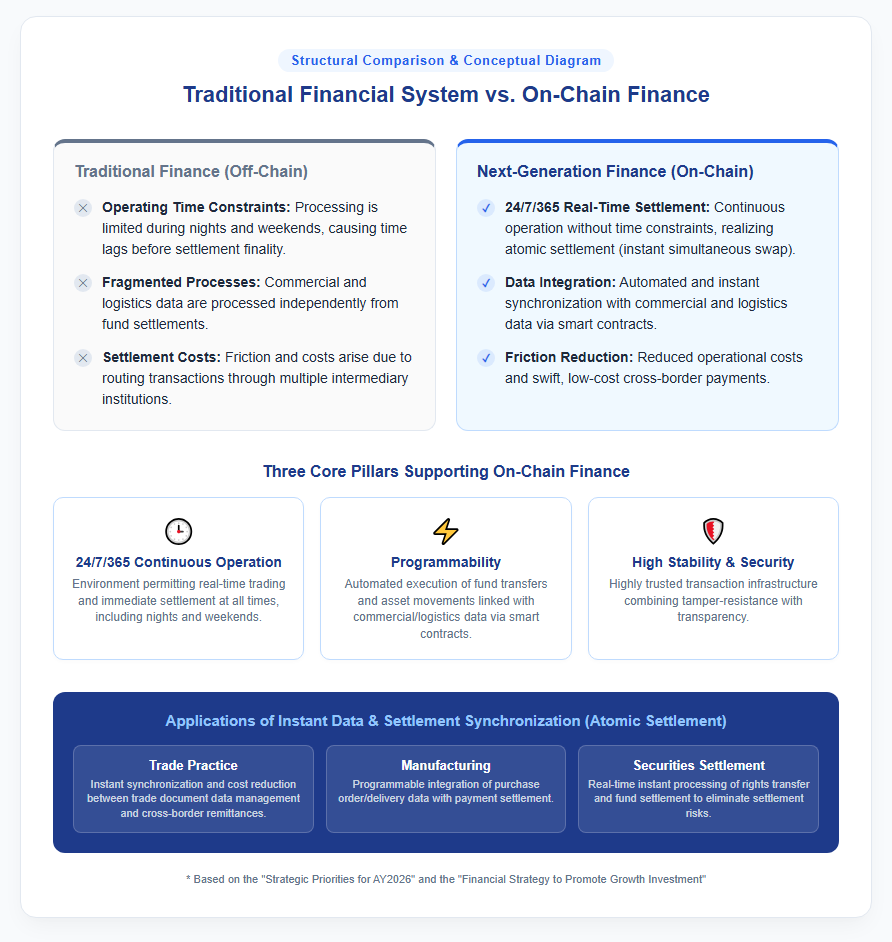
By instantly synchronizing fund settlements with logistics and commercial data across areas such as documentation management in trade practice, order/delivery data management in manufacturing, and securities settlement, enterprises are expected to achieve operational cost reductions and productivity gains (realizing atomic settlement). Furthermore, compared to traditional cross-border remittances involving multiple intermediary institutions, fast, low-cost cross-border payments become feasible, significantly reducing friction across economic activities.
Public-Private Roadmap Formulation and Forum Launch
To systematically advance the societal implementation of on-chain finance, the FSA established the “On-Chain Finance Forum for the AI Era” in the summer of 2026 to conduct cross-departmental reviews alongside relevant ministries. The forum plans to compile an interim report by early 2027. Three primary review tracks have been established: promoting societal implementation, establishing a supportive environment, and adapting to emerging technologies such as AI.
Specific initiatives include creating a public-private roadmap for on-chain finance that integrates logistics, commerce, and settlement, as well as supporting PoC trials through the FSA’s “Payment Modernization Project (PIP).” The goal is to encourage transition into real transactions and create tangible use cases such as trade settlement and public disbursements.
Furthermore, regarding institutional review topics, discussions are underway to ensure interoperability between yen-denominated stablecoins and foreign currency-denominated stablecoins through dialogue with international authorities, tokenization of JGBs, and identifying legal/technical issues regarding BOJ current accounts on-chain. Public and private sectors are jointly accelerating preparations toward practical implementation while ensuring alignment between technical and legal finality.
AI Agent Utilization, Cybersecurity, and PQC Measures
An indispensable element in the future of on-chain finance is the role of AI (Artificial Intelligence) and AI agents. The Financial Strategy predicts the arrival of “Agentic Commerce,” where AI agents autonomously conduct economic activities and commercial transactions on behalf of humans. Because transactions conducted by AI agents occur with high frequency and micro-denominations regardless of time zones or languages, a 24/7 instantly operational on-chain settlement base is essential.
Please refer to the figure below.
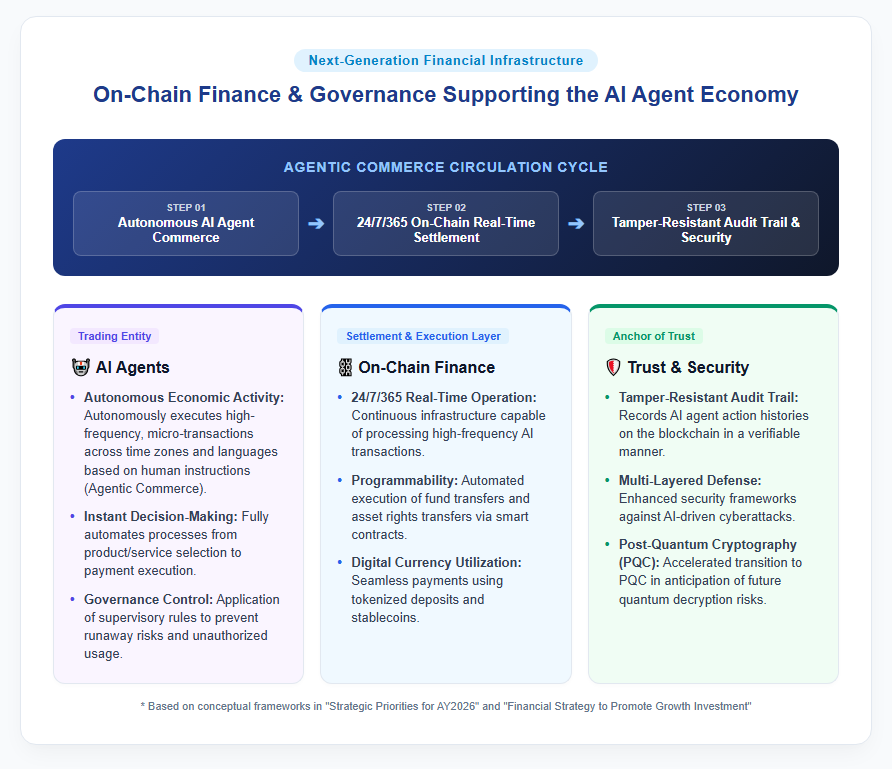
While acknowledging the potential of AI to fundamentally transform the financial industry, the FSA is reviewing supervisory and governance frameworks to mitigate AI runaway risks and unauthorized use. Through study groups such as the “Study Group on Promoting Sound Utilization of AI,” the agency intends to strongly support sound innovation.
In addition to strengthening multi-layered defenses against AI-powered cyberattacks, promoting migration to Post-Quantum Cryptography (PQC) to counter future decryption risks posed by quantum computing has been formally included in administrative priorities. Creating tamper-resistant audit trail infrastructure capable of recording AI agent action histories in a verifiable manner is strongly demanded to balance security and trust.
Market and Institutional Impact, and Future Outlook
Best Mix with Existing Financial Infrastructure and Asian Expansion
The rise of on-chain finance is forcing traditional financial institutions, such as banks and securities firms, to redesign their business models. As the transition unfolds from a traditional bank-integrated model toward a three-layered architecture—Infrastructure, Asset, and Service layers—routine settlement and record-keeping will shift to smart contracts, positioning financial institutions to strengthen their role as “anchors of trust” assuming legal liability, governance, and discretionary judgment.
Rather than immediately replacing existing off-chain financial infrastructure, building a “best mix” that combines the strengths of both approaches is recognized as a realistic path to enhance efficiency while preventing market disruption. For financial institutions, adapting to the next-generation financial OS and creating new value-add through division of labor with technology will determine future survival.
Moreover, the FSA is extending this effort beyond domestic borders to deepen cooperation within Asia. Coinciding with “Japan Fintech Week” scheduled for February–March 2027, the FSA will host “Asia Day 2027” to drive public-private policy dialogues with Asian nations on enhancing cross-border remittances and cross-border on-chain finance. The objective is for Japan to lead in fostering digital financial integration across the region.
Regulatory Enhancements, Market Surveillance, and Key Watchpoints for 2027
Achieving societal implementation of on-chain finance requires not only technical verification but also comprehensive legal, tax, and market surveillance frameworks. Following discussions at the Financial System Council, regulatory approaches to crypto-assets and tokenized assets are being overhauled, exploring shifts from Payment Services Act-centered regulation to the Financial Instruments and Exchange Act, introducing insider trading prohibitions, and clarifying disclosure requirements.
Additionally, in its FY2027 budget and staffing requests, the FSA is expediting organizational capability building, including establishing new specialized divisions dedicated to monitoring crypto-asset exchange service providers and addressing frontier AI risks. The goal is to ensure market integrity and transparency, enabling institutional investors and general users to participate with confidence.
Key developments to watch moving forward include:
- The interim report expected in early 2027 from the “On-Chain Finance Forum for the AI Era” launched in summer 2026
- The progress of PoC projects transitioning into live commercial transactions via the Payment Modernization Project (PIP)
- Public-private agreements and implementation roadmaps with Asian nations at “Asia Day 2027” in spring 2027
- Concrete policy directions regarding the on-chain integration of JGBs and BOJ current accounts targetable for early 2027
Attention remains focused on whether Japan’s financial market can establish global standards for the digital era.
Reference Pages
- [Key Points of AY2026 Financial Administrative Policies] https://www.fsa.go.jp/news/r8/202609/260915.html
- [AY2026 Financial Administrative Policies (Full PDF)] https://www.fsa.go.jp/news/r8/202609/strategic_priorities_2026_main.pdf
- [Cabinet Secretariat: Financial Strategy to Promote Growth Investment] https://www.cas.go.jp/jp/seisaku/nipponseichosenryaku/kinyu/index.html
- [National Tax Agency: A Study on the Tax Treatment of DeFi (Decentralized Finance)] https://www.nta.go.jp/about/organization/ntc/kenkyu/ronsou/113/02/index.htm
【#OnChainFinance #FSA #FinancialAdministrativePolicy #BasicPolicy2026 #Blockchain #DeFi #Web3 #CryptoAssets】


コメント