Toyota Motor Corporation’s Customer First Promotion Group has adopted a cloud-based low-code platform to digitize its accounting processing, which handles over 10,000 cases annually, reducing operational steps by approximately 46%. This move aims to eliminate manual data re-entry and rework while establishing robust internal controls that comply with US SOX auditing requirements.
- Key Highlights of Platform Adoption at Toyota’s Customer First Promotion Group
- Conventional Analog Operations and Challenges Facing the Field
- Technical Approach Achieving a 46% Reduction in Processing Steps
- Strict Compliance Measures for the Electronic Books Maintenance Act and US SOX Act
- Departmental Rollout and Future Concept for Generative AI Utilization
- Implications for Industry Demonstrated by Back-Office Reform in a Large Enterprise
Key Highlights of Platform Adoption at Toyota’s Customer First Promotion Group
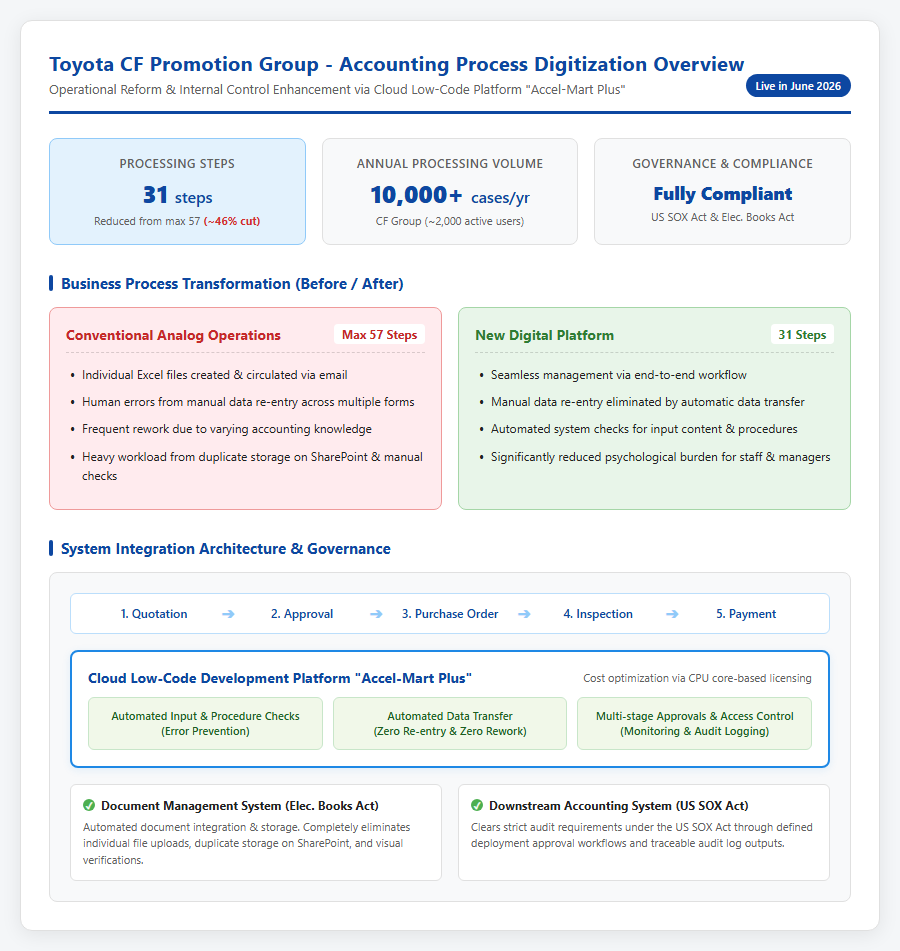
Toyota Motor Corporation’s Customer First Promotion Group (CF Promotion Group) adopted NTT DATA Intra-mart’s cloud-based low-code platform, “Accel-Mart Plus,” to digitize accounting processes covering over 10,000 purchases of goods and services annually. The new system went live in June 2026. Through this digital transformation, the maximum number of processing steps in the conventional workflow was reduced by approximately 46%, dropping from 57 to 31 steps. Furthermore, the initiative simultaneously achieved a robust governance framework by preventing input errors and satisfying audit requirements under the US SOX Act. In a global automaker, this initiative balancing efficiency and accuracy in back-office operations stands out as a landmark case of enterprise-level DX.
Conventional Analog Operations and Challenges Facing the Field
Toyota’s CF Promotion Group bears comprehensive responsibility for ensuring safety and quality across the entire product lifecycle for customers worldwide. Meanwhile, in its day-to-day accounting processes attached to procurement—ranging from obtaining quotes, planning approvals, and issuing purchase orders to inspection and payment—individually created Excel files had long been circulated. Under this analog operation, structural challenges became chronic:
- Human errors caused by manual data re-entry across multiple forms
- Frequent rework in downstream processes due to varying accounting knowledge among originators and approvers
- Heavy workloads from duplicate storage of supporting documentation on SharePoint for internal sharing and manual visual checks
Although the CF Promotion Group established common manuals and thoroughly educated staff on compliance with regulations like the Electronic Books Maintenance Act, relying solely on human attention failed to eradicate errors. Such inefficient tasks created significant psychological burdens for both originators and managers, making end-to-end systemization of the entire business process an urgent priority.
How the New System Balances Efficiency and Internal Control
Technical Approach Achieving a 46% Reduction in Processing Steps
The CF Promotion Group launched a business process improvement project in October 2024 and began system development in July 2025. “Accel-Mart Plus” was selected due to its ability to build a seamless end-to-end workflow from quotation to payment, its extensive API integration capabilities for connecting flexibly with existing systems, and its cost optimization through a CPU core-based licensing model. Rather than pursuing complete in-house development, Toyota chose a development structure utilizing technical support from development partners and NTT DATA Intra-mart to prevent systems from becoming black boxes or reliant on specific individuals following employee reassignments. Key functional improvements implemented include:
- Automated system checks for input content and processing procedures
- Automatic data transfer from preceding to subsequent processes, eliminating manual re-entry
- Automatic integration and storage of supporting documents with a document management system compliant with the Electronic Books Maintenance Act
These automated mechanisms eliminated the need for manual double-checks and duplicate storage verifications, successfully achieving a dramatic reduction in operational steps and easing field workloads.
Strict Compliance Measures for the Electronic Books Maintenance Act and US SOX Act
For Toyota Motor Corporation, which is listed on the US stock market, the accounting platform that transfers data to downstream accounting systems is subject to strict audits under the US SOX Act. Consequently, constructing the new system required not only operational efficiency but also meeting stringent governance and security standards. The project team ensured full compliance with the Electronic Books Maintenance Act while designing and implementing strict system operational rules to satisfy audit requirements. Specific measures to strengthen internal controls included defining multi-stage approval workflows for program code modifications and deployment, establishing daily system health monitoring processes, and designing audit log output specifications to enable third-party tracking. As a result, the organization transitioned from manual check-dependent operations to a robust internal control framework where compliance is automatically enforced by the system. As shown in the overview diagram below, secure data integration is guaranteed.
Future Outlook and Social Significance in Enterprise DX
Departmental Rollout and Future Concept for Generative AI Utilization
As the new accounting system that went live in June 2026 takes root within the CF Promotion Group, ongoing functional expansions and continuous improvements are being driven by user feedback. Leveraging the significant reduction effects and internal control model proven in the CF Promotion Group, Toyota is considering a phased rollout to other divisions across the company. Furthermore, as a future concept, further business transformation combining advanced digital technologies is under review. Specifically, this includes implementing an automated assist feature for accounting and legal judgments using generative AI. By having generative AI support complex regulation interpretations and historical case inquiries in real time, Toyota aims to standardize decision-making tasks that require specialized knowledge, further reducing the operational burden on originators and approvers. The fusion of low-code platforms and generative AI is expected to mark the next step toward complete automation in back-office operations.
Implications for Industry Demonstrated by Back-Office Reform in a Large Enterprise
This initiative by Toyota Motor Corporation, a leading global enterprise in Japan, offers major insights into how back-office DX should be approached in manufacturing and large-scale organizations. While many companies have prioritized digitizing front-line departments like sales and manufacturing, administrative departments such as accounting and legal have often been left with legacy processes and manual work. However, this case demonstrates that utilizing a low-code platform enables organizations to modernize legacy operational structures quickly and cost-effectively.
- Preventing vendor lock-in, black-boxing, and individual reliance through collaboration with development partners
- Customized development prioritizing user experience (UX) to ensure ease of use in the field
- Simultaneous achievement of operational efficiency (approx. 46% step reduction) and regulatory compliance (SOX Act and Electronic Books Maintenance Act)
To achieve sustainable growth amid rapidly changing global conditions and regulatory environments, enterprises must enhance productivity and governance not only in direct business units but also in administrative functions. Toyota’s initiative serves as a guidepost for accelerating digital transformation across administrative divisions in all industries.
Reference Pages
- 【NTT DATA Intra-mart Co., Ltd. Case Study】https://www.intra-mart.jp/case-study/006482.html
- 【NTT DATA Intra-mart Accel-Mart Plus】https://www.accel-mart.com/plus.html
【#Toyota #AccountingDX #LowCode #AccelMartPlus #OperationalEfficiency #InternalControl #SOXAct】
コメント