Following the Bank of Japan’s decision at its Monetary Policy Meeting on September 18, 2026, to raise its policy rate to 1.25%, dissenting votes on the Policy Board and receding expectations for a rapid acceleration in future rate hikes sparked a broad-based sell-off of the yen, driving USD/JPY sharply higher to around 157.14 yen. The market reaction reflected priced-in expectations of the rate increase and the continuation of the wide interest rate gap following the FOMC meeting.
- Additional 0.25% Rate Hike Decision and Dovish Split Within Policy Board
- Broad-Based Yen Sell-Off in Foreign Exchange and Surge in USD/JPY to 157 Range
- Conclusion of FOMC Rate Hike and Persistence of US-Japan Interest Rate Differential
- Positive Stock Market Response and Substantial Rally in Nikkei 225
- Heightened Intervention Caution and Technical Resistance Battles
- Future Monetary Policy Conduct and Pace of Subsequent Rate Hikes
Additional 0.25% Rate Hike Decision and Dovish Split Within Policy Board
At its Monetary Policy Meeting on September 18, 2026, the Bank of Japan decided by a majority vote to raise its policy interest rate, the uncollateralized overnight call rate, by 0.25% to around 1.25%. This rate hike marks the first policy move in three months since June 2026, clearly shortening the interval from the previous pace of roughly once every six months. At 1.25%, the policy rate reached its highest level in approximately 31 years since 1995, surpassing the lower bound of the BOJ’s estimated neutral interest rate range of nominal 1.1% to 2.5% for the first time.
The decision was approved by a 7-to-2 vote. Policy Board members Asada and Sato cast the dissenting votes, adopting a dovish stance that keeping rates unchanged was preferable because recent price trends and economic conditions did not justify a rate hike at this timing. Because some market participants had anticipated an unanimous hawkish vote, the presence of dovish dissents served as a major factor mitigating market anxiety over an aggressive acceleration in the rate hike trajectory.
Please refer to the chart below.
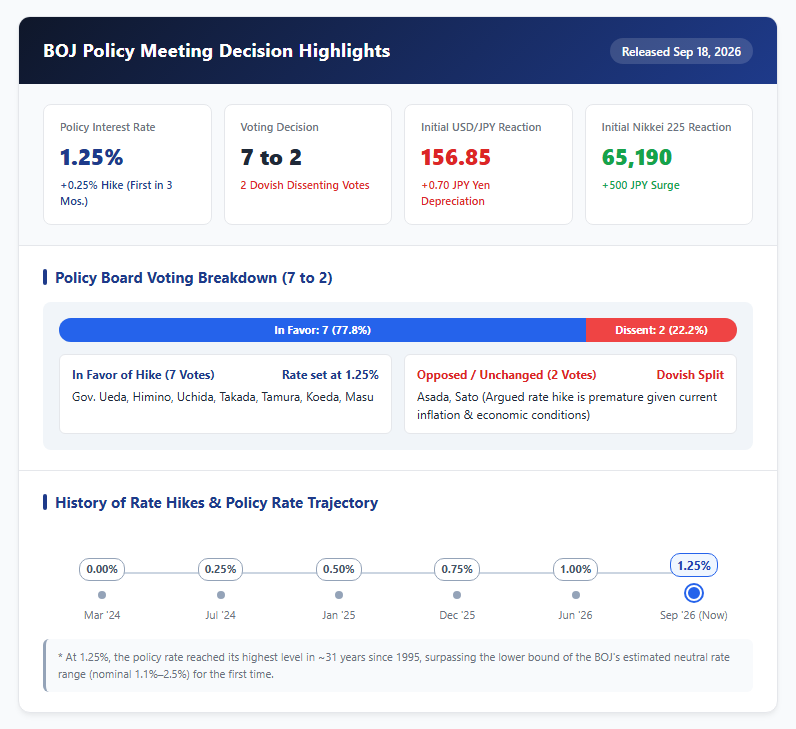
In its official policy statement, the central bank noted that underlying inflation is approaching 2% and explicitly highlighted for the first time that it is important to stabilize underlying inflation around 2% to prevent the risk of an upward overshoot that could negatively affect the economy.
Broad-Based Yen Sell-Off in Foreign Exchange and Surge in USD/JPY to 157 Range
Immediately following the announcement of the interest rate hike by the BOJ, the foreign exchange market reacted with swift and dominant selling pressure on the Japanese yen. USD/JPY, which had been trading around 156.16 yen prior to the release, surged roughly 70 sen in a single minute to around 156.85 yen, followed by sustained buying momentum. During the Tokyo afternoon session, the pair rose further to test the 157.14 to 157.33 yen zone, reaching its highest level in approximately two weeks.
The primary driver behind this widespread yen depreciation was a classic sell-the-fact reaction, as the 0.25% rate increase had already been fully priced in by the market. Furthermore, the two dissenting votes were perceived as a dovish surprise, rapidly dampening speculation that the Bank of Japan would embark on consecutive and swift rate increases.
The weakness was not confined to USD/JPY; EUR/JPY recovered to the 180 yen range and GBP/JPY extended its gains toward the 210 yen mark, demonstrating a comprehensive depreciation of the yen against major currencies. Although market participants increasingly adopted a wait-and-see stance ahead of Governor Ueda’s press conference, initial trading was firmly dominated by clear yen-selling flows.
Financial Environment and Impact on Other Markets
Conclusion of FOMC Rate Hike and Persistence of US-Japan Interest Rate Differential
This Monetary Policy Meeting took place under an unusual schedule, coming right after the US Federal Open Market Committee announced its policy decision early the previous morning. The Federal Reserve unanimously voted to raise interest rates by 0.25%, raising the target range for the federal funds rate to 3.75%–4.00%. This reinforced expectations that high interest rates in the United States will persist for the time being, fostering a market environment supportive of US dollar strength.
Even though the BOJ raised its policy rate by 0.25% to 1.25% on the same day, a substantial interest rate gap of 2.50 to 2.75 percentage points remains between the US and Japan. Because both central banks raised rates simultaneously, the effective interest rate differential did not narrow, leaving the structural dynamics driving yen-selling and dollar-buying carry trades intact, which further fueled yen weakness.
Please refer to the chart below.
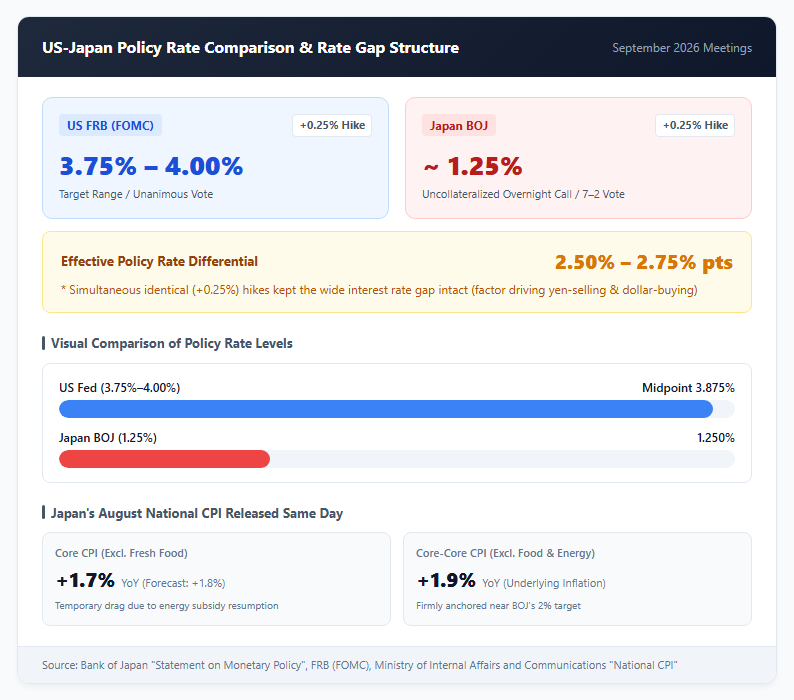
Meanwhile, Japan’s August national core Consumer Price Index, released earlier that morning, rose 1.7% year-on-year, slightly below the market forecast of 1.8%. However, this deceleration was primarily due to the resumption of government energy subsidies, while the core-core CPI excluding fresh food and energy maintained its momentum at 1.9%, having no direct impact on the Bank of Japan’s decision.
Positive Stock Market Response and Substantial Rally in Nikkei 225
Japanese equity markets welcomed the BOJ’s additional rate hike, as relief over the removal of event risk and the earnings boost from a weaker yen outweighed concerns over monetary tightening. The Nikkei 225 index rebounded sharply from around 64,660 yen prior to the decision to around 65,190 yen immediately afterward, surging by roughly 500 yen. Buying momentum continued into the afternoon session, leading to a gain of 882 yen at the close to extend its winning streak for a third day.
In general, central bank interest rate hikes create upward pressure on borrowing costs, posing a headwind for equities. However, market sentiment was lifted by the perception that a rapid acceleration in the rate hike trajectory had been ruled out, alongside expectations that yen weakness above 157 per dollar would enhance full-year corporate earnings for export-oriented businesses.
Capital flowed into a broad range of equities centered on Tokyo Stock Exchange Prime Market leaders, indicating that equity investors are pricing in the continuation of a virtuous economic cycle supported by rising real wages and corporate price pass-through. Even as the BOJ moves forward with policy normalization, the alignment of steady economic growth with moderate inflation continues to provide solid support for risk assets.
Currency Intervention Defense Lines and Future Outlook
Heightened Intervention Caution and Technical Resistance Battles
The rapid rally in USD/JPY to the 157 yen level has revived market caution regarding potential currency intervention by the Japanese government and the Bank of Japan. In late July 2026, Japanese and US monetary authorities conducted joint yen-buying intervention for the first time in roughly 28 years, driving USD/JPY back to the 155 yen range. Coupled with past single-month record intervention exceeding 11.73 trillion yen, market participants widely regard levels above 160 yen as a formidable defense line.
From a technical perspective, heavy sell-limit orders are clustered near the 21-day moving average around 157.0 yen on the daily chart and the psychological 157.0 level, forming a resistance ceiling. On the other hand, a decisive breakout above this zone risks triggering stop-loss buy orders between 157.0 and 157.8 yen, which could accelerate an upward surge toward the 200-day moving average located in the lower 158 yen range.
Market order book data reveals that a substantial volume of short positions established between 155.5 and 156.8 yen are currently carrying unrealized losses. If yen weakness persists further, short covering could serve as additional fuel for a higher breakout.
Future Monetary Policy Conduct and Pace of Subsequent Rate Hikes
Looking ahead, the market’s primary focus centers on how much the Bank of Japan will accelerate its rate hike timeline. Since ending its negative interest rate policy in March 2024, the BOJ had implemented cautious rate increases at an approximate six-month interval. However, executing this latest hike just three months after the June move symbolizes a distinct narrowing of the rate adjustment timeframe.
According to surveys of private sector economists and Overnight Index Swap market pricing, the consensus view is shifting toward a quarterly rate hike cadence. Expectations for the next rate increase are divided between the December 2026 meeting (around 35%) and the January 2027 meeting (around 60%), with the median terminal rate expected around 1.75%.
Governor Ueda stated that future policy decisions will account for expanding AI-related demand and foreign exchange market volatility, signaling a flexible approach to manage inflation overshoot risks. Investors will closely monitor upcoming economic indicators leading into the October Outlook Report meeting and year-end to gauge the progression of the BOJ’s interest rate normalization cycle.
Reference Pages
【#BOJMeeting #USDJPY #YenWeakness #JapaneseEconomy #MonetaryPolicy】

コメント