The Bank of Japan raised its policy interest rate to 1.25% at its September 2026 Monetary Policy Meeting, with Governor Kazuo Ueda indicating that consecutive or larger rate hikes cannot be ruled out depending on price developments. This decision comes against the backdrop of rising corporate prices, persistent yen weakness, and heightened vigilance against domestic and global inflationary pressures.
- Achieving 1.25% for the First Time in 31 Years and a “Shift in the Policy Regime”
- A Hawkish Stance Leaving the Door Open for Consecutive and Larger Rate Hikes
- A 7.6% Surge in Corporate Prices and Three Upside Inflation Risks
- Overseas Central Bank Moves and the Shadow of U.S. Treasury Pressure
- Surprising Initial Market Responses and Banking Sector Trends
- Monetary Policy Outlook and Economic Wave Effects
Achieving 1.25% for the First Time in 31 Years and a “Shift in the Policy Regime”
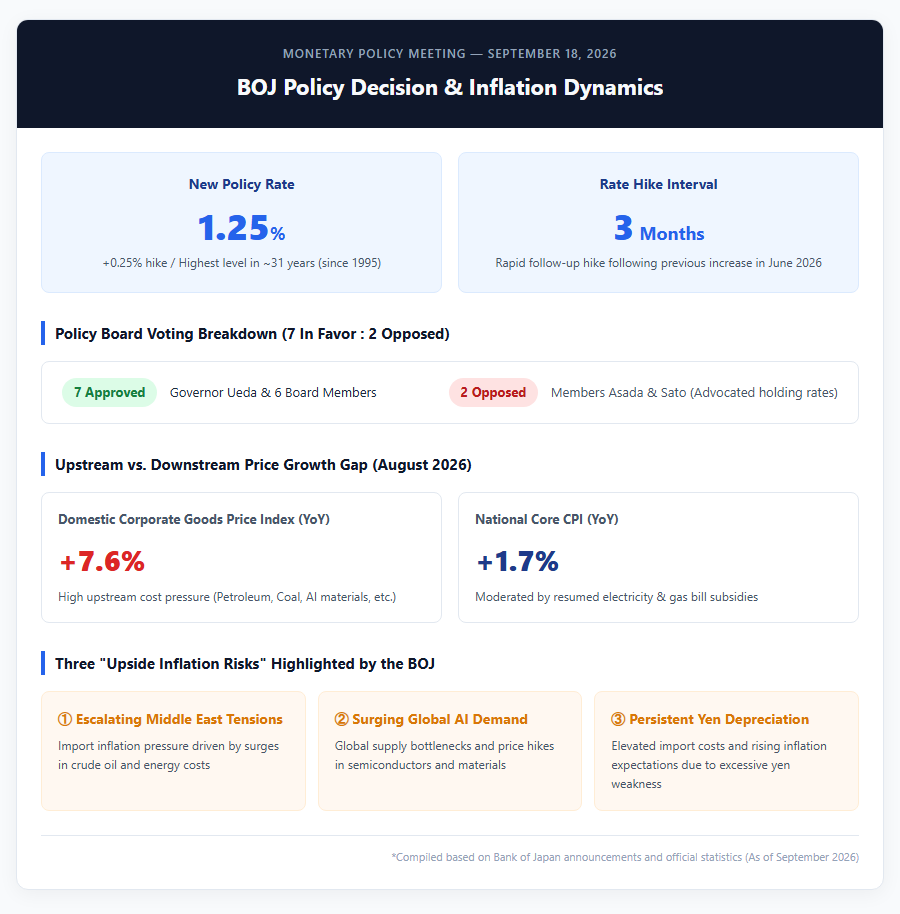
At its Monetary Policy Meeting on September 18, 2026, the Bank of Japan (BOJ) decided to raise its uncollateralized overnight call rate target by 0.25 percentage points to 1.25%. Coming just three months after the previous rate hike in June 2026, this rapid follow-up marked an unusually swift tightening pace. At 1.25%, the policy rate reached its highest level in approximately 31 years, dating back to 1995. Since ending its negative interest rate policy in March 2024, the BOJ had been cautiously scaling back monetary easing at a pace of roughly once every six months; however, this latest move clearly accelerated the tempo of rate increases.
The Policy Board approved the rate hike by a 7–2 majority vote. Seven members, including Governor Kazuo Ueda, voted in favor, while two members—Toyoichiro Asada and Ayano Sato—dissented. The dissenting members advocated for keeping the policy rate unchanged, arguing that the central bank should carefully monitor the momentum of consumer prices and broader economic recovery. Despite internal caution, the BOJ pushed forward with its transition toward a world with positive interest rates, raising the interest rate applied to complementary deposit facilities to 1.25% and the basic loan rate to 1.5%.
A Hawkish Stance Leaving the Door Open for Consecutive and Larger Rate Hikes
In a press conference following the decision, Governor Kazuo Ueda noted that underlying inflation is steadily approaching the 2% target, warning that the risk of inflation overshooting expectations is beginning to materialize. He underscored this shift by stating, “The previous regime of accommodative monetary policy has changed.” The BOJ’s official statement incorporated new language, emphasizing that it is vital to stabilize inflation around 2% to prevent underlying price growth from overshooting the target and negatively affecting the economy.
When asked about the future pace of rate increases, Governor Ueda noted that while the central bank is not bound by a predetermined calendar or fixed intervals, “no specific approach can be ruled out depending on price developments,” including consecutive hikes at back-to-back meetings or a larger 0.50% increase in a single step. By abandoning the conventional framework of “0.25% every six months,” the BOJ demonstrated a decidedly hawkish willingness to tighten policy flexibly as conditions warrant. Regarding the terminal rate—the ultimate endpoint for policy rates—and the level of the neutral rate, Ueda described them as “concepts that are extremely difficult to specify precisely in advance,” indicating that the central bank will adjust policy as it evaluates incoming economic and inflation data.
Please refer to the figure below.
Inflation Dynamics and the Global Backdrop Driving Accelerated Rate Hikes
A 7.6% Surge in Corporate Prices and Three Upside Inflation Risks
The primary catalyst behind the BOJ’s accelerated tightening is intense upstream price pressure and the risk of persistent inflation. On September 11, 2026, the BOJ reported that the Corporate Goods Price Index (CGPI) for August rose 7.6% year-on-year, highlighting sustained cost inflation in inter-company transactions. Price gains were particularly pronounced in petroleum and coal products, information and communication equipment, and non-ferrous metals. Meanwhile, the national Core Consumer Price Index (core CPI) for August rose a more modest 1.7% year-on-year, moderated by the resumption of government subsidies for electricity and gas bills; excluding fresh food and energy, underlying inflation hovered near 2%.
The BOJ identified three primary upside risks to its inflation outlook:
- Escalating tensions in the Middle East, leading to spikes in crude oil and energy costs
- Surging global demand for artificial intelligence (AI), tightening supplies of semiconductors and raw materials
- Excessive yen depreciation in foreign exchange markets, inflating import costs
While a single supply-side shock might be treated as transitory, the BOJ strongly cautions that these overlapping risks could raise inflation expectations among businesses and labor unions. This could prompt companies to pass on costs earlier and unions to demand higher wages, creating a self-fulfilling inflationary spiral.
Overseas Central Bank Moves and the Shadow of U.S. Treasury Pressure
International monetary policy developments also played a critical role in the BOJ’s decision. As major central banks moved in tandem toward tighter policy, the Federal Reserve raised its federal funds target rate by 0.25 percentage points to a range of 3.75% to 4.00% at its FOMC meeting on September 15–16, 2026, marking its first rate hike in three years and two months. The European Central Bank (ECB) also raised its main refinancing rate to 2.65% on September 10, reigniting expectations of prolonged global monetary tightness.
Political dynamics from Washington added another layer of pressure on Japanese monetary policy. U.S. Treasury Secretary Scott Bessent met with Governor Ueda during a G20 gathering, expressing strong support for decisive market and monetary policy measures by Japan to address the significant undervaluation of the yen. Historically, Washington often urged Tokyo to maintain easy monetary policy to spur domestic demand or prevent yen appreciation. However, concern over excessive yen weakness boosting Japanese export competitiveness while fanning U.S. inflation transformed American rhetoric into an unprecedented external push for BOJ tightening. Fearing that lagging behind global peers would further widen interest rate differentials and accelerate yen depreciation, the BOJ felt compelled to act.
Market Reactions and Broader Impacts on Households, Businesses, and the Economy
Surprising Initial Market Responses and Banking Sector Trends
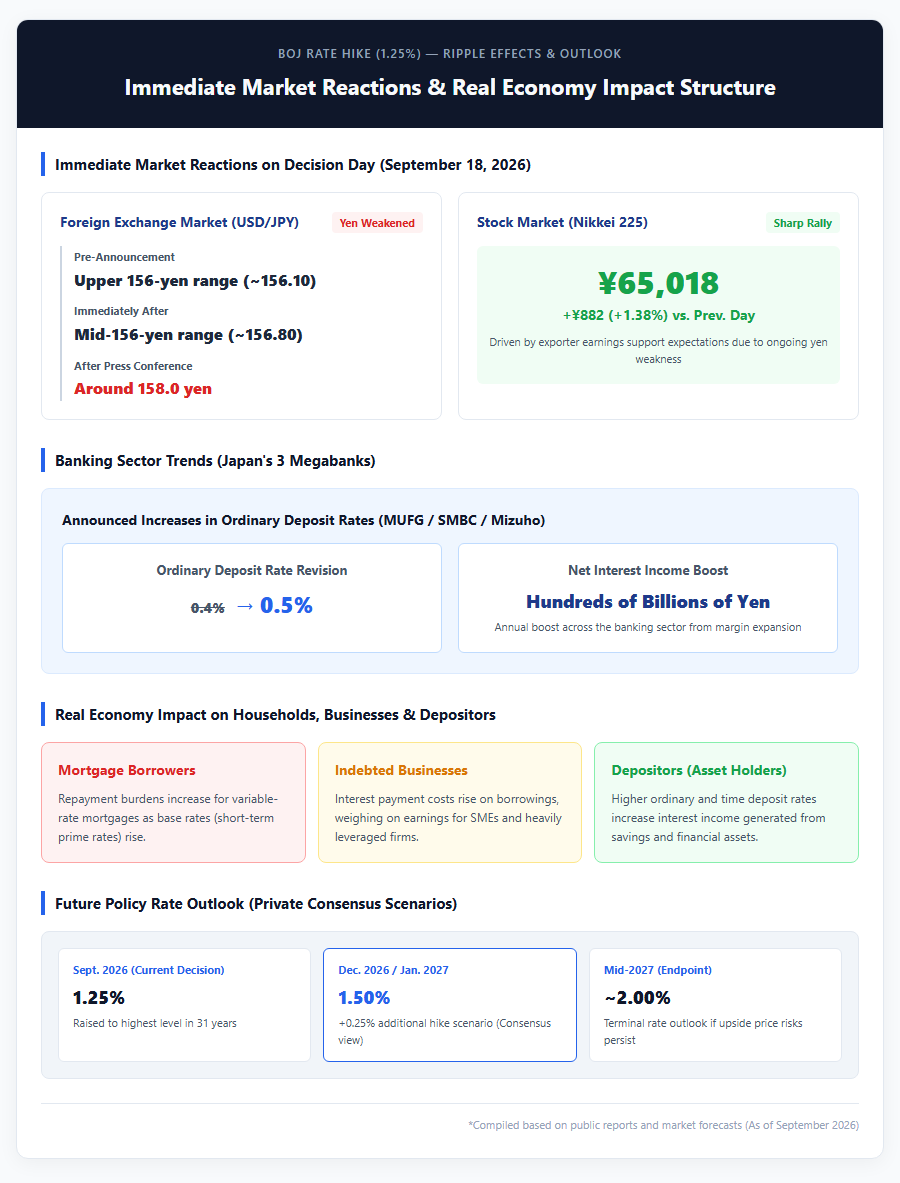
Despite the BOJ’s rate hike and hawkish communications, financial markets exhibited a complex initial reaction. Immediately following the announcement on September 18, the U.S. dollar surged against the yen from the upper 156-yen range to around 156.80 yen, eventually touching the 158-yen level after the press conference. Because the rate hike had been widely anticipated, the two dissenting votes on the Policy Board and Governor Ueda’s hesitation to specify a terminal rate led some market participants to dial back expectations of an immediate, aggressive series of hikes, resulting in renewed yen selling.
In contrast, the stock market rallied strongly, with the Nikkei 225 average closing up 882 yen at 65,018. Investors drew comfort from the sense that the rate hike would not trigger an abrupt economic slowdown, while the persistent weakness of the yen bolstered earnings prospects for exporters. In the financial sector, the arrival of a “world with interest rates” renewed enthusiasm for bank stocks. Japan’s three megabanks—Mitsubishi UFJ Bank, Sumitomo Mitsui Banking Corporation, and Mizuho Bank—promptly announced increases in their ordinary deposit rates from 0.4% to 0.5%. While expanding net interest margins are expected to boost net interest income across the banking sector by hundreds of billions of yen annually, regional banks and megabanks may see diverging impacts depending on their revenue structures and local credit costs.
Please refer to the figure below.
Monetary Policy Outlook and Economic Wave Effects
With the policy rate reaching 1.25%, Japan’s economy and monetary policy enter a pivotal phase. A growing consensus among market analysts and private-sector economists predicts that the BOJ will implement an additional 0.25% rate hike in December 2026 or January 2027, bringing the policy rate to 1.50%. Some research institutions suggest that if upside price risks persist, the policy rate could reach a terminal rate of around 2.00% by mid-2027.
As policy rates enter the lower bound of the estimated neutral rate range (1.1% to 2.5%), the impact will filter directly into the real economy:
- Homeowners: Rising base rates (short-term prime rates) will increase interest payment burdens for both new and existing variable-rate mortgage borrowers.
- Corporate Management: Higher borrowing costs will weigh on corporate earnings, particularly for small and medium-sized enterprises (SMEs) and heavily leveraged firms.
- Depositors: Increased interest rates on ordinary and time deposits will boost interest income for asset-holding households.
As the central bank navigates this uncharted territory, market observers worldwide will closely monitor whether the BOJ can anchor inflation without triggering an economic downturn.
References
- 【Bank of Japan】Conduct of Monetary Policy (September 18, 2026) https://www.boj.or.jp/mopo/mpmdeci/mpr_2026/index.htm
- 【Bank of Japan】Monetary Policy Meetings Schedule and Minutes https://www.boj.or.jp/mopo/mpmsche_minu/index.htm
- 【Bank of Japan】Corporate Goods Price Index (August 2026 Preliminary Report) https://www.boj.or.jp/statistics/pi/cgpi_release/index.htm
- 【Statistics Bureau, MIC】Consumer Price Index (Japan) https://www.stat.go.jp/data/cpi/
- 【Cabinet Office】Quarterly Estimates of GDP https://www.esri.cao.go.jp/jp/sna/menu.html
【#BOJRateHike #GovernorUeda #MonetaryPolicy #JapaneseEconomy #ForexMarket #MortgageRates #CorporatePrices #StockMarket】


コメント