As the Bank of Japan resumes interest rate hikes, the competitive landscape of the home mortgage market—long dominated by online banks—is shifting dramatically, with mega-banks and regional banks regaining a strong market presence. This reversal is driven by widening gaps in deposit procurement costs amidst rising rates and the inherent advantage held by traditional lenders with deep deposit bases tied to primary payroll accounts.
- From Online Bank Dominance to a Resurgence by Mega-Banks and Regional Banks
- How Deposit Funding Costs Control the Fate of Rate Competition
- The Dawn of Variable Rates Exceeding 1% and Rising Repayment Burdens
- The Traps of the 5-Year and 125% Rules and the Risks of Ultra-Long-Term Loans
- Strengthening Regional Financial Capabilities and Capitalizing on Local Client Bases
- Regulatory Inspections and Key Milestones for the Mortgage Market
From Online Bank Dominance to a Resurgence by Mega-Banks and Regional Banks
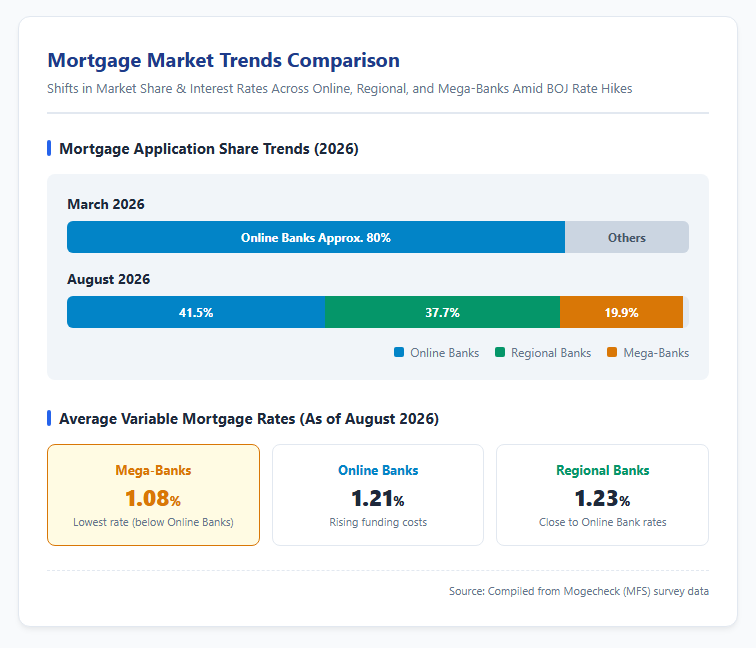
As the Bank of Japan advances a series of interest rate hikes in 2026, the competitive landscape of the home mortgage market is reaching a major turning point. According to data from MFS, operator of the mortgage comparison diagnosis service “Mogecheck,” online banks accounted for roughly 80% of all mortgage applications submitted through the platform as of March 2026. However, by August 2026, the share of online banks dropped sharply to 41.5%, while regional banks rose to 37.7% and mega-banks reached 19.9%, rapidly narrowing the gap. The dominance of online banks, which had long conquered the market with ultra-low interest rates, is now shaking as traditional brick-and-mortar institutions stage a powerful comeback. The primary catalyst behind this reversal is the significant narrowing of interest rate spreads offered across different banking categories. As of August 2026, the average interest rate for variable-rate mortgages stood at 1.21% for online banks, 1.23% for regional banks, and 1.08% for mega-banks—creating a surprising reversal where mega-banks offered lower rates than online banks in certain cases. Borrower mindsets are shifting accordingly; rather than automatically opting for online lenders, consumers are increasingly comparing rate levels and service offerings across all banking categories before making a careful choice.
How Deposit Funding Costs Control the Fate of Rate Competition
The single biggest factor driving this structural shift in rate competition is the rising cost of acquiring deposits following the end of the Bank of Japan’s fund-provisioning operations and subsequent interest rate hikes. As Japan fully transitioned into a “world with interest rates”—marked by the BOJ raising its policy rate from 0.75% to 1.0% in June 2026—the cost of gathering deposits to fund mortgage lending surged. Online banks previously leveraged low funding costs to aggressively offer discounted mortgage rates, but their relatively weak base for primary payroll deposits and daily transaction accounts forced them to offer high promotional interest rates on term deposits to attract funds. Conversely, mega-banks and regional banks benefit from millions of primary payroll and household settlement accounts, giving them a steady influx of low-cost deposits without needing to run aggressive high-yield campaigns. This disparity in procurement costs directly dictates mortgage lending rates, handing traditional mega-banks and regional institutions a clear competitive edge. Online banks are not standing idle, however; following SBI Sumishin Net Bank’s acquisition by NTT Docomo in May 2025, online lenders are forging new strategies to leverage the massive customer bases of telecommunication giants to capture deposits.
The Impact of Rising Interest Rates on Households and Mortgage Choices
The Dawn of Variable Rates Exceeding 1% and Rising Repayment Burdens
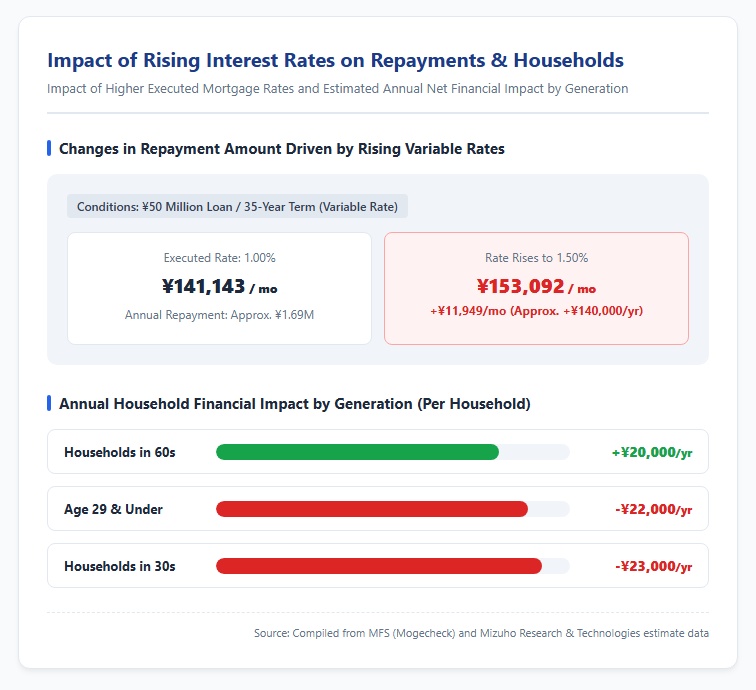
In tandem with policy rate increases, baseline mortgage rates and execution rates are rising noticeably. At most financial institutions, baseline variable rates are set at 1% above the short-term prime rate (around 2.125% in 2026) and are revised twice a year in April and October. As baseline rates were pushed up by successive BOJ rate hikes, variable execution rates at many lenders crossed the 1% threshold by April 2026. Rising interest rates are directly impacting household monthly budgets. According to estimates by MFS, for a 50 million yen, 35-year variable-rate mortgage, a rate increase from 1.00% to 1.50% raises monthly payments from 141,143 yen to 153,092 yen—a monthly increase of 11,949 yen, or nearly 140,000 yen per year. Analysis by Mizuho Research & Technologies highlights a clear generational split: while households in their 60s with substantial financial assets see an annual income gain of about 20,000 yen due to higher deposit yields, younger homeowners under age 29 face an annual net loss of 22,000 yen from heavier mortgage interest, with those in their 30s suffering a 23,000 yen annual decline.
The Traps of the 5-Year and 125% Rules and the Risks of Ultra-Long-Term Loans
During periods of rising variable interest rates, consumers must understand two crucial protective mechanisms: the “5-Year Rule” and the “125% Rule” (or 1.25x Rule). The 5-Year Rule keeps monthly loan payments fixed for five years even if interest rates rise, while the 125% Rule caps any payment increase at the six-year mark to no more than 1.25 times the previous monthly amount. While these rules appear to be a safe buffer protecting household budgets, interest is still recalculated continuously under the new higher rate. Consequently, a larger portion of each monthly payment goes toward interest rather than principal, delaying loan amortization. In extreme rate-hike scenarios, the fixed monthly payment may fail to cover even the accruing monthly interest, giving rise to “unpaid interest” that is added back onto the principal balance. Furthermore, growing alarm surrounds ultra-long-term mortgages with maturities of 40 or 50 years, which grew in popularity amidst soaring property prices. Because interest constitutes an exceptionally large portion of total repayments in a 50-year loan, interest charges can easily eclipse the original principal under higher rates. In response, the Financial Services Agency (FSA) plans to launch comprehensive inspections of commercial bank underwriting standards and borrower disclosure practices starting in autumn 2026.
Survival Strategies of Financial Institutions and Future Outlook
Strengthening Regional Financial Capabilities and Capitalizing on Local Client Bases
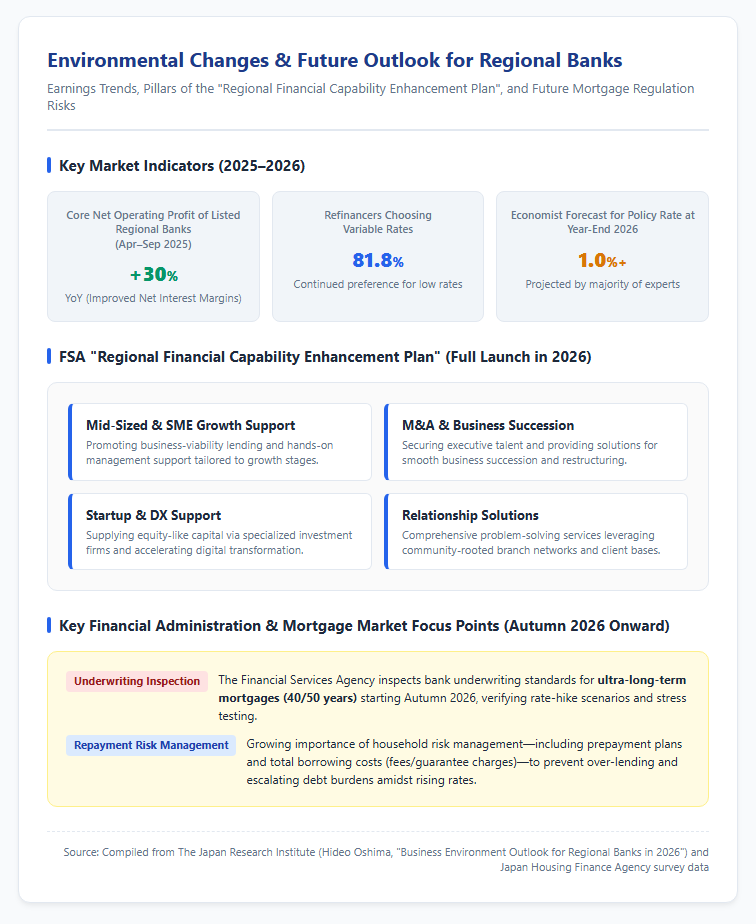
The resumption of interest rate hikes has widened net interest margins (NIMs), creating a welcome tailwind for regional bank profitability. Interim financial results for the April–September 2025 period showed improved margins across numerous regional institutions, boosting the combined core net operating profit of listed regional banks by 30% year-on-year. Yet higher rates bring challenges alongside profits, widening performance gaps among lenders and intensifying competition for depositors and borrowers. Against this backdrop, the Financial Services Agency published its “Regional Financial Capability Enhancement Plan” in 2025, rolling out concrete measures in 2026. Rather than relying solely on higher lending rates, regional financial institutions are strongly urged to demonstrate “regional financial capability” by supporting mid-sized and small-and-medium enterprise (SME) growth, facilitating M&A and business succession, backing local startups, and driving digital transformation (DX). Regional banks are increasingly shifting toward comprehensive, solution-driven consulting that leverages their branch networks and local relationship banking to deepen client ties beyond simple rate competition.
Regulatory Inspections and Key Milestones for the Mortgage Market
Looking ahead at the mortgage market from 2026 onward, the central points of interest will be expectations of further policy rate hikes and tightening regulatory oversight. A majority of economists project that the BOJ’s policy rate will reach 1.0% or higher by the end of 2026, sustaining upward pressure on both short- and long-term interest rates. To prevent excessive debt burdens and predatory over-lending, the FSA is moving aggressively to examine how major banks, regional lenders, and online banks incorporate rate-hike scenarios and stress testing into their underwriting. On the borrower side, a survey by the Japan Housing Finance Agency shows that 81.8% of refinancers still choose variable rates to maximize low-rate benefits; nevertheless, anxiety over rate trajectories is prompting an increasing number of buyers to consider fixed-rate and long-term hybrid loans. In navigating future mortgage decisions, consumers must look beyond headline interest rates to evaluate total borrowing costs—including administrative and guarantee fees—while actively leveraging tax deductions and crafting prepayment strategies to build resilient household financial defenses.
Reference Pages
- 【Business Environment Outlook for Regional Banks in 2026: Resumption of Rate Hikes and Strengthening Regional Financial Capability | The Japan Research Institute】https://www.jri.co.jp/page.jsp?id=112848
- 【Japanese Economy 2006-2007 (Full Text) Chapter 5: Normalization of Financial Markets and Trends in Monetary Policy – Cabinet Office】https://www5.cao.go.jp/keizai3/2006/1208nk/nk06.html
【#MortgageLoans #BOJRateHike #VariableRates #RegionalBanks #MegaBanks #InterestRateTrends】

コメント