The Japanese government has finalized plans to establish a new public entity to support defense equipment exports and bolster domestic production capabilities. The move aims to overcome the limitations of the domestic market, enhance the global competitiveness of Japan’s defense industry, and ensure operational sustainability during contingencies.
- Establishing a New Agency for “Japanese-Style FMS” and Its Background
- Strengthening Sustainment Capability Through GOCO and State Ownership
- Impact of Revising the Three Principles and Abolishing the Five Categories
- Obstacles to Moving Beyond a Single-Customer, Cost-Plus Model
- Debates Over Constitutional Pacifism and Fanning International Conflicts
- Future Prospects for Public-Private Collaboration and Global Expansion
Establishing a New Agency for “Japanese-Style FMS” and Its Background
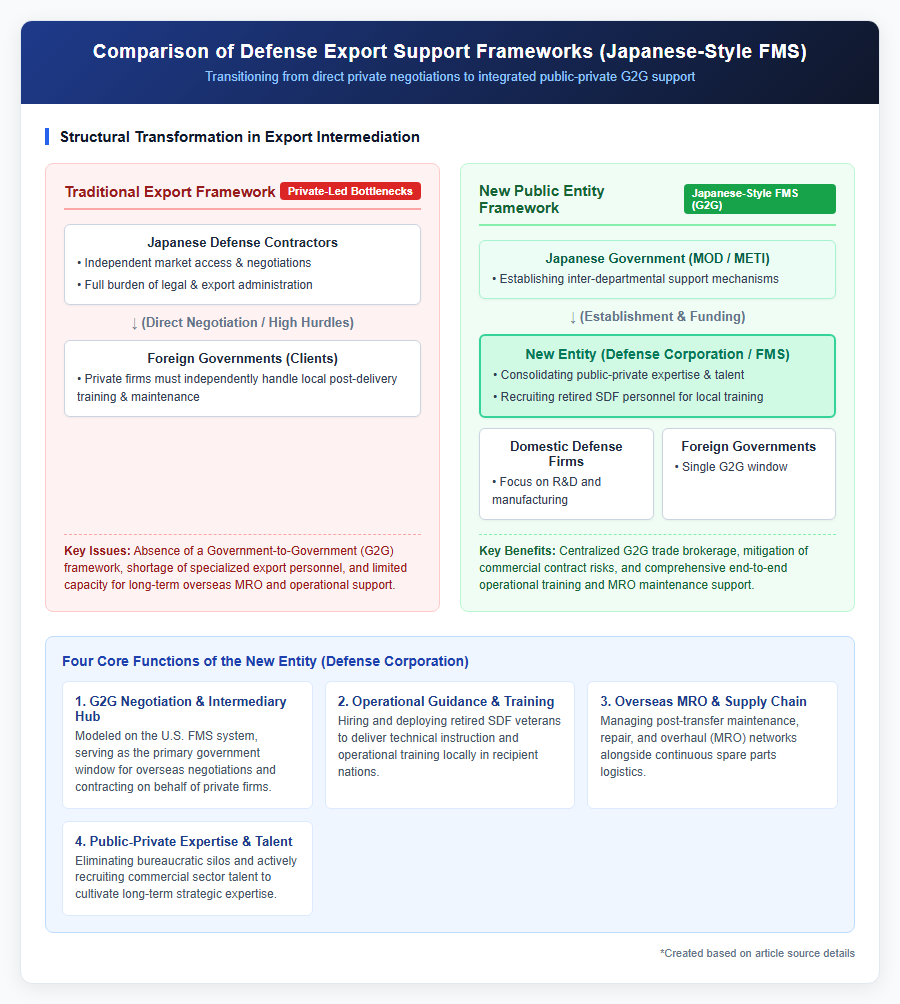
The Japanese government is advancing plans to establish a “Defense Corporation”—a new entity similar to an incorporated administrative agency—designed to support defense equipment exports and strengthen the domestic industrial base. Under traditional defense transactions, private defense contractors had to negotiate directly with foreign governments. The new organization will act as a central interface representing these companies, fulfilling a role akin to a “Japanese-Style Foreign Military Sales (FMS)” system by comprehensively supporting Government-to-Government (G2G) transactions. Specifically, it will broker negotiations with foreign governments and match them with domestic suppliers. Furthermore, its scope of support extends to post-transfer operational guidance and maintenance infrastructure in recipient countries. Rather than relying on active Self-Defense Forces (SDF) personnel to conduct direct training abroad, the new entity plans to recruit retired SDF personnel to provide technical advice and operational instruction locally. Guided by reports from government advisory panels on fundamental defense upgrades and recommendations from the Ministry of Finance, this initiative seeks to break through traditional bureaucratic silos that hamper talent acquisition and foster an environment where public and private expertise can unite. As illustrated in the concept diagram below, an integrated public-private export support structure will be established.
The government plans to reflect these core principles in the updates to key security documents, such as the National Security Strategy at the end of the year, and submit relevant legislation to the ordinary parliamentary session.
Strengthening Sustainment Capability Through GOCO and State Ownership
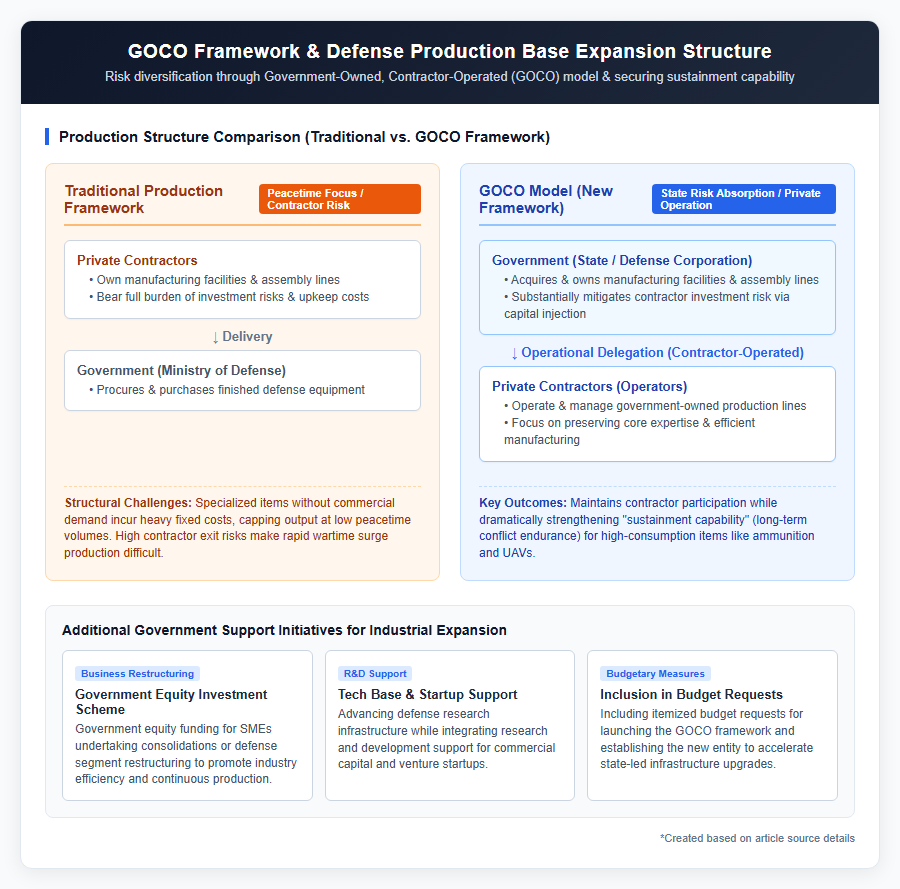
In parallel with establishing the new public entity, the Ministry of Defense is undertaking fundamental reforms of Japan’s defense manufacturing infrastructure to prepare for the mass production of high-consumption items during wartime, such as ammunition and uncrewed aerial vehicles (UAVs). Historically, Japan’s defense industry maintained low-volume production suited only for peacetime, making the securing of “sustainment capability”—the ability to endure prolonged conflict—an urgent priority. To address this, the government is considering the Government-Owned, Contractor-Operated (GOCO) model, where the state acquires and owns manufacturing facilities and production lines while delegating actual operations and management to private contractors. By injecting public funds to nationalize defense-exclusive facilities that lack commercial demand, the government reduces business risk for contractors while maintaining and expanding critical assembly lines. Additionally, new institutional measures have been outlined to allow government equity investments in small and medium-sized enterprises (SMEs) considering business consolidations or defense segment restructuring. Budgetary requests from the Ministry of Defense explicitly include funding for launching the GOCO framework and founding the new entity, alongside integrated support for private capital involvement and startup research and development (R&D). As shown in the following structure diagram, Japan is shifting toward a framework where the state assumes capital risk while private enterprise drives manufacturing.
Regulatory Reforms and Structural Challenges in the Defense Industry
Impact of Revising the Three Principles and Abolishing the Five Categories
The major catalyst behind expanding defense exports is the historic revision of the “Three Principles on Transfer of Defense Equipment and Technology” and its operational guidelines on April 21, 2026. Under the former regime, exports of fully assembled equipment were strictly limited to five non-combat categories: rescue, transport, warning, surveillance, and minesweeping. The 2026 revision abolished these categorical restrictions entirely. Under the new framework, transfer conditions are categorized based on whether an item qualifies as a “weapon” under the Self-Defense Forces Act (equipment designed to directly kill, injure, or destroy). Completed items that do not fall under the definition of weapons are freed from recipient country restrictions. Conversely, completed items classified as weapons remain restricted to international co-development partner nations or countries with which Japan has signed defense equipment and technology transfer agreements (17 nations as of April 2026, including the U.S., U.K., Australia, India, and the Philippines). However, weapon transfers to countries currently engaged in armed conflict remain prohibited in principle, and strict reviews by the National Security Council (NSC) alongside parliamentary notifications are mandatory. Defense contractors must now implement sophisticated export control mechanisms, including proper transaction scheme designs from the initial contract phase and comprehensive ledger tracking.
Obstacles to Moving Beyond a Single-Customer, Cost-Plus Model
Japan’s defense industry is currently benefiting from an unprecedented fiscal expansion, with defense spending reaching a historic total of 43 trillion yen over a five-year period. While major defense prime contractors such as Mitsubishi Heavy Industries (7011), Kawasaki Heavy Industries (7012), and IHI (7013) continue to report strong financial results, deep-rooted structural challenges persist. The defense market remains exceptionally concentrated, with the Ministry of Defense operating as the sole customer. Furthermore, profitability has traditionally been capped under a “cost-plus” pricing model, where a fixed profit margin is added to verified production costs. Consequently, efficiency gains by companies do not easily translate into higher profit margins, discouraging continuous investments in cutting-edge tech and preventing the high profitability seen in commercial markets. Looking globally, South Korea’s defense industry (“K-Defense”) has leveraged major industrial clusters like Changwon and Gumi to offer rapid delivery timelines and cost competitiveness, securing massive export contracts in Eastern Europe and the Middle East for items like the K9 self-propelled howitzer and K2 main battle tank. For Japanese firms to compete internationally, they must break through the traditional barrier of “high quality, high price” and offer comprehensive value propositions that include overseas Maintenance, Repair, and Overhaul (MRO) hubs and strategic partnerships.
Key Concerns and the Medium-to-Long-Term Outlook
Debates Over Constitutional Pacifism and Fanning International Conflicts
Strong reservations and opposition persist regarding the expansion of defense equipment exports and production capacity. On January 23, 2025, the Japan Federation of Bar Associations (JFBA) compiled a formal opinion paper opposing the expansion of defense transfers and submitted it to the Prime Minister as well as the Ministers of Foreign Affairs and Defense. The JFBA’s opinion paper voices deep concern that the long-standing de facto embargo on arms exports under the former Three Non-Nuclear Principles and arms export rules is being systematically eroded. Specifically, the opinion paper highlights the following key points:
- The risk that expanding overseas transfers of lethal weaponry could exacerbate and prolong international conflicts
- Concerns that such moves undermine the core principles of permanent pacifism enshrined in the Constitution of Japan
- The danger of recipient nations and transferable items expanding indefinitely under the guise of enhancing international deterrence
In response to these concerns, the government and defense contractors must maintain rigorous transparency and fulfill strict compliance obligations. Furthermore, businesses entering or expanding in the defense sector face not only security-related export control risks but also the imperative task of managing corporate image and reputational risks.
Future Prospects for Public-Private Collaboration and Global Expansion
Policy measures strengthening the defense production base and supporting exports will profoundly shape Japan’s security landscape and industrial structure. At the end of 2026, the government is scheduled to revise its three key security documents—the National Security Strategy, National Defense Strategy, and Defense Buildup Program—which, alongside a new Defense Production and Technology Base Strategy, will establish concrete operational guidelines. Joint international projects with allied and like-minded nations are already underway, including the Global Combat Air Programme (GCAP) for next-generation fighter jets with the U.K. and Italy, as well as the supply and local maintenance support for general-purpose frigates for Australia. Once operational, if the Defense Corporation enables comprehensive overseas MRO support and government-level negotiations that individual contractors could not handle alone, Japan’s defense sector could evolve from a domestic-dependent industry into a growth-oriented export market. However, with administrative lead times expected to grow due to stringent export licensing and parliamentary notification requirements, meticulous public-private strategic planning with a long-term perspective will remain the cornerstone of success.
Reference Pages
- 【Japan Federation of Bar Associations】Opinion Paper Opposing the Expansion of Defense Equipment Transfers https://www.nichibenren.or.jp/document/opinion/year/2025/250123_2.html
【#DefenseEquipment #NationalSecurity #DefenseIndustry #EconomicNews #JapaneseEconomy #ThreePrinciplesOnTransferOfDefenseEquipment】
コメント