In the earthquake-damaged Noto region, the failed bidding rate for disaster recovery public works—such as roads and rivers—has reached nearly 30%, raising severe concerns over reconstruction delays. This issue stems from deep-rooted structural challenges, including acute labor shortages among local contractors, difficulties in procuring essential materials like ready-mix concrete, a lack of worker accommodation in remote areas, and a widening gap between official cost estimates and actual market prices.
- The Reality and Numbers Behind Widespread Bidding Failures in Disaster Recovery
- Severe Bottlenecks in Infrastructure Restoration and Publicly Funded Demolition
- Labor Shortages and Material Procurement Constraints in Ready-Mix Concrete and Aggregates
- Discrepancies in Official Cost Estimates and Lack of Worker Accommodation
- Relaxing Bidding Eligibility and Building Regional Construction Frameworks
- Reflecting Incremental Costs Appropriately and Alleviating Engineer Burdens
- Managing Long-Term Recovery Timelines and Sustainable Regional Rebuilding
The Reality and Numbers Behind Widespread Bidding Failures in Disaster Recovery
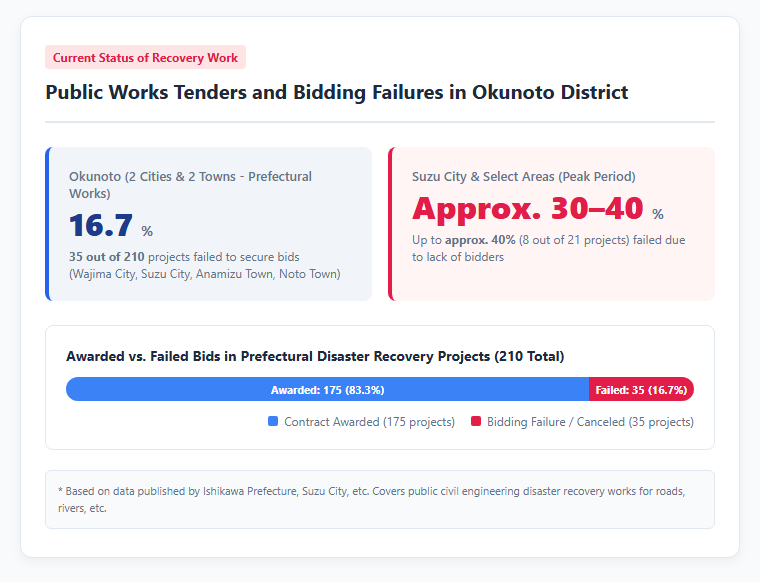
In the aftermath of the 2024 Noto Peninsula Earthquake that struck in January 2024, full-scale infrastructure recovery work has been underway across the affected Noto region in Ishikawa Prefecture. However, public works tenders are increasingly suffering from bidding failures and failed auctions due to a lack of participating contractors, casting a dark shadow over reconstruction progress. According to data tracked by Ishikawa Prefecture, 35 out of 210 public civil engineering disaster recovery projects issued by the prefecture in the Okunoto district (Wajima City, Suzu City, Anamizu Town, and Noto Town) suffered bidding failures, representing a failure rate of 16.7%. In severely impacted municipalities like Suzu City, the situation is even more critical, with failed bids rising to nearly 30% to 40% of tendered projects during certain periods. Please refer to the figure below.
These prolonged bidding failures directly delay the recovery timeline for essential infrastructure such as roads, rivers, and ports. Although a vast number of disaster recovery projects are being launched simultaneously, there is a severe shortage of bidding companies. Consequently, repeated retendering often fails to secure contractors, creating a vicious cycle. Increasing the contract award rate for public works and securing a smooth construction system have become urgent priorities for the early rebuilding of local communities.
Severe Bottlenecks in Infrastructure Restoration and Publicly Funded Demolition
Bidding failures do not merely delay the start of civil engineering projects; they also trigger widespread ripple effects across the entire reconstruction process for disaster-affected residents. The impact is particularly pronounced in publicly funded demolition projects aimed at removing collapsed houses and commercial structures. Frequent bidding failures in demolition contracts have led to unavoidable and significant delays beyond the original completion targets. Without completing these public demolitions, residents cannot move forward to the next steps of recovery, such as rebuilding homes, transitioning out of temporary housing, or reopening businesses.
Furthermore, delays in restoring roads and rivers restrict local transport networks, impeding daily mobility as well as the revival of logistics and tourism. While Ishikawa Prefecture is leveraging direct government intervention programs to restore coastal stretches of National Route 249, persistent bidding failures on local secondary roads and arterial connections continue to prolong the path toward comprehensive regional recovery. Compounded by capacity limits at temporary storage sites and final disposal facilities for disaster debris, the entire sequence from demolition to civil restoration faces a heightened risk of prolonged stagnation.
Structural Factors Driving Bidding Failures and On-Site Limitations
Labor Shortages and Material Procurement Constraints in Ready-Mix Concrete and Aggregates
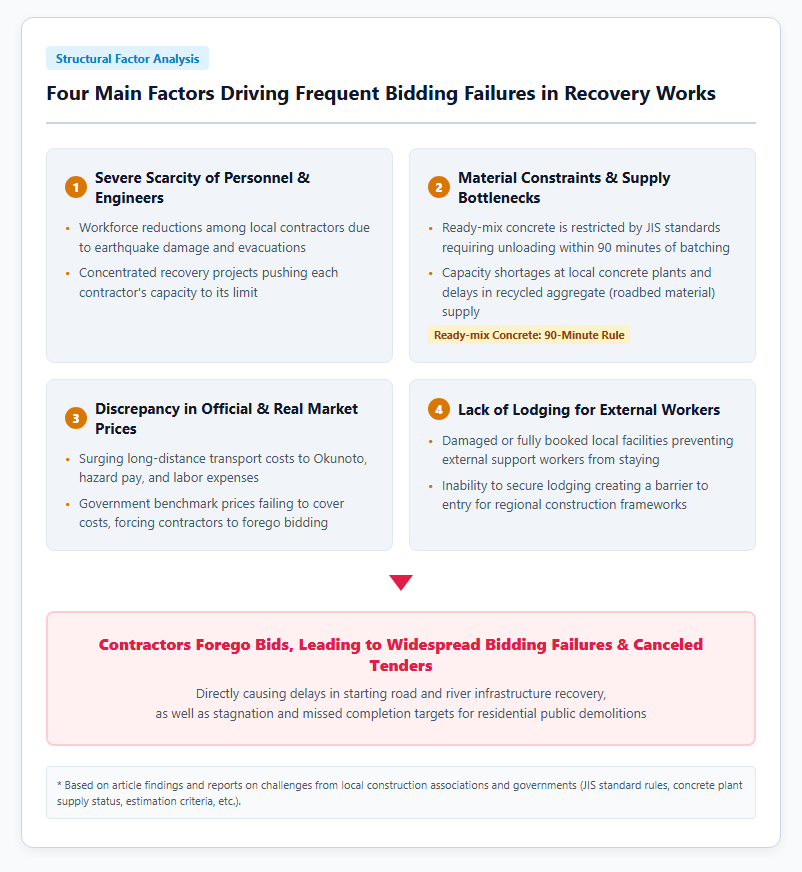
The recurring bidding failures in recovery projects are driven by Noto’s unique geographical conditions and severe structural resource shortages. The primary factor is a chronic scarcity of engineers and skilled construction workers among local contractors. Since the earthquake, workforce reductions caused by local displacement and evacuations, combined with an overwhelming concentration of projects assigned to limited staff, have pushed contractor capacity to its absolute limit. Local construction associations have voiced desperation, stating that taking on additional projects under existing operational setups is virtually impossible.
The second major factor is the constrained supply of vital construction materials, particularly ready-mix concrete and roadbed aggregates (recycled aggregate). Under Japanese Industrial Standards (JIS), ready-mix concrete must be unloaded at the job site within 90 minutes of batching. However, operational concrete plants in the Okunoto region are extremely limited, rendering them unable to keep pace with surging demand. Additionally, the recycling pipeline that processes disaster debris into roadbed material is not functioning smoothly. Anticipating an inability to secure required materials on-site, many contractors frequently opt out of bidding altogether. Please refer to the figure below.
Discrepancies in Official Cost Estimates and Lack of Worker Accommodation
The third major factor is a cost mismatch between the official benchmark prices set by local governments and the actual market prices required for execution. Because the Noto region is geographically distant from major urban centers like Kanazawa City, long-distance transportation costs for machinery, materials, and crews escalate rapidly. Coupled with surging labor costs and special hazard allowances unique to disaster zones, local government budget ceilings frequently fail to cover real-world expenses, forcing contractors to abandon bid submissions due to unprofitability.
The fourth factor is an acute shortage of lodging for external workers brought in from outside the prefecture or region. In the Okunoto district, local accommodations were heavily damaged by the disaster, while surviving facilities remain fully booked by existing recovery personnel and support teams. Even when contractors manage to recruit workers from distant areas, they cannot deploy them to the field without securing living quarters. These harsh lodging conditions and high-cost structures create formidable barriers to entry for outside firms.
Administrative Countermeasures and Key Focus Areas for Future Recovery
Relaxing Bidding Eligibility and Building Regional Construction Frameworks
In response to frequent tender failures, Ishikawa Prefecture and the Hokuriku Regional Development Bureau of the Ministry of Land, Infrastructure, Transport and Tourism (MLIT) have initiated emergency measures to overhaul traditional bidding rules and construction frameworks. Starting in October 2025, Ishikawa Prefecture relaxed participation requirements for provincial disaster recovery contracts. Specifically, for projects valued between 300 million yen and 1.5 billion yen, contractors located outside Okunoto and Nakanoto within Ishikawa Prefecture are now permitted to join Joint Ventures (JVs).
Furthermore, for large-scale projects valued at 1.5 billion yen or more, construction firms headquartered outside Ishikawa Prefecture that maintain branch offices within the prefecture are now allowed to serve as lead partners in specified JVs. By actively tapping into the technical expertise and financial capacity of major and mid-sized nationwide firms, authorities aim to reduce bid failure rates for workload volumes that local contractors cannot handle alone. The national government is also expanding direct authority execution and Early Contractor Involvement (ECI) models—which integrate contractor expertise during the design phase—to build broader regional construction frameworks.
Reflecting Incremental Costs Appropriately and Alleviating Engineer Burdens
Procuring authorities are also refining operational practices to align budget estimates with market realities and ease on-site burdens. Ishikawa Prefecture updated its pricing policies to allow direct cost markups for worker housing expenses needed to recruit non-local labor, including the installation and removal of prefabricated temporary quarters, as well as rental and lodging fees for apartments and hotels. By rapidly tracking the latest labor and material unit rates and utilizing market quotes, officials are calculating budget ceilings that reflect actual regional costs. Please refer to the figure below.
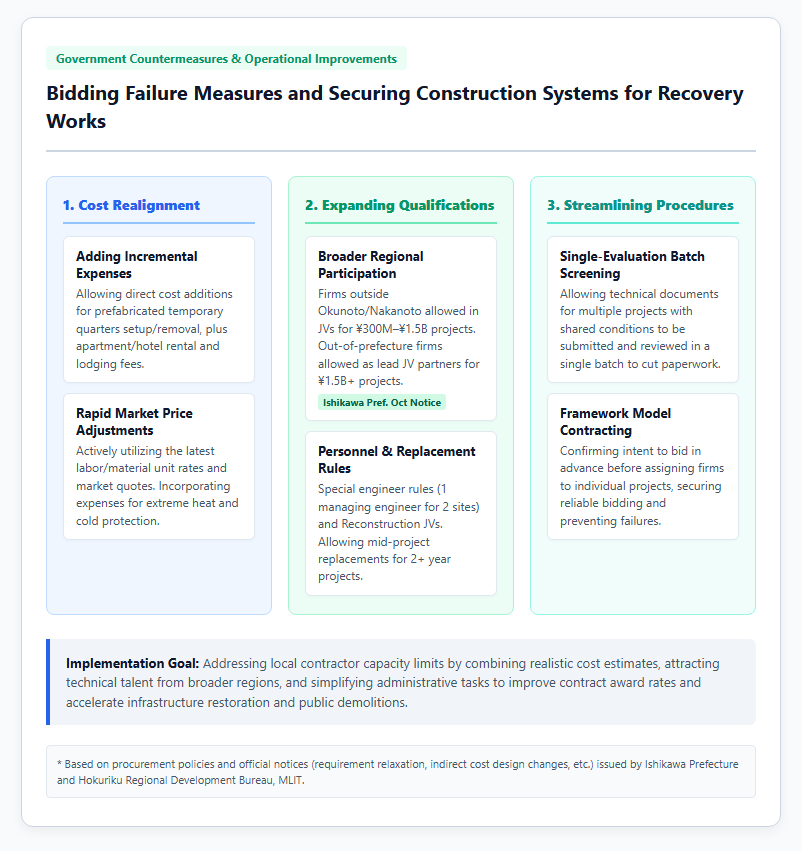
To address workforce shortages on construction sites, administrative procedures are being simplified and engineer assignment rules relaxed. For long-term projects spanning two or more years, mid-project replacements of managing engineers are now permitted. Additionally, policies encourage the use of special managing engineer provisions—allowing one engineer to oversee up to two sites—and the formation of reconstruction JVs. Administrative burdens on bidders are further reduced through single-evaluation batch screening systems for multiple related projects and framework model contracting, which confirms bidding intent in advance before issuing invitations.
Managing Long-Term Recovery Timelines and Sustainable Regional Rebuilding
Recovery and reconstruction following the Noto Peninsula Earthquake require a medium-to-long-term vision focused on future regional sustainability rather than mere infrastructure restoration to original states. Leveraging recovery funds, Ishikawa Prefecture is supporting residential rebuilding, industrial and livelihood revival, and road network enhancements. However, because institutional policy changes take time to yield tangible results on the ground, continuous progress monitoring and flexible administrative adjustments based on field needs remain essential.
The key focus moving forward is whether local governments, the construction industry, and residents can collaborate to establish a sustainable recovery model. Innovative local-circulation initiatives are being proposed, such as utilizing wooden trailer houses built with local timber to supply worker housing. By maintaining strict health management and seasonal weather protections for crews during extended construction schedules, coordinated public-private action to accelerate infrastructure restoration and life recovery will be vital to unlocking Noto’s future.
Reference Pages
- 【Notices Issued Regarding the 2024 Noto Peninsula Earthquake – Ishikawa Prefecture】https://www.pref.ishikawa.lg.jp/gijyutsu/tsuchibun.html
- 【Governor’s Explanation of Bills at the 3rd Regular Session of the Ishikawa Prefectural Assembly in 2025】https://www.pref.ishikawa.lg.jp/chiji/gikai/giannsetumeiyousi.html
- 【Summary of Governor Press Conference (October 29, 2025) – Ishikawa Prefecture】https://www.pref.ishikawa.lg.jp/chiji/kisya/r7_10_29/1.html
- 【Regarding the 2024 Noto Peninsula Earthquake Reconstruction Fund – Ishikawa Prefecture】https://www.pref.ishikawa.lg.jp/fukkyuufukkou/souzoutekifukkousuishin/fukkoukikin.html
- 【Case Studies of Recovery and Reconstruction Projects in Local Governments – Ministry of Land, Infrastructure, Transport and Tourism】http://www.mlit.go.jp/report/press/totikensangyo13_hh_000538.html
【#NotoPeninsulaEarthquake #DisasterRecovery #BiddingFailures #IshikawaPrefecture #ConstructionIndustry #InfrastructureRestoration #PublicDemolition #PoliticsSociety】


コメント