
Anthropic has begun implementing government-issued ID and photo verification (KYC) for its AI service “Claude.” Behind this move are two major factors: the U.S. government’s tightened export restrictions on cutting-edge AI models, and ensuring safety as AI evolves into an autonomous “agent” performing tasks on its behalf.
- Key Points of the Announcement and Target User Scope
- Direct linkage with US AI export controls
- Technical procedures for identity verification and the role of partner companies
- Clarifying responsibility for the evolution to autonomous AI
- Supply Disruption Risks Faced by Engineers in Japan
- AI Sovereignty as a National Strategy and the Significance of Domestic Models
- Transitioning to the new verification process “KYA”
Key Points of the Announcement and Target User Scope
In June 2026, AI developer Anthropic revised its privacy policy to announce that some users will undergo age verification and identity verification using government-issued identification cards. This measure is scheduled to take full effect on July 8, 2026, mainly targeting personal accounts such as Claude’s Free, Pro, and Max accounts. On the other hand, corporate and developer accounts such as Team, Enterprise, and API are currently excluded.
Anthropic cites the purpose of implementing this as protection of minors, blocking fraudulent accounts, enforcement of terms of service, and compliance with legal obligations. However, within the industry, the prevailing view is that AI is positioned as a national strategic asset, laying the groundwork to provide advanced services only to specific trusted targets. In reality, this is not a uniform requirement for all users; it is designed to select targets for access to specific features, platform integrity checks, and safety measures. Please refer to the diagram below.
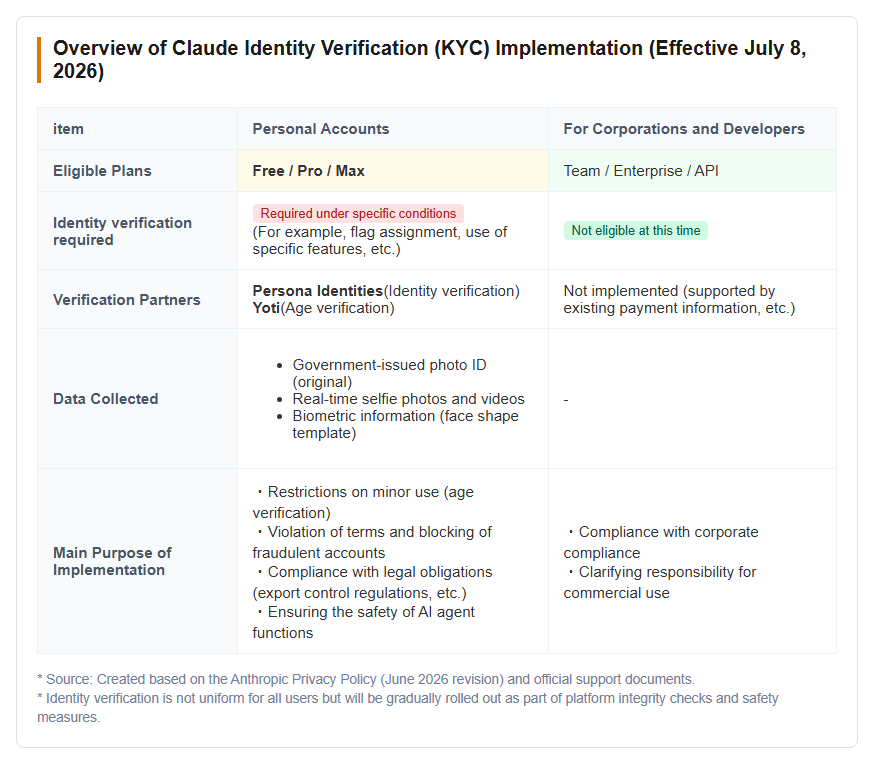
Users deemed to require identity verification may have access to cutting-edge models restricted unless they follow the notification and complete the procedures. This marks a major turning point in the shift from “anonymity” to “real-name and verified identity.”
Direct linkage with US AI export controls
The introduction of identity verification is closely linked to export restrictions on frontier AI models implemented by the U.S. government a few days earlier. On June 12, 2026, the U.S. Department of Commerce issued an unusual order to Anthropic, prohibiting access to its top-tier models, the “Fable 5” and “Mythos 5,” to all foreign users, both inside and outside the U.S., and even to the company’s foreign employees.
When receiving this regulatory order, the API key authentication system at the time could not accurately identify users’ nationality or physical location, forcing Anthropic to temporarily suspend the target model worldwide. As a result, legitimate users outside the United States, including Japan, were also affected and unable to access the service.
Therefore, the newly introduced selfie and ID verification is a technical implementation method to reliably prove that users are unregulated individuals (such as U.S. nationals) and to resume services in compliance with the Export Control Regulations (EAR). For Japanese users, completing identity verification carries the risk that completing identity verification could actually serve as a permanent gate to confirm their foreign nationality and exclude them from top-tier models.
Technical procedures for identity verification and the role of partner companies
The specific identity verification process is not conducted directly by Anthropic, but through an external specialized partner company called “Persona Identities (Persona).” Persona is a leading KYC (Know Your Customer) platform, adopted by companies like OpenAI and LinkedIn.
The steps required of users are as follows.
-
Photos of valid government-issued photo IDs such as passports, driver’s licenses, and national ID cards are taken with a smartphone or PC camera and uploaded.
-
To match with the certificate photo, take a real-time selfie (live selfie) or video on the spot.
-
The system generates templates (biometric information) showing facial shapes from this data to verify that the person is the same person.
To protect privacy, Anthropic does not copy or store submitted ID images on its own servers, but processes them solely on the Persona side. It is also stated that this verification data will not be used to train AI models at all and will not be handed over to third parties for marketing purposes. However, concerns remain persistent about entrusting biometric data—a sensitive information that cannot be changed once leaked—to third-party vendors in other countries, and there have been reports of strong backlash and cancellations in communities like Reddit.
AI Agent Transformation and Its Impact on Organizations
Clarifying responsibility for the evolution to autonomous AI
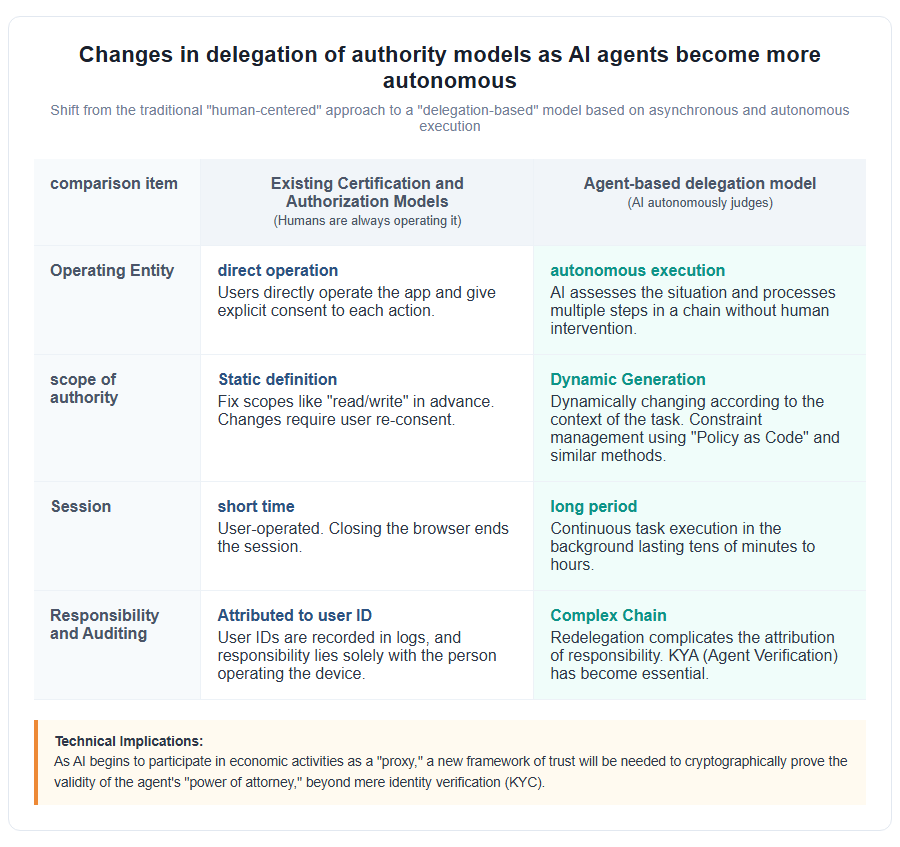
The reason this policy revision suddenly required “identity verification” is that Claude has evolved from a mere chatbot into an “AI agent” that operates cross-service services on behalf of users. Claude is now integrating with external apps such as Google Drive, Slack, and Notion, enabling it to autonomously perform complex tasks involving multiple steps—from searching for tickets to booking and creating itineraries.
As AI begins to perform legally responsible actions such as payments and reservations in the real world, it becomes essential to have mechanisms to identify who gave those instructions. This is because it is necessary to clarify responsibility if an agent causes information leaks or unauthorized access due to poor judgment, or if they enter into an unintended contract.
In other words, this identity verification serves as an investment that lays the foundation for trusting and empowering AI. As AI agents become more autonomous, it is technically inevitable that strict identity verification comparable to financial institutions will be required. The figure below shows the model changes in delegation of authority as AI agents become more autonomous.
Supply Disruption Risks Faced by Engineers in Japan
For Japanese IT engineers and organizations, this incident is not just a privacy issue but highlights an extremely serious risk of “supply chain continuity.” It has been proven that foreign-made AI models, which have been naturally integrated into production systems and internal operations, can be cut off within just a few hours at the slightest order from a foreign government.
To address this risk, engineers need to take the following measures:
-
It provides an abstraction layer that allows the model to be replaced, without relying on hardware code for specific frontier models.
-
As a backup in case of supply interruptions, open-weight models such as Apertus, Llama, or domestic models are evaluated, and designs capable of degenerate operation are introduced.
-
Formally add the item “Suspension of AI Supply Due to Vendor Country Regulations” to threat models and business continuity plans (BCP).
Furthermore, when employees individually verify their identities, a legal review is required regarding the transfer of biometric data to U.S. KYC vendors in light of Japan’s Personal Information Protection Law and internal compliance regulations. Providing data based on careless personal decisions can become an organizational security risk, making policy decisions urgently necessary for companies.
Future Outlook and a New Framework of Trust
AI Sovereignty as a National Strategy and the Significance of Domestic Models
The recent U.S. export restrictions and the resulting forced identity verification have reaffirmed the strategic importance of securing “AI sovereignty” for many countries, including Japan. The structure overly dependent on APIs and clouds provided by overseas big tech companies is fragile, where policy changes in the supplier country can paralyze domestic AI services and economic activities themselves.
In response, South Korea is advancing the “Original AI Infrastructure Model” project led by the Ministry of Science and ICT, and in Japan, the development of domestically produced platform models is being strongly promoted as a national strategy through projects such as the GENIAC project by the Ministry of Economy, Trade and Industry. Having a choice of models that can be fully controlled and operated domestically has no longer gone beyond a performance competition and has become a matter of national security.
Moreover, the importance of lightweight and optimization technologies to operate efficiently on limited infrastructure is increasing, not only for top-level models that rely on massive computing resources. Only by having the capability to stably operate AI within a unique infrastructure environment, free from external policy variables, can true AI sovereignty be established.
Transitioning to the new verification process “KYA”
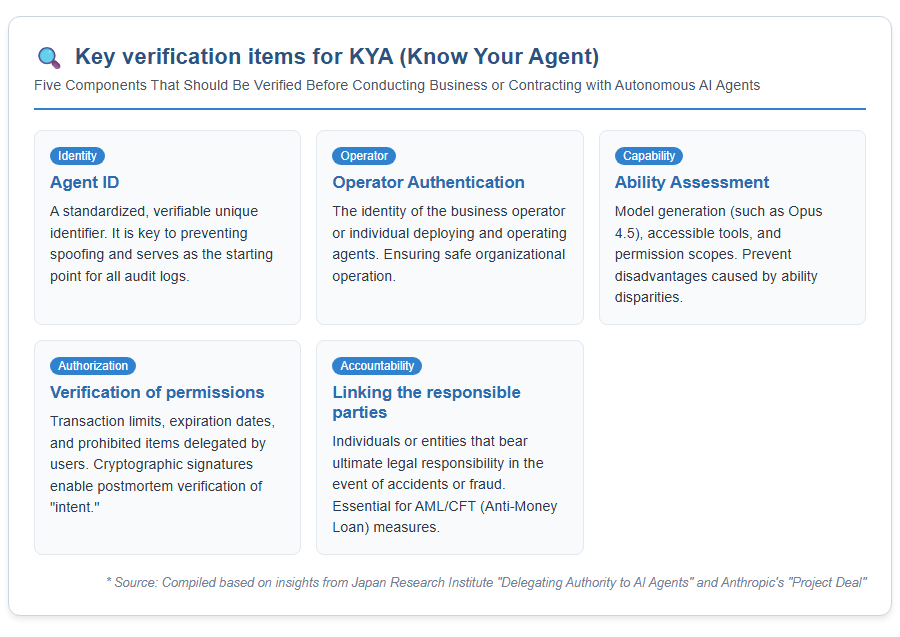
In the future, it is expected that a new process called “KYA (Know Your Agent)” will be needed, which will verify not only human identity verification (KYC) but also the AI agent’s own identity, authority, and responsible parties before transactions. In a society where agents negotiate with other agents’ agents as economic entities and complete orders and settlements, it is essential to cryptographically prove that the agent is operated by whom, and what authority is delegated.
The items that may be subject to verification in KYA are as follows.
-
Agent ID: A standardized, verifiable unique identifier.
-
Operator authentication: The identity of the business operator deploying and operating agents.
-
Capability assessment: model generation, accessible tools, and scope of authority.
-
Linking responsible parties: Identifying individuals or entities ultimately responsible in the event of accidents or fraud.
The diagram below illustrates the conceptual flow of KYA in future commercial transactions.
。 Going forward, the key to the success or failure of AI utilization will be whether it can be proven that the agent is a “legitimate agent with delegated authority,” not only when humans operate directly, but also in building a chain of trust.
[#Anthropic #Claude #本人確認 #AI輸出管理 #AIエージェント #経済安全保障 #KYA #プライバシー]
_en.png)
コメント