Japan and the Association of Southeast Asian Nations (ASEAN) have agreed to initiate joint research and review the ASEAN-Japan Comprehensive Economic Partnership (AJCEP) to expand its scope. Against the backdrop of lingering U.S.-China tensions and rising geopolitical risks, the two sides aim to build an updated economic framework capable of strengthening supply chain resilience for critical minerals and energy, while driving co-creation in digital and AI sectors.
- Core Elements of the Agreement to Upgrade the ASEAN-Japan EPA (AJCEP)
- Heightened Geopolitical Risks and Supply Chain Fragmentation Concerns
- The Trajectory of AJCEP and Achievements in Trade Liberalization
- Strengthening Co-Creation in Digital, AI, and Green Sectors
- Ripple Effects on Japanese Enterprises and Regional Supply Chains
- Outlook and Key Focus Areas for East Asian Trade Order
Core Elements of the Agreement to Upgrade the ASEAN-Japan EPA (AJCEP)
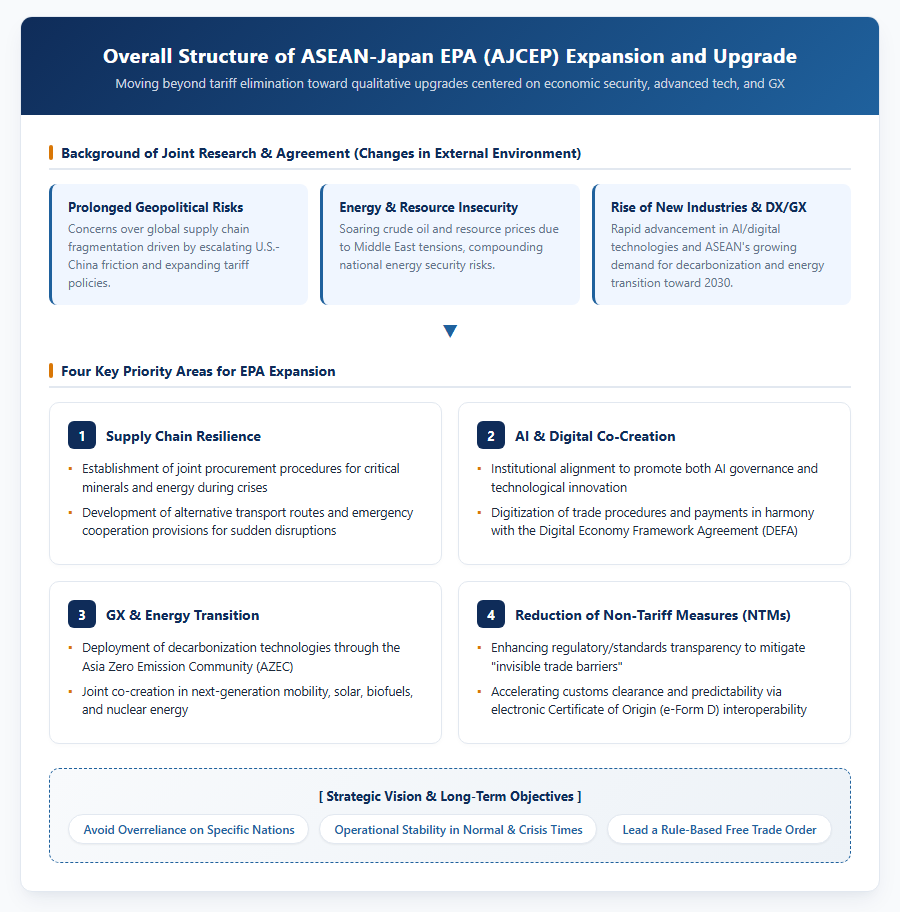
During the ASEAN-Japan Special Economic Ministers’ Meeting held on May 20, 2025, Japan and ASEAN member states agreed to begin discussions on reviewing and updating the rules of their existing Economic Partnership Agreement (EPA), the ASEAN-Japan Comprehensive Economic Partnership (AJCEP). Entering into force in 2008 and subsequently expanding through the signature of an amendment protocol in 2019 to liberalize trade in services and investment, the agreement now faces growing calls for a comprehensive upgrade to keep pace with dramatic shifts in the global environment. Reconfirmed at the bilateral leaders’ summit in May 2026, these efforts are expected to establish cooperative provisions for joint procurement procedures and alternative transport routes during supply chain crises involving critical minerals and energy. Furthermore, promoting cooperation in advanced industries such as artificial intelligence (AI), next-generation vehicles, and decarbonization technologies has been positioned as a central priority. Both sides reaffirmed their commitment to maintaining and strengthening a trust-based free trade system, directing senior officials to deepen discussions toward constructing concrete cooperation frameworks.
Heightened Geopolitical Risks and Supply Chain Fragmentation Concerns
The agreement to conduct joint research on revising the EPA is driven by escalating global geopolitical risks and rising trade protectionism. In addition to prolonged U.S.-China trade friction since 2018, the universal tariff policies and expanded tariffs introduced under the second Trump administration in 2025 have severely impacted global supply chains. Furthermore, heightened tensions in the Middle East have driven up crude oil and natural gas prices, triggering supply anxieties that hit Middle East-dependent Asian economies particularly hard. Energy security has quickly emerged as an urgent priority across the region, prompting Thailand to enforce energy-saving measures across government agencies in March 2026, while the Philippines declared a state of national energy emergency. Under such uncertain international conditions, building resilient, flexible cooperative frameworks to avoid overreliance on specific nations, mitigate oversupply issues, and counter economic coercion represents a shared strategic objective for both Japan and ASEAN.
Evolution of Trade Agreements and the Scope of Economic Partnership in Emerging Sectors
The Trajectory of AJCEP and Achievements in Trade Liberalization
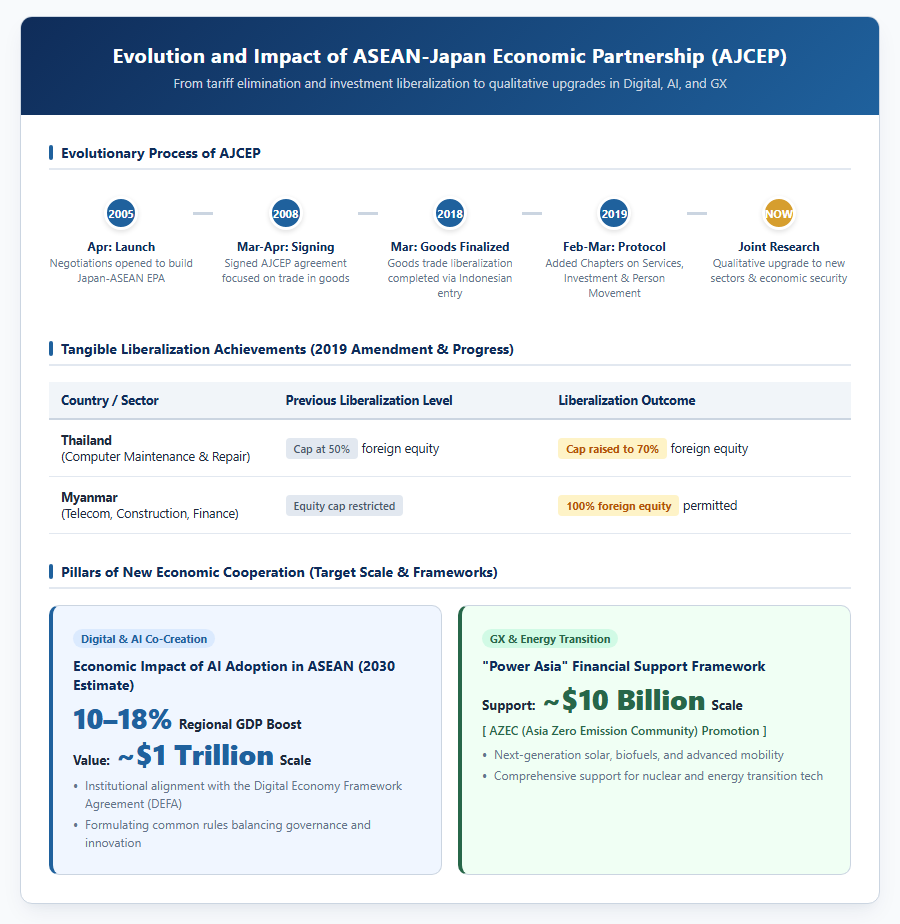
Economic partnership between Japan and ASEAN has evolved progressively since negotiations opened in April 2005. Signed between March and April 2008 as a framework primarily focused on trade in goods, the AJCEP agreement achieved complete tariff elimination across the original ASEAN members and newer signatories, culminating in March 2018 when Indonesia enacted domestic implementing regulations to finalize the goods liberalization architecture. To address delays in liberalizing services and investment, an amendment protocol was signed between February and March 2019, adding dedicated chapters on trade in services, investment, and the movement of natural persons. This yielded tangible breakthroughs: Thailand raised its foreign equity cap for computer maintenance and repair services from 50% to 70%, while Myanmar permitted 100% foreign capital participation in telecommunications, construction, and financial sectors. The current review agreement aims to transcend these traditional tariff eliminations and investment liberalizations, pursuing a qualitative upgrade to address second-generation trade challenges.
Strengthening Co-Creation in Digital, AI, and Green Sectors
Beyond traditional trade rules, the newly updated EPA will center on robust collaboration in emerging domains such as digital transformation (DX) and green transformation (GX). In the digital sphere, negotiators are exploring institutional alignment in data flows, electronic payments, and cybersecurity while maintaining harmony with ASEAN’s Digital Economy Framework Agreement (DEFA). With AI projected to boost ASEAN’s gross domestic product (GDP) by 10% to 18%—generating approximately \$1 trillion in economic value by 2030—establishing common rules that balance governance and innovation remains a critical imperative. In green sectors, Japan plans to comprehensively integrate decarbonization technology deployment and energy transition initiatives through the Asia Zero Emission Community (AZEC) and “Power Asia,” a \$10 billion financing framework supporting next-generation solar, nuclear power, biofuels, and advanced mobility.
Impact on Corporate Management, Regional Economies, and Future Challenges
Ripple Effects on Japanese Enterprises and Regional Supply Chains
Expanding the ASEAN-Japan EPA will directly and significantly impact Japanese corporations that operate extensive regional production networks, as well as the broader regional economy. In a post-tariff era where regional duties have virtually reached zero, corporate competitiveness depends not on tariff margin differentials, but on the ability to leverage trade agreements and reduce total trade costs. Enhancing transparency, reducing non-tariff measures (NTMs), and harmonizing sanitary and phytosanitary (SPS) measures alongside technical barriers to trade (TBT) will alleviate the invisible trade barriers facing businesses. Furthermore, cross-border logistics will become faster and more cost-effective as electronic Certificate of Origin (e-Form D) interoperability and customs digitization expand through the ASEAN Single Window (ASW). Establishing joint procurement networks for critical minerals and essential components will also allow companies to drastically reduce the risk of operational shutdowns during geopolitical shocks or sudden supply disruptions.
Outlook and Key Focus Areas for East Asian Trade Order
Moving forward, key areas to monitor include the timeline for transitioning from joint research to formal text negotiations, as well as potential synergies with other mega-FTAs. Under its AEC Strategic Plan 2026–2030, ASEAN is shifting its focus from quantitative tariff liberalization toward operational sophistication and resilience. Amid the coexistence of major trade blocs such as the Regional Comprehensive Economic Partnership (RCEP) and the Comprehensive and Progressive Agreement for Trans-Pacific Partnership (CPTPP), an upgraded AJCEP will complement these frameworks while driving a free and open trade order among like-minded nations. Concrete discussions among senior officials are expected to take shape through meetings such as the 31st ASEAN-Japan Economic Ministers’ Meeting in autumn 2025, paving the way for negotiations targeting entry into force around 2027. Mitigating trade dependency risks with specific nations and rapidly establishing sustainable, rule-based supply chains will play a decisive role in shaping future economic growth and security across East Asia.
Reference Pages
- [Ministry of Economy, Trade and Industry] Joint Media Statement of the ASEAN-Japan Special Economic Ministers’ Meeting
https://www.meti.go.jp/press/2025/05/20250520002/20250520002-c.pdf
- [Ministry of Foreign Affairs of Japan] Amendment of the Agreement on Comprehensive Economic Partnership among Japan and Member States of the Association of Southeast Asian Nations (AJCEP)

[#ASEANJapan #EPA #SupplyChain #EconomicSecurity #TradePolicy #AJCEP #ASEAN #InternationalEconomy]


コメント