Mitsubishi Electric is significantly expanding the adoption of power semiconductors using next-generation silicon carbide (SiC), a material for consumer appliances such as air conditioners. By leveraging its proprietary parallel connection technology, we have succeeded in reducing air conditioner power consumption by about 40%, and we plan to accelerate demand capture against the backdrop of stricter global energy-saving regulations.
- The birth of the “new generation IPM” that dramatically reduces air conditioner power consumption
- Mitsubishi Electric’s winning strategy leveraging “in-house synergy”
- Moving away from focusing solely on automotive applications and focusing on “industry, infrastructure, and civilian life”
- Partnership with Coherent USA and the Strategic Value of Kumamoto 8-Inch Factory
- Ambition to become the world’s No. 2 market share through trio merger with ROHM and Toshiba
- “Selection and Concentration” to Achieve a 20% Profit Margin by Fiscal Year 2030
The birth of the “new generation IPM” that dramatically reduces air conditioner power consumption
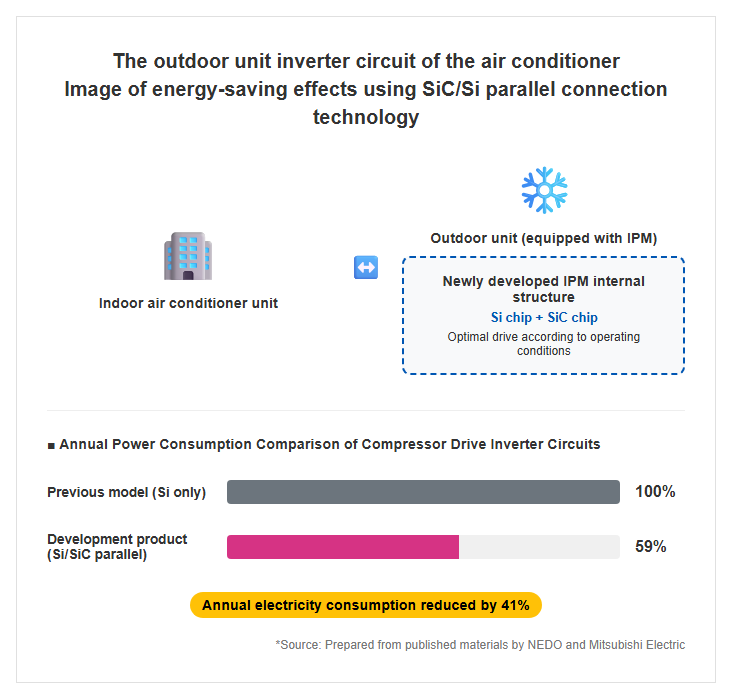
Mitsubishi Electric has developed an Intelligent Power Module (IPM) that uses SiC power semiconductors for compressor drive inverter circuits installed in air conditioner outdoor units. This development has been ongoing since fiscal year 2021 through NEDO’s grant program, and it has been confirmed that compared to conventional products equipped only with silicon (Si) chips, annual power consumption can be reduced by 41%. A major feature is that Si and SiC chips are connected in parallel, and the drive circuit maximizes the characteristics of each unit according to the air conditioner’s operating condition within a single module.
This newly developed IPM also offers high practicality, as its external dimensions are identical to those of conventional products, allowing replacement of existing board designs without major changes. Mitsubishi Electric began sample shipments mainly for air conditioners starting April 22, 2025, to help achieve the new energy-saving standards targeting fiscal year 2027. Please refer to the following configuration image.
In the residential and commercial air conditioner markets, the strengthening of global energy-saving regulations is a strong tailwind for SiC applications, and the company aims to contribute to achieving carbon neutrality by 2050 through the widespread adoption of these high-efficiency devices.
Mitsubishi Electric’s winning strategy leveraging “in-house synergy”
Mitsubishi Electric’s strength lies in its “vertically integrated model,” making it both a semiconductor manufacturer and a comprehensive electronics manufacturer handling railway vehicles, air conditioning equipment, and industrial robots. By incorporating our own SiC power semiconductors into our own products such as the “Kirigamine” brand, we aim to achieve overwhelming energy-saving performance that competitors cannot match, thereby enhancing the competitiveness of our products themselves. This in-house synergy enables customers to offer added value not only to semiconductors alone but also to the entire device system.
In particular, the company holds the number one global market share in consumer IPM, and its long-cultivated technological foundation and strong customer base support a smooth transition to SiC. SiC chips are several times more expensive than conventional Si-made chips, but Mitsubishi Electric emphasizes the “overall cost advantage of the system.” For example, by adopting SiC, power loss can be reduced, allowing for simplification and miniaturization of cooling radiators and water cooling systems, thereby reducing overall equipment cost and size. In this way, product development leveraging the expertise gained from the “position of semiconductor users” has solidified our market advantage.
[Background of Management and Strategy] Strengths in diversification and vertical integration to offset the EV slowdown
Moving away from focusing solely on automotive applications and focusing on “industry, infrastructure, and civilian life”
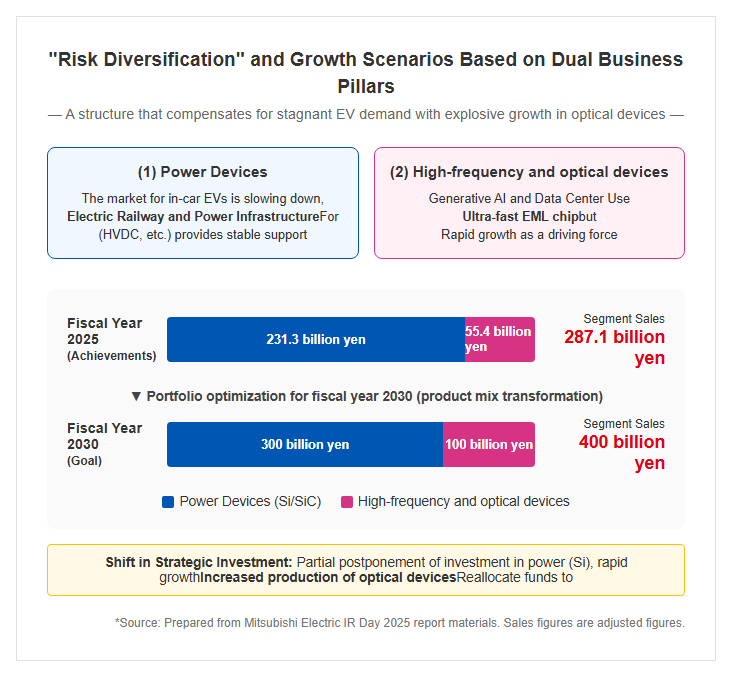
Until now, the power semiconductor market has been driven by electric vehicles (EVs), but the global slowdown in EV adoption and intense price competition with Chinese manufacturers have made the market environment increasingly challenging. In this context, Mitsubishi Electric has clearly defined a policy to strategically diversify resources not only for automotive applications but also to three areas where its strengths can be demonstrated: “Railways & Power,” “Industry & Renewables,” and “Civilian Sectors.” Although the automotive market is huge, due to rapid changes in the external environment, we are simultaneously developing sectors with long-term and stable demand, such as railways and power infrastructure, to build a revenue structure less swayed by market conditions.
In fact, Mitsubishi Electric’s Semiconductor Devices division has maintained profitability even amid headwinds in the SiC market, achieving record-high profits for the entire group in the fiscal year ending March 2026 (FY2026). This is due to stagnation in the EV market, while optical devices for data centers have exploded, enabling risk diversification. The company had planned capital investments of 260 billion yen by fiscal 2025, but in response to market changes, it has postponed investments in some Si power semiconductors and is flexibly reallocating funds to the rapidly growing optical devices and next-generation SiC. Please check the following changes in sales composition.
Partnership with Coherent USA and the Strategic Value of Kumamoto 8-Inch Factory
The biggest challenges in the spread of SiC power semiconductors are high manufacturing costs and wafer supply stability. To address this issue, Mitsubishi Electric signed a basic agreement in 2023 with Coherent, a major U.S. substrate manufacturer, for the joint development of 8-inch SiC substrates, and decided to invest 500 million USD (approximately 75 billion yen) in Coherent’s SiC business company. This vertical collaboration enables stable procurement of high-quality 8-inch substrates and accelerates the reduction of manufacturing costs.
In terms of production systems, a new factory building responsible for the pre-production process of SiC, constructed in Kikuchi City (Shisui area), Kumamoto Prefecture, was completed in October 2025. This factory has introduced a cleanroom equipped with the latest energy-saving features and thorough automation, and plans to begin prototyping using 8-inch wafers from 2026. By strengthening the existing 6-inch line, SiC production capacity is expected to be expanded to five times the previous level by fiscal 2026. Furthermore, in the Fukuoka area, we are operating a new factory building as the mother factory for the subsequent processes, strengthening a system that integrates everything from design to manufacturing, thereby shortening lead times and enhancing product competitiveness.
[Medium- to Long-Term Outlook] Restructuring of the Hinomaru Semiconductor Alliance and Financial Targets for 2030
Ambition to become the world’s No. 2 market share through trio merger with ROHM and Toshiba
Japan’s power semiconductor industry is currently in the midst of a major restructuring. On March 27, 2026, Mitsubishi Electric reached a basic agreement with ROHM and Toshiba Device & Storage (Toshiba D&S), a Toshiba subsidiary, to begin discussions toward integrating its power semiconductor business. If these three companies merge, they will simply hold the world’s second-largest market share after Germany’s Infineon Technologies, dramatically enhancing their influence in the global market. Mitsubishi Electric’s President Urushima stated, “The sooner the timing of the reorganization, the better,” aiming to secure “economies of scale” to compete with Western and rising Chinese companies.
It is analyzed that Mitsubishi Electric is in a very advantageous position in this integration negotiation. Against ROHM, which was hurt by impairment write-offs, and Toshiba, which was delisted, Mitsubishi Electric is able to negotiate against the backdrop of overwhelming financial soundness, as the entire group has posted record profits and the device division has maintained profitability. This margin is also expected to be a decisive variable in the leadership struggle within the integrated new company, with attention focused on the specific integration policy scheduled to be announced around summer 2026.
“Selection and Concentration” to Achieve a 20% Profit Margin by Fiscal Year 2030
Mitsubishi Electric has set new financial targets for its semiconductor and device business toward fiscal 2030, aiming for sales of 400 billion yen and an adjusted operating profit margin of 20%. This is not just about pursuing scale, but about shifting the product mix toward “high value-added areas” such as high-voltage IGBTs and SiC, and thoroughly improving capital efficiency through value chain optimization. In particular, we aim for high-quality growth by expanding power sources for data centers, where power shortages are a concern due to the explosive expansion of AI demand, and by expanding SiC applications for railway and power infrastructure. Please refer to the following financial target trends.
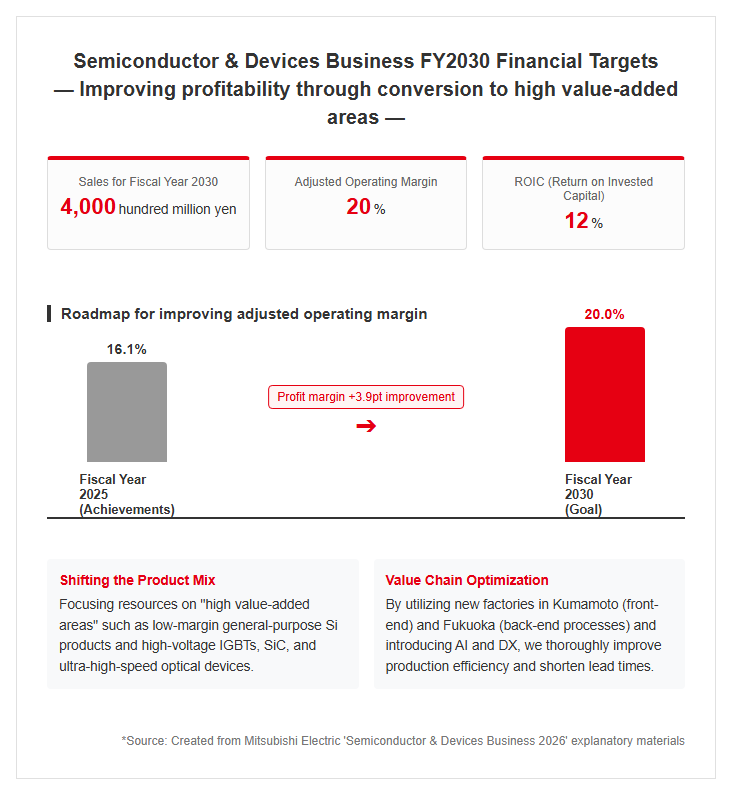
Additionally, we have established a certain outlook for investments in the power device business, which had been made in advance until now, and plan to further accelerate growth investments in the optical device business, which holds the world’s number one market share. In optical devices, riding the wave of AI infrastructure investment, we plan to increase EML chip production capacity to more than three times the 2025 level by fiscal 2029 (20 times compared to 2020). Toward 2030, Mitsubishi Electric will accelerate ROIC management by concentrating resources in its strengths and aiming for sustainable enhancement of corporate value.
[#三菱電機 #パワー半導体 #SiC #省エネ #エアコン #経済ニュース #半導体業界 #GX]

コメント