On September 24, 2026, Sakura Internet Inc. launched API access to “Weblab-MedLLM-gpt-oss-120b,” a medical-domain large language model developed by the Matsuo-Iwasawa Laboratory at the University of Tokyo and collaborating partners, via its inference API platform “Sakura’s AI Engine.” The commercial API release of a domestic AI infrastructure fine-tuned on Japanese medical literature and clinical guidelines is poised to significantly accelerate healthcare DX and secure clinical AI integration across Japan in 2026.
- Sakura Internet Initiates API Service for Medical-Domain LLM
- Outcomes of National BRIDGE and NEDO Projects
- Traditional Challenges in Deploying Generative AI in Healthcare
- 120-Billion Parameter Base Model and Domain Adaptation
- Alignment with Japan’s Medical System and Clinical Guidelines
- Domestic Scratch-Built Models and Proprietary Technical Know-How
- High Performance on Board Exams and National Licensing Benchmarks
- 50,000-Case Safety Benchmark and Red-Teaming Audits
- Empirical Validation Across Four Clinical Administrative Scenarios
- Compliance with “3 Ministries, 2 Guidelines” and AI Operator Frameworks
- Position under SaMD Regulations and Diagnostic Support Classification
- FY2026 Medical Fee Revision Accelerating AI Efficiency Gains
- Expanding Integration with EHRs and Medical IT Systems
- Phased Social Implementation as Shared Infrastructure
- Mitigating Healthcare Shortages and Raising Quality of Care
Sakura Internet Initiates API Service for Medical-Domain LLM
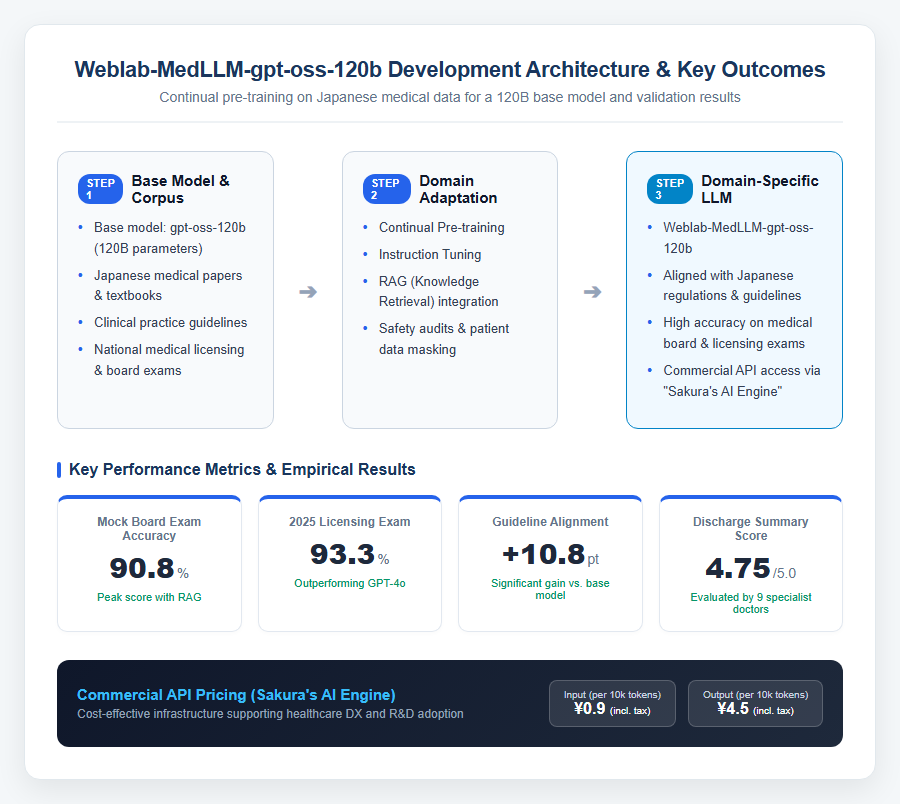
On September 24, 2026, Sakura Internet Inc. commenced API service for “Weblab-MedLLM-gpt-oss-120b,” a domain-specific medical large language model, through its generative AI inference API platform, “Sakura’s AI Engine.” Developed primarily by the Matsuo-Iwasawa Laboratory at the University of Tokyo’s Graduate School of Engineering, this model provides research institutions, healthcare enterprises, and developers with seamless API access to advanced medical language processing capabilities. Pricing is set at 0.9 yen per 10,000 input tokens and 4.5 yen per 10,000 output tokens (including tax). This highly cost-effective structure drastically lowers financial barriers to development, prototyping, and clinical validation compared to conventional commercial LLMs.
Outcomes of National BRIDGE and NEDO Projects
This model represents a tangible milestone from the “Project for Promoting Security Verification and Demonstration of Japanese Medical-Domain LLMs for Social Implementation,” commissioned by the New Energy and Industrial Technology Development Organization (NEDO) under the Cabinet Office’s “Bridge Opportunity for R&D and Society 5.0 (BRIDGE)” program. The initiative convened a 10-member public-private consortium comprising Sakura Internet, the Matsuo-Iwasawa Laboratory, RIKEN, ABEJA, Inc., Kyushu University, Institute of Science Tokyo, Fujita Health University, International University of Health and Welfare, and Healios K.K. Together, they successfully reconciled rigorous safety standards with the deep expertise demanded by Japanese healthcare environments.
Traditional Challenges in Deploying Generative AI in Healthcare
Integrating general-purpose generative AI into clinical settings has historically faced three structural bottlenecks. First, routing medical queries through overseas servers or third-party cloud vendors poses inherent risks of patient data leaks and cross-border data transfers. Second, a lack of data standardization—stemming from fragmented terminology and coding systems across hospitals—hampers interoperability. Third, specialized safety and evaluation frameworks tailored to medical AI have been largely absent. By enabling secure processing of sensitive patient data within domestic cloud and on-premises environments, this project provides a decisive framework to resolve these long-standing industry challenges.
Training Methodology and Japanese Medical Continual Pre-Training
120-Billion Parameter Base Model and Domain Adaptation
“Weblab-MedLLM-gpt-oss-120b” utilizes “gpt-oss-120b,” an open-weight 120-billion parameter base model. The team applied systematic continual pre-training and instruction tuning using extensive domestic medical datasets, including Japanese medical papers, textbooks, clinical practice guidelines, and historical questions from national medical licensing and specialty board examinations. Consequently, the model exhibits not only strong general linguistic fluency but also an intricate understanding of complex medical contexts and terminology, delivering highly accurate, context-aware responses.
Alignment with Japan’s Medical System and Clinical Guidelines
Overseas general-purpose AI models frequently struggle to produce outputs aligned with Japan’s universal health insurance system, Ministry of Health, Labour and Welfare (MHLW) regulations, and domestic medical society guidelines. By systematically embedding domestic clinical practice guidelines into its training corpus, Weblab-MedLLM achieved up to a 10.8 percentage point improvement in guideline alignment and fidelity compared to its base model. This capacity to offer accurate information strictly consistent with Japanese standard-of-care protocols and prescribing guidelines gives the model a critical advantage in administrative and clinical workflows.
Domestic Scratch-Built Models and Proprietary Technical Know-How
Alongside fine-tuning open-weight architectures, the project validated domestic scratch-built models—such as the AscleLM1 series—built on custom architectures. These experimental models demonstrated competitive performance against comparable overseas open models, yielding invaluable technical insights and curated datasets essential for Japan’s future AI self-reliance. As illustrated in the figure below, bridging domestic medical expertise with AI engineering actively advances a sovereign, high-precision national AI infrastructure.
Achieving 90.8% on Board Exams and Comprehensive Safety Verification
High Performance on Board Exams and National Licensing Benchmarks
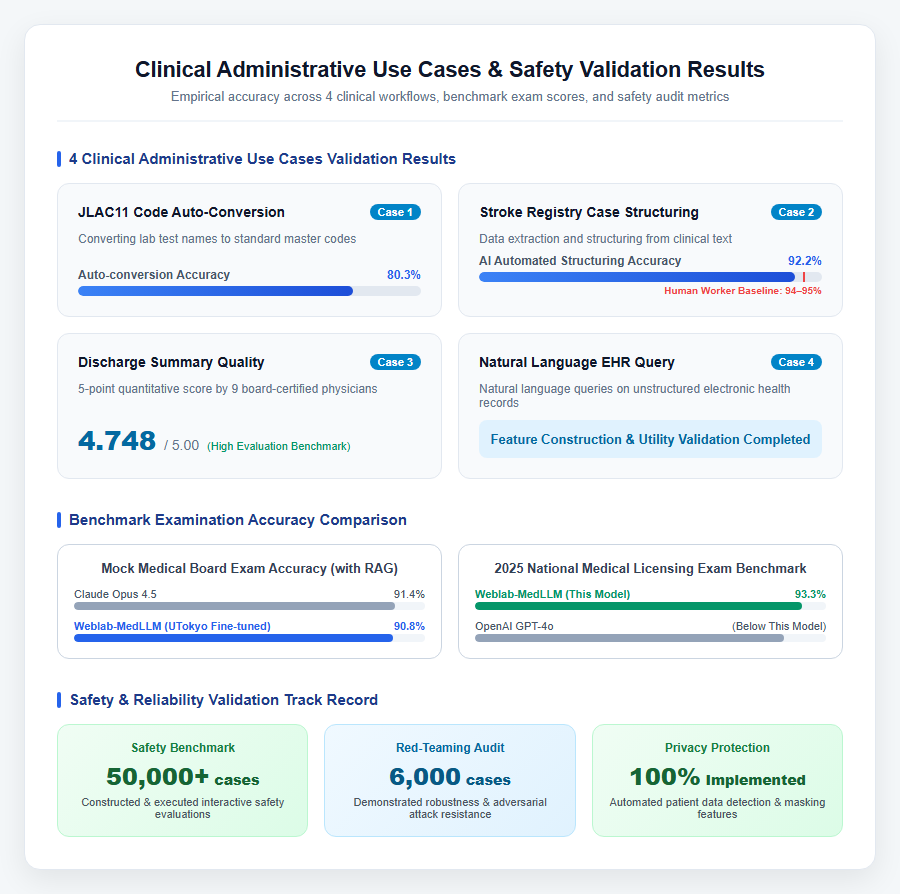
To validate the model’s specialized competence, researchers developed custom benchmarks drawing from past examination questions across seven specialties: ophthalmology, surgery, emergency medicine, anesthesiology, internal medicine, obstetrics and gynecology, and orthopedics. Combined with Retrieval-Augmented Generation (RAG) techniques, the top-tier fine-tuned model developed by the University of Tokyo achieved a peak accuracy of 90.8%, rivaling world-class commercial models like Claude Opus 4.5 (91.4%). Furthermore, on the 2025 Japanese National Medical Licensing Examination benchmark, the model scored 93.3% accuracy, outperforming general-purpose frontier models such as OpenAI’s GPT-4o.
50,000-Case Safety Benchmark and Red-Teaming Audits
Given the paramount importance of safety in healthcare, the project established rigorous Japanese safety validation protocols. Researchers developed quantitative metrics to evaluate the risk of memorizing patient personal information in training data and implemented automated masking features to sanitize patient identifiers in prompts. Additionally, the team constructed an interactive safety benchmark comprising over 50,000 cases reflecting Japanese medical scenarios and executed a comprehensive red-teaming audit spanning 6,000 adversarial attack prompts, proving robust defense against adversarial manipulation.
Empirical Validation Across Four Clinical Administrative Scenarios
The model was subjected to empirical testing across four practical healthcare administrative workflows. First, in converting non-standard test names into standardized JLAC11 lab codes, the model achieved an automated accuracy of 80.3%. Second, in extracting and structuring case data for stroke registries, it recorded a 92.2% accuracy rate, approaching human expert baseline levels (94–95%). Third, in generating discharge summaries, nine board-certified physicians awarded the model a mean quality score of 4.748 out of 5.0. Fourth, the team successfully established natural-language query capabilities for searching electronic health records.
Healthcare DX Regulations and Practical Implementation in 2026
Compliance with “3 Ministries, 2 Guidelines” and AI Operator Frameworks
In 2026, medical AI operations in Japan are governed by the “3 Ministries, 2 Guidelines” framework—comprising MHLW’s “Safety Management Guidelines for Medical Information Systems (Ver. 6.0)” and METI/MIC’s “Safety Management Guidelines for Information System and Service Providers Handling Medical Information (Ver. 2.0).” Furthermore, aligning with the risk-based approach outlined in the MIC/METI “AI Operator Guidelines (Ver. 1.1),” healthcare organizations are establishing clear governance structures that delineate responsibility among AI developers, providers, and clinical users.
Position under SaMD Regulations and Diagnostic Support Classification
Understanding the model’s status under Software as a Medical Device (SaMD) regulations under the Pharmaceutical and Medical Devices Act (PMD Act) is essential. Weblab-MedLLM is designed exclusively as an administrative support tool to assist healthcare professionals with documentation and data organization; it does not perform direct medical functions such as disease diagnosis or treatment planning. Sakura Internet and the development team explicitly advise against diagnostic or therapeutic usage, positioning the model strictly as an informational assistant to support medical professionals, thereby ensuring strict legal and ethical compliance.
FY2026 Medical Fee Revision Accelerating AI Efficiency Gains
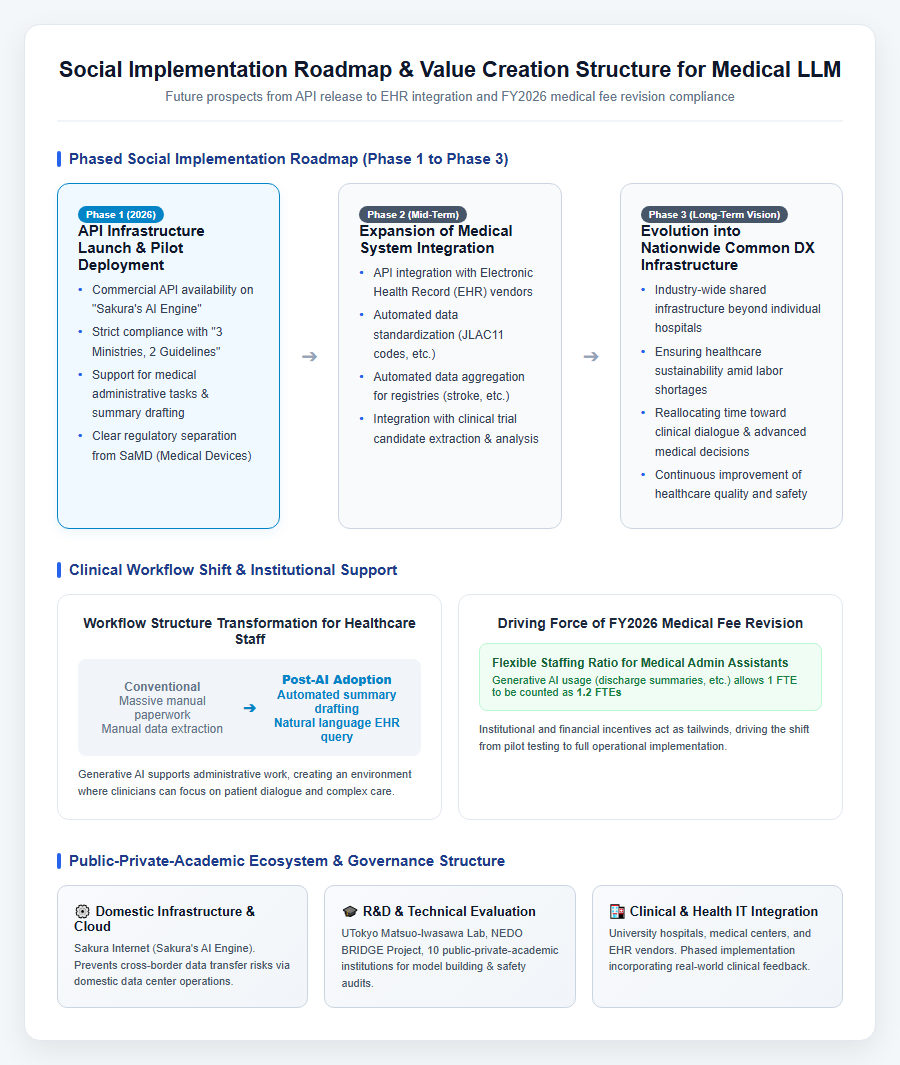
Japan’s FY2026 (Reiwa 8) Medical Fee Revision explicitly prioritizes the “promotion of ICT, AI, and IoT to enhance operational efficiency.” Specifically, healthcare facilities implementing generative AI for automated discharge summary drafting or voice-assisted diagnostic report generation benefit from relaxed staffing ratio calculations for medical administrative assistants (where 1 FTE can be counted as 1.2 FTEs). Supported by these legislative and financial incentives, medical AI adoption in Japan has definitively transitioned from exploratory trials into full-scale operational implementation.
Future Outlook and Horizons for Japanese Healthcare Data AI
Expanding Integration with EHRs and Medical IT Systems
With public API availability through “Sakura’s AI Engine,” third-party electronic health record (EHR) vendors and healthtech enterprises are expected to rapidly build integrated applications. Automating routine tasks—such as natural language EHR search, automatic coding of unstructured clinical notes, and clinical trial candidate identification—will drastically reduce the manual administrative burden long shouldered by medical personnel.
Phased Social Implementation as Shared Infrastructure
The outcomes of this R&D initiative extend far beyond an individual corporate service, possessing the potential to fundamentally transform Japanese medical data utilization. By deepening collaboration among research institutes, medical centers, and pharmaceutical companies, stakeholders will drive phased social implementation incorporating direct clinical feedback. Over time, the platform is expected to evolve from individual hospital initiatives into a shared, secure national infrastructure.
Mitigating Healthcare Shortages and Raising Quality of Care
Faced with severe healthcare worker shortages driven by a declining population and urgent demands for physician work-style reform, generative AI automation offers a path forward. By relieving staff of administrative burdens, AI allows clinicians to devote more time to patient interaction and complex clinical decision-making. In 2026, AI in Japan has evolved from a futuristic concept into an indispensable operational utility, safeguarding both healthcare quality and system sustainability.
References
-
[Press Release] Sakura Internet Launches API Service for Medical-Domain LLM “Weblab-MedLLM-gpt-oss-120b” on “Sakura’s AI Engine” https://www.sakura.ad.jp/corporate/information/newsreleases/2026/09/24/1968225752/
-
[Press Release] Development of High-Performance Japanese LLM to Support Healthcare Administrative Tasks – Sakura Internet https://www.sakura.ad.jp/corporate/information/newsreleases/2026/05/28/1968224678/
-
[Research Announcement] Matsuo-Iwasawa Lab (University of Tokyo) Develops Japanese Medical-Domain LLM for Healthcare DX and Releases Interactive AI Service https://weblab.t.u-tokyo.ac.jp/news/2026-03-05-02/
-
[Project Information] NEDO Project for Promoting Security Verification and Demonstration of AI Safety https://www.nedo.go.jp/activities/ZZJP_100327.html
-
[Guidelines] MHLW Safety Management Guidelines for Medical Information Systems (Ver. 6.0) https://www.mhlw.go.jp/stf/shingi/0000516275_00006.html
[#MedicalAI #GenerativeAI #SakuraInternet #SakurasAIEngine #MedicalLLM #HealthcareDX #2026Healthcare]
コメント