Mie University and Taiwan’s National Yang Ming Chiao Tung University have signed a basic agreement concerning the establishment of a joint research laboratory for next-generation semiconductors. Behind the initiative to combine the strengths of both universities to advance efforts ranging from basic research to practical application and the development of highly skilled human resources lies intensifying global competition in semiconductor development and a strong imperative to reinforce the foundation of the domestic industry.
- [Key Event] Basic agreement on the establishment of a joint research lab by Mie University and National Yang Ming Chiao Tung University
- [Research Background] The Journey from Inter-University Agreements to Basic Agreement in 2025
- [Research Methods and Technical Focus] The Potential of Wide-Bandgap and Ultra-Wide-Bandgap Semiconductors
- [Collaboration with Regional Industry] Semiconductor Cluster in Mie Prefecture’s Hokusei Region and the Roles of Industry, Academia, and Government
- 【Talent Development System】Introducing a Taiwan-Style Ecosystem That Produces Ready-to-Work Professionals
- [Future Outlook and Focus Points] The Future of Next-Generation Electronics Pictured by Global Collaboration
[Key Event] Basic agreement on the establishment of a joint research lab by Mie University and National Yang Ming Chiao Tung University
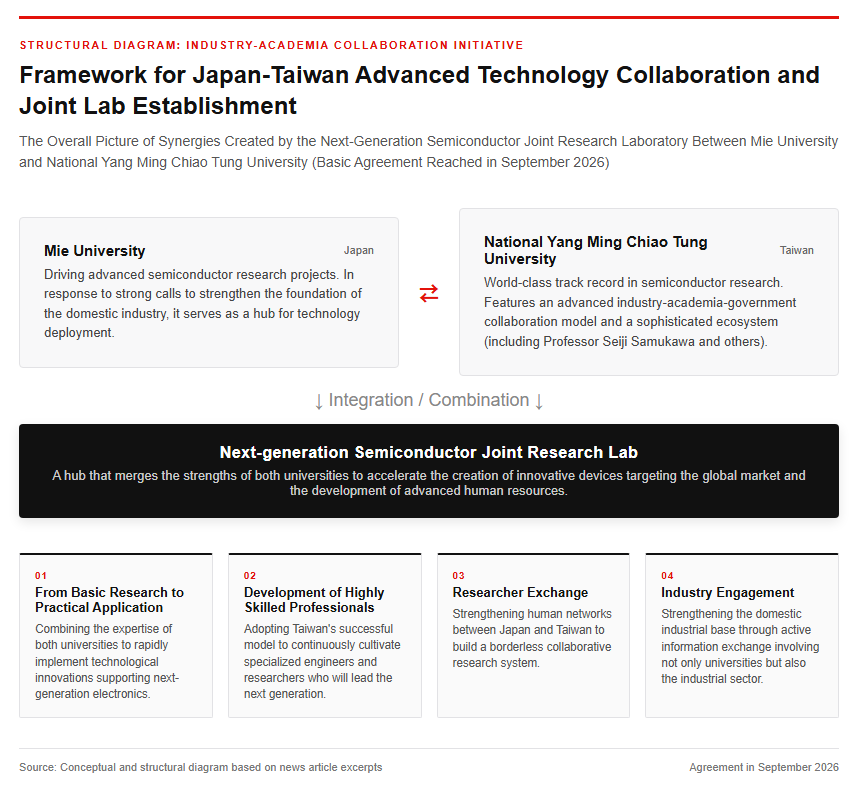
On September 25, 2026, Mie University concluded a basic agreement with Taiwan’s National Yang Ming Chiao Tung University, which boasts a world-class track record in the field of semiconductor research, regarding the establishment of a joint research laboratory on next-generation semiconductors. This agreement aims to strongly combine the research foundations and educational know-how that both universities have cultivated thus far, thereby accelerating technological innovation to support next-generation electronics. At the special lecture held in conjunction with the signing ceremony, Professor Seiji Samukawa of National Yang Ming Chiao Tung University took the stage and delivered an insightful lecture on successful models of industry-academia-government collaboration in Taiwan and the importance of developing advanced human resources. With the establishment of the joint research lab, it is expected to function not only as a hub for the research and development of cutting-edge technologies, but also as a new base for mutual exchange among researchers between Japan and Taiwan and for information exchange involving the industrial sector. By fusing the advanced semiconductor research projects promoted at Mie University with Taiwan’s sophisticated ecosystem, the creation of innovative devices targeting the global market is expected to accelerate. The following figure shows the role of the joint laboratory.
[Research Background] The Journey from Inter-University Agreements to Basic Agreement in 2025
The basic agreement concluded this time did not happen overnight, but rather is the culmination of a gradual accumulation of mutual exchanges and collaborations. The two universities signed an inter-university agreement in July 2025, establishing a foundation for academic research and student exchange. Furthermore, in November 2025, a declaration of cooperation was signed by three parties: Mie University, National Yang Ming Chiao Tung University, and Kuwana City in Mie Prefecture. This marked the first time nationwide that a Taiwanese university signed a cooperation declaration in the semiconductor field with a Japanese local government, reflecting a steady progression in building a region-wide cooperative framework integrating industry, academia, and government. The northern Mie Prefecture region, including Kuwana City, is one of Japan’s premier manufacturing hubs with a heavy concentration of plants from major semiconductor manufacturers, where securing specialized talent for cutting-edge technologies and strengthening a sustainable industrial base have been urgent tasks. The alignment between these regional industrial needs and the strategy of Taiwan’s world-class academic institution led to the tangible result of establishing this joint research lab.
The Technological Depth of Next-Generation Semiconductor Technology and Its Ripple Effects on Regional Industries
[Research Methods and Technical Focus] The Potential of Wide-Bandgap and Ultra-Wide-Bandgap Semiconductors
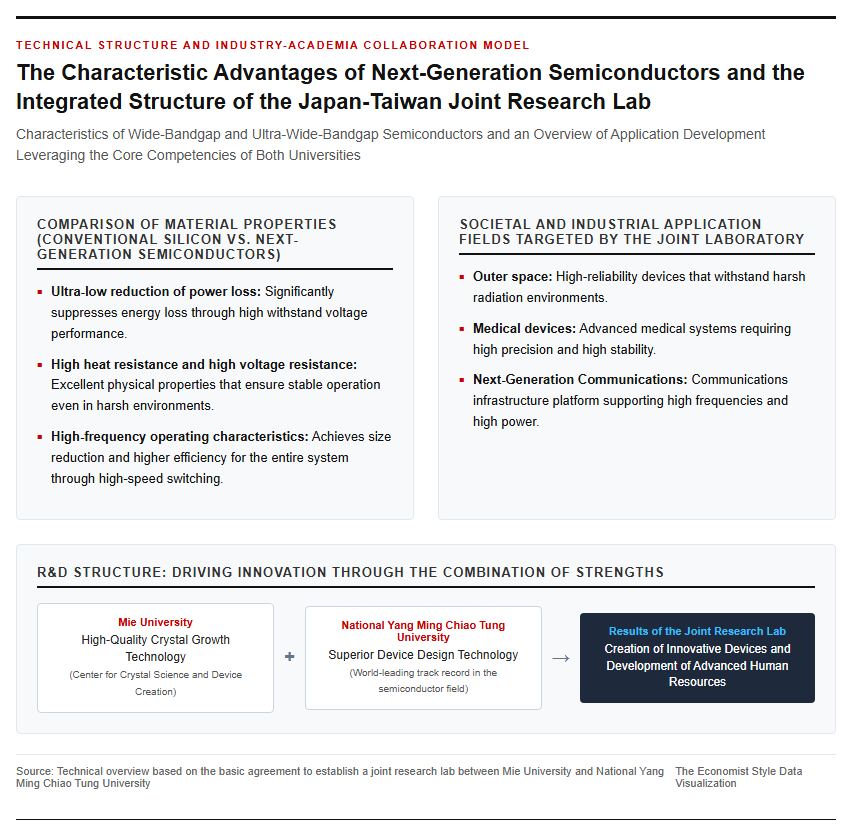
The core technical themes handled in the joint research lab are applied developments ranging from basic research to the social implementation of next-generation materials known as wide-bandgap and ultra-wide-bandgap semiconductors. Compared to conventional silicon semiconductors, these new materials possess high voltage resistance, heat resistance, and high-frequency operation characteristics, with the feature of being able to reduce power loss to the absolute limit. Especially in crystal growth and device formation technologies for materials such as aluminum nitride, the Semiconductor Crystal Science and Device Creation Center—a strategic research core at Mie University—has achieved world-class research results and has a track record of achieving the world’s highest level of luminous efficiency. By combining these high-quality crystal fabrication technologies with National Yang Ming Chiao Tung University’s excellent device design technologies, the joint research lab aims to develop innovative devices that can be utilized in a wide range of fields, such as radiation-resistant devices for outer space, high-precision medical equipment, and next-generation communication systems. A diagram of the research results is presented below.
[Collaboration with Regional Industry] Semiconductor Cluster in Mie Prefecture’s Hokusei Region and the Roles of Industry, Academia, and Government
The Hokusei region of Mie Prefecture is one of Japan’s leading semiconductor manufacturing hubs, clustered with global semiconductor-related companies such as Kioxia, Western Digital, and United Semiconductor Japan. The establishment of the joint research laboratory goes beyond mere academic exchange between universities, serving as a stepping stone to directly boost the competitiveness of local industries. In the local industrial sector, the shortage of advanced engineers who understand cutting-edge manufacturing processes and can address on-site technical challenges has become a serious issue, raising expectations for universities to supply human resources. Through industry-academia-government collaboration platforms such as the Semiconductor and Digital Future Research Center established by Mie University and the “Mie Semiconductor Network,” a system is in place to return the knowledge and results obtained from the joint research laboratory to local companies. This is expected to enable the entire region to acquire a cyclical structure of cutting-edge technology R&D and practical human resource development, dramatically enhancing its presence as a semiconductor cluster within Japan.
The Taiwanese Semiconductor Ecosystem and Future Prospects
【Talent Development System】Introducing a Taiwan-Style Ecosystem That Produces Ready-to-Work Professionals
Behind Taiwan’s leadership in the global semiconductor industry lies a semiconductor ecosystem where universities, the government, and corporations work together to cultivate advanced talent. National Yang Ming Chiao Tung University is adjacent to the Hsinchu Science Park, often referred to as Taiwan’s Silicon Valley, and continues to produce numerous engineers who are ready to contribute immediately upon graduation by providing hands-on education utilizing cutting-edge production lines actually used by companies. Through this partnership, this Taiwan-style practical talent development model will be introduced to educational institutions in Japan, starting with Mie University. Specifically, plans include international internship programs for students and young researchers, reciprocal researcher exchanges between Japan and Taiwan, and practical workshops involving corporate engineers. By providing opportunities to directly encounter real-world challenges on the manufacturing floor—going beyond conventional university lectures and basic research—the program aims to train engineers with flexible thinking who can bridge basic academia and industrial applications.
[Future Outlook and Focus Points] The Future of Next-Generation Electronics Pictured by Global Collaboration
With the establishment of the joint research lab, industry-academia-government networks between Japan and Taiwan will become even tighter, and initiatives aimed at creating global innovation will move into full swing. Specifically, the prototyping and evaluation of ultra-high-performance devices for the space, medical, and telecommunications fields will be advanced, and joint projects involving companies and local governments from both Japan and Taiwan are expected to be launched in succession. Furthermore, in coordination with employment and living support measures for foreign engineers promoted by local governments such as Kuwana City, efforts are underway to build an environment that attracts exceptional researchers and students from Taiwan to the region. At a time when the cultivation of semiconductor talent and industrial revitalization are urgent priorities for Japan as a whole, this initiative—with universities acting as the core to connect international technological partners, regional industries, and local governments—will serve as an advanced model case for regional universities and local industries across the country. Through the fusion of global technological capabilities and local industrial foundations, great expectations are placed on the creation of new value in the next-generation electronics market.
Reference page
- [Mie University Press Release] https://www.mie-u.ac.jp/news/topics/
- 【Kuwana City Corporate Attraction Special Site】https://www.invite-kuwana.jp/news/taiwan2025
- [Mie University Center for Semiconductor Crystal Science and Device Creation] https://www.mie-u.ac.jp/research/singularity/
- [Mie University Semiconductor and Digital Future Creation Center] https://www.icsdf.mie-u.ac.jp/
【#Semiconductors #MieUniversity #NationalYangMingChiaoTungUniversity #IndustryAcademiaGovernmentCollaboration #TalentDevelopment #WideBandgapSemiconductors】

コメント