Wall Street financial institutions are adopting a cautious stance toward a $500.0-billion GPU-backed financing initiative promoted by U.S. semiconductor giant NVIDIA, citing concerns over asset value fluctuation risks and collateral valuation. The backdrop includes differing views on useful lives associated with the rapid obsolescence of technology, the expansion of off-balance-sheet debt, and wariness regarding circular transactions that boost sales of the company’s own products.
- Launch of a 0 Billion AI Compute Financing Initiative
- Customer Lock-in through Asset Standardization and a 25% Residual Value Guarantee
- The 10-Year vs. 3-Year Useful Life Gap and Cautious Stance
- Shift Toward Stronger Credit Enhancement and Reliance on Customer Contracts
- Antitrust Concerns Regarding the Expansion of Off-Balance-Sheet Liabilities and Circular Transactions
- Risk Diversification Through Insurance Schemes and Monetization Challenges of AI Infrastructure
Launch of a 0 Billion AI Compute Financing Initiative
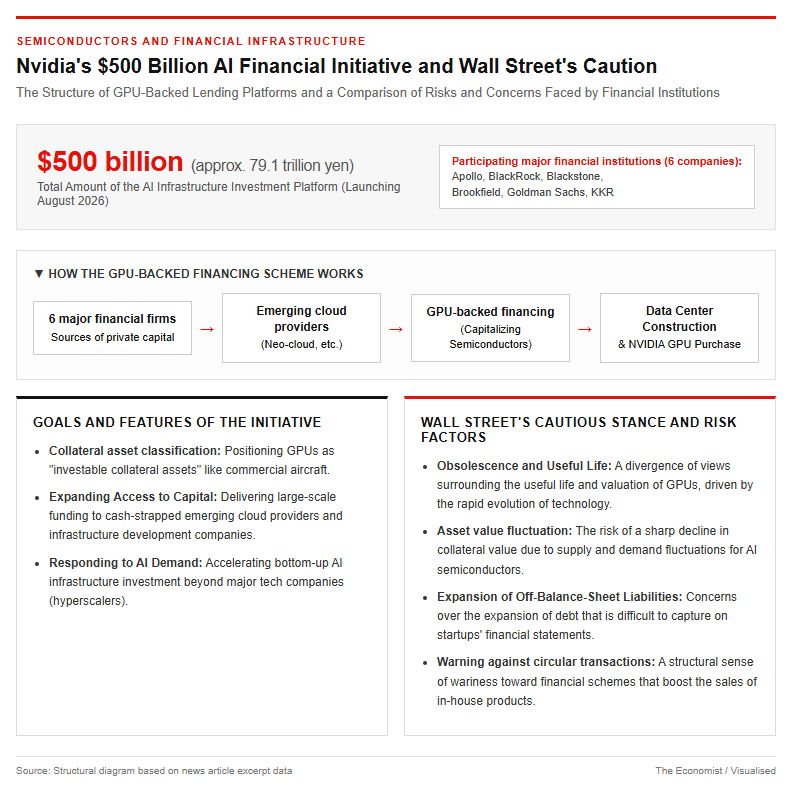
In August 2026, U.S.-based NVIDIA partnered with six major financial institutions—Apollo Global Management, BlackRock, Blackstone, Brookfield, Goldman Sachs, and KKR—to launch a $500 billion (approx. 79.1 trillion yen) AI infrastructure investment platform. This initiative aims to position graphics processing units (GPUs), which are essential for the development and operation of generative AI, as an “investable collateral asset class” comparable to commercial aircraft, thereby mobilizing private capital for the construction of AI data centers. Under this mechanism, emerging cloud providers (neoclouds) and infrastructure developers can raise funds for data center construction by pledging the acquired GPUs themselves as collateral. Amid the rapid expansion of AI demand, it has attracted significant attention as a groundbreaking financial method that paves the way for capital supply not only to tech giants (hyperscalers) but also to emerging companies with limited internal capital. The following diagram illustrates the structure of AI infrastructure finance.
Customer Lock-in through Asset Standardization and a 25% Residual Value Guarantee
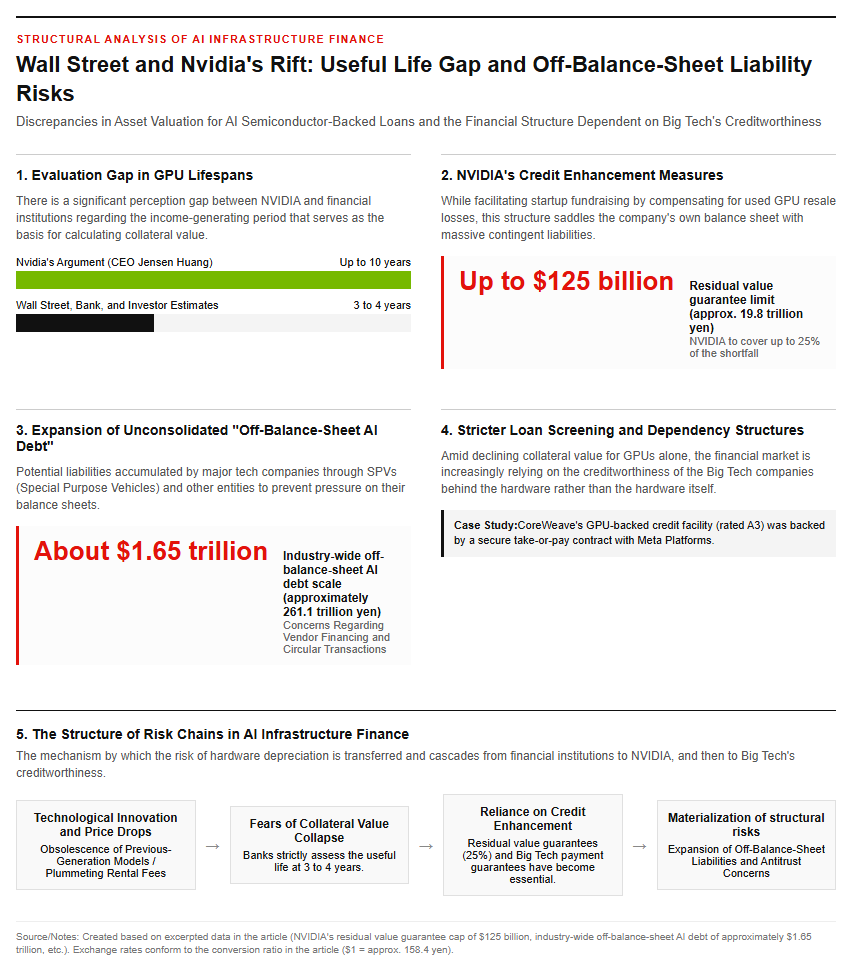
NVIDIA’s financing scheme incorporates a rule making it a loan condition that data center designs and cooling systems be completely standardized according to its proprietary specification (the DSX reference design). By standardizing these specifications, even if a borrower goes bankrupt, financial institutions can easily transfer the entire facility to another company for reuse (a takeover), thereby increasing the certainty of debt recovery. Furthermore, NVIDIA has indicated its policy to provide residual value guarantees, compensating for up to 25% of any shortfall (up to $125 billion, or approximately 19.8 trillion yen) if losses occur from the sale of used GPUs in the event of payment delays or defaults. This credit enhancement measure offers the advantage of making it easier even for startups with low creditworthiness to raise funds at low interest rates. Through this financial structure, the company aimed to expand sales of its own GPUs and strongly lock in customers, but at the same time, it also created the risk of saddling its balance sheet with substantial guarantee liabilities.
The Gap with Wall Street: Differences in Asset Valuation and Useful Lives
The 10-Year vs. 3-Year Useful Life Gap and Cautious Stance
Wall Street financial institutions and rating agencies have reacted very conservatively to Nvidia’s ambitious financial initiative. The biggest gap lies in the evaluation of the period for which the collateralized GPUs can continue to generate revenue, namely their useful life. Nvidia CEO Jensen Huang argues that cutting-edge GPUs (such as the H100 and B200) can generate revenue for up to 10 years. In contrast, credit investors and banks, such as Impax Asset Management, calculate depreciation periods of just 3 to 4 years for their reviews due to the extremely fast pace of technological innovation. With Nvidia introducing a new generation of semiconductor architecture every year, the prices of older model generations are plummeting, and rental rates for the H100 have dropped significantly since its introduction. Banks also point out a lack of historical data, and are strongly wary of the risk that future collateral value could collapse.
Shift Toward Stronger Credit Enhancement and Reliance on Customer Contracts
As Wall Street grows skeptical of the collateral value of GPUs alone, deals currently taking shape are demanding stricter credit enhancement than the initially proposed terms. According to banking sources, NVIDIA’s 25% residual value guarantee is no longer considered sufficient, and in an increasing number of cases, full payment guarantees or backing from long-term lease agreements with investment-grade customers, such as major IT companies, have become essential. For example, the GPU-backed credit facility established by emerging cloud provider CoreWeave was able to secure an investment-grade rating (A3) because of a solid minimum payment guarantee (take-or-pay) contract with Meta Platforms. Similarly, rival Broadcom effectively guaranteed over 80% of its $35 billion financing for Anthropic, reflecting a growing tendency in financial markets to rely on the creditworthiness of underlying Big Tech companies rather than the value of the hardware itself.
Structural Risks and Future Outlook: The AI Bubble Debate and Financial Regulation
Antitrust Concerns Regarding the Expansion of Off-Balance-Sheet Liabilities and Circular Transactions
With the rise of GPU financing, concerns over structural risks in financial markets are rapidly escalating. To prevent their balance sheets from being strained and their credit ratings from being downgraded, major tech companies have been utilizing special purpose vehicles (SPVs) with low equity stakes. It is estimated that unconsolidated “off-balance-sheet AI debt” has reached approximately $1.65 trillion (about 261.1 trillion yen) industry-wide. Furthermore, there is strong criticism of “vendor financing (circular transactions),” in which NVIDIA invests in or provides loans to customer companies, enabling them to use those funds to purchase NVIDIA’s own GPUs. The “AI Computing Cooperation Program,” introduced in July 2026, included clauses requiring customers to allocate 50% of their revenue in exchange for financing, as well as restrictions on lease destinations. However, facing concerns over antitrust violations and backlash from partner companies, it was forced to suspend certain transactions in less than two months. The following diagram illustrates the industry’s capital circulation.
Risk Diversification Through Insurance Schemes and Monetization Challenges of AI Infrastructure
Facing regulatory risks and reluctance from financial institutions, NVIDIA has begun exploring a new framework to transfer a portion of its credit risk to insurance companies and hedge funds. In collaboration with insurance broker Howden Re, it is designing “residual value insurance” to cover shortfalls from the sale of used GPUs if a borrower defaults. The goal is to make it easier for credit-weak cloud startups to raise capital, thereby dispersing risk throughout the financial system. However, the fundamental turning point for whether AI infrastructure investments will bear fruit depends on whether the massive data centers constructed and the aggregated GPU clusters can generate enough revenue to justify the enormous debt and cost of capital. If the monetization of AI demand is delayed and a fire sale of older-generation GPUs occurs, losses could potentially spill over to pension funds and retail investors via securitized products, and the market is closely monitoring the pace of future investment recovery.
Reference Page
- 【BIS Bulletin No. 120: Financing the AI Boom: From Cash Flows to Debt】https://www.bis.org/publ/bisbull120.htm
【#Nvidia #AIInfrastructure #GPUFinance #WallStreet #OffBalanceSheetDebt】

コメント