On the Tokyo Stock Exchange on October 5, 2026, the Nikkei Stock Average rebounded significantly, gaining 1,637.40 yen from the previous business day to close at 69,946.86 yen. During trading hours, it recovered the milestone 70,000-yen level for the first time in about three months. This was driven by receding expectations for interest rate hikes following a slowdown in U.S. job growth, as well as a concentration of aggressive buying in AI- and semiconductor-related stocks.
- The Full Story Behind the Nikkei Stock Average’s Surge and Recovery to the 70,000-Yen Range
- Stronger risk appetite driven by the slowdown in US employment data and US interest rate expectations
- Over-Concentration in AI and Semiconductor-Related Stocks and Their Contribution to the Rise
- Polarization Between Sectors and Stocks and the Challenges of the “AI-Centric Market”
- The macroeconomic environment and the drag of domestic and international interest rates and exchange rates
- Future Market Outlook and Policy/Earnings Events to Watch for Investors
The Full Story Behind the Nikkei Stock Average’s Surge and Recovery to the 70,000-Yen Range
On the Tokyo Stock Exchange on October 5, 2026, the Nikkei Stock Average finished trading up 1,637.40 yen from the previous day at 69,946.86 yen. Reclaiming the 69,000-yen level on a closing basis marks the first time in about a month and a half, since August 17, 2026. The market opened with buying dominance in the morning, and during the morning session, it temporarily surged by more than 1,700 yen to break through the 70,000-yen milestone. This was the first time the Nikkei recorded the 70,000-yen range in about three months, since July 6, 2026. Trading volume on the TSE Prime Market reached 2.258 billion shares, with a trading value of 7.7509 trillion yen. Among the component stocks, 157 advanced and 68 declined. Entering the afternoon, there were periods when gains stalled due to caution over short-term highs and profit-taking, but supported by the strength of Asian markets—such as Taiwan’s Taiex index hitting record highs—the market maintained its high levels to close the session. Behind the sharp rebound, in addition to a technical rebound from recent declines, changes in the global financial market environment had a significant impact.
Stronger risk appetite driven by the slowdown in US employment data and US interest rate expectations
The biggest external factor behind the recent sharp rebound in Japanese stocks is the September employment report released in the United States on Friday, October 2, 2026. Nonfarm payroll employment increased by 29,000 from the previous month, falling well short of market expectations, while the unemployment rate worsened to 4.2%. Prompted by data indicating a slowdown in the labor market, expectations for an early additional rate hike by the U.S. Federal Reserve (FRB) receded, causing investors’ risk appetite (risk-on stance) to rapidly strengthen worldwide. Additionally, the Group of Seven (G7) nations’ decision to release emergency stockpiles of crude oil and diesel fuel alleviated concerns over stubbornly high energy prices, contributing to improved market sentiment. With major indices performing solidly in the U.S. stock market late last week, the Tokyo market on October 5 carried over this momentum, opening significantly higher with strong buying that pushed the index up 804 yen from the previous business day to 69,113 yen. As concerns over prolonged U.S. monetary tightening eased among investors, capital inflows into the stock market accelerated.
Over-Concentration in AI and Semiconductor-Related Stocks and Their Contribution to the Rise
The market’s rise was strongly driven by major AI and semiconductor-related stocks, which have been breaking record highs for consecutive days. In particular, semiconductor test equipment giant Advantest (6857) boosted the Nikkei Average by approximately 360 yen on its own. Furthermore, the top four stocks combined—including Tokyo Electron (8035), Fast Retailing (9983), and SoftBank Group (9984)—pushed the Nikkei Average up by more than 1,000 yen. This was fueled by strong earnings announced by major U.S. memory manufacturer Micron Technology and expanding demand for large-scale AI data centers. The start of business partnership discussions between major electronic component makers TDK (6762) and Taiyo Yuden (6976) was also welcomed as positive news. Please refer to the figure below for the breakdown of sector contributions.
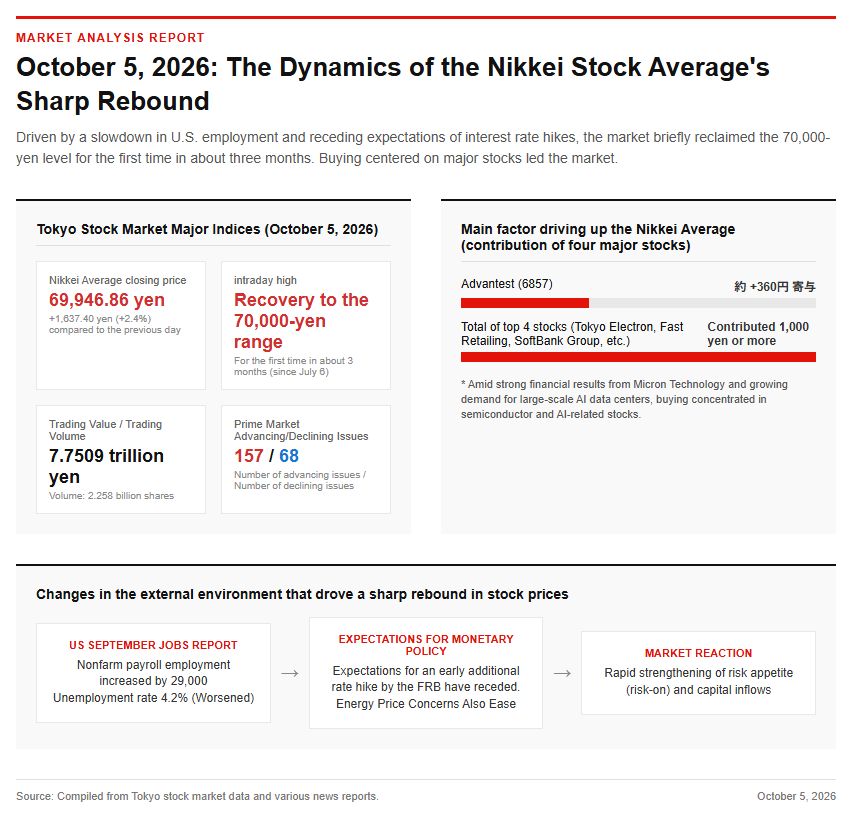
Near-term upward revisions to analyst forecasts are concentrated in the semiconductor sector, creating a polarized market where investment funds are being overwhelmingly funneled into AI-related stocks.
Comprehensive Market Analysis, Downside Risks, and Key Factors to Watch
Polarization Between Sectors and Stocks and the Challenges of the “AI-Centric Market”
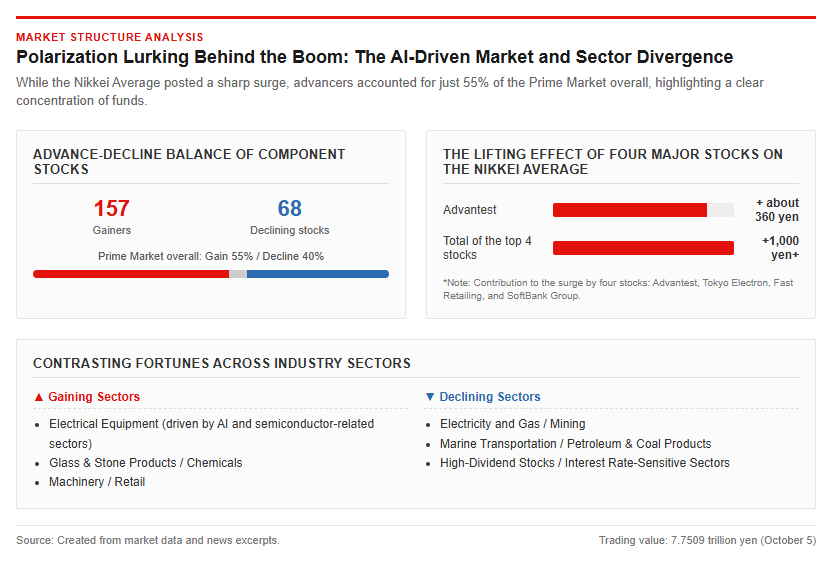
While the Nikkei Stock Average surged by over 1,600 yen, observing the internal structure of the market reveals a clear polarization. The proportion of advancing issues across the entire Prime Market of the Tokyo Stock Exchange remained at just 55%, with declining issues accounting for 40%. By industry sector, electrical appliances, glass and ceramic products, chemicals, machinery, and retail rose, while electric and gas utilities, mining, marine transportation, and oil and coal products fell. Selling pressure remained on cyclical and financial stocks other than AI-related stocks; for instance, semiconductor memory maker Kioxia Holdings (285A), Shionogi & Co. (4507), and Sony Group (6758) acted as factors dragging down the index. Amid concerns over high interest rates and a global economic recession, there is an aspect of funds fleeing and concentrating into AI-related stocks from high-dividend stocks and interest-rate-sensitive sectors. Please refer to the figure below for the advance-decline balance of major issues.
The macroeconomic environment and the drag of domestic and international interest rates and exchange rates
Although stock prices have staged a significant recovery, persistent macroeconomic concerns continue to cap their upside. In the U.S., despite deteriorating employment data, the 10-year Treasury yield temporarily surged to the 5.30% range, marking a 19-year high. In Europe, a sharp spike in French government bond yields amid mounting fiscal concerns has brought default risks to the forefront, raising alarms over a potential resurgence of the European debt crisis, as evidenced by a plunge in bank stocks. In Japan, the 10-year government bond yield climbed to the 3.1% range for the first time in 30 years, weighing heavily on debt-laden sectors such as construction and real estate, as well as insurance and banking stocks facing growing unrealized losses on their bond holdings. In the foreign exchange market, the dollar-buying, yen-selling trend has persisted in the upper 157 yen range, a scenario that would normally be expected to lift export earnings. However, the simultaneous presence of upward pressure on long-term interest rates at home and abroad, coupled with global credit uncertainty and recession risks, serves as a major factor restricting any sustained push to higher levels across the broader stock market. There is also a strong, lingering view that until domestic and international interest rate trends stabilize, it will be no easy task for the stock market as a whole to return to a sustained upward trajectory.
Future Market Outlook and Policy/Earnings Events to Watch for Investors
When forecasting the future direction of the Japanese stock market, political and monetary policy events, as well as corporate earnings, will hold the key. Domestically, an extraordinary session of the Diet will be convened, and Prime Minister Sanae Takaichi will deliver her policy speech. Attention will be focused on how the market digests the Prime Minister’s stance on fiscal and monetary policy and remarks by Bank of Japan Governor Kazuo Ueda. In the U.S., the minutes of the Federal Open Market Committee (FOMC) are scheduled to be released on October 7, and the contents of discussions regarding additional interest rate hikes and monetary tightening could affect stock prices. In addition, interim earnings reports from companies with fiscal years ending in February—such as Seven & i Holdings (3382), Fast Retailing (9983), and Yaskawa Electric (6506)—will be released successively. From a medium- to long-term perspective, progress in corporate reforms driven by the Tokyo Stock Exchange’s PBR reforms, calls for improved capital efficiency, and the effective utilization of corporate retained earnings and cash and deposits is expected to remain the primary framework supporting the structural bullish scenario for Japanese equities.
Reference Page
- [Tokyo Stock Exchange] https://www.jpx.co.jp/equities/follow-up/index.html
【#NikkeiAverage #StockMarket #SemiconductorStocks #JapaneseEconomy #AssetManagement】


コメント