Although the U.S. Treasury announced an increase in the scale of its long-term bond buybacks to a maximum of $6 billion, it fell short of market expectations, prompting disappointment-driven selling and a sharp surge in U.S. long-term interest rates. Behind this lie the expanding fiscal deficit, the rapid increase in interest payment burdens, and a divergence in policy stance from the Federal Reserve.
- Key Points of the Event
- Background of the Buyback Increase and Market Disappointment Sell-Off
- Policy Stances and Background of the Treasury and the FRB
- Structural Differences and Limitations Compared to Quantitative Easing (QE)
- Ripple effects on the Japanese market and the global economy
- Future Developments and Key Points
Key Points of the Event
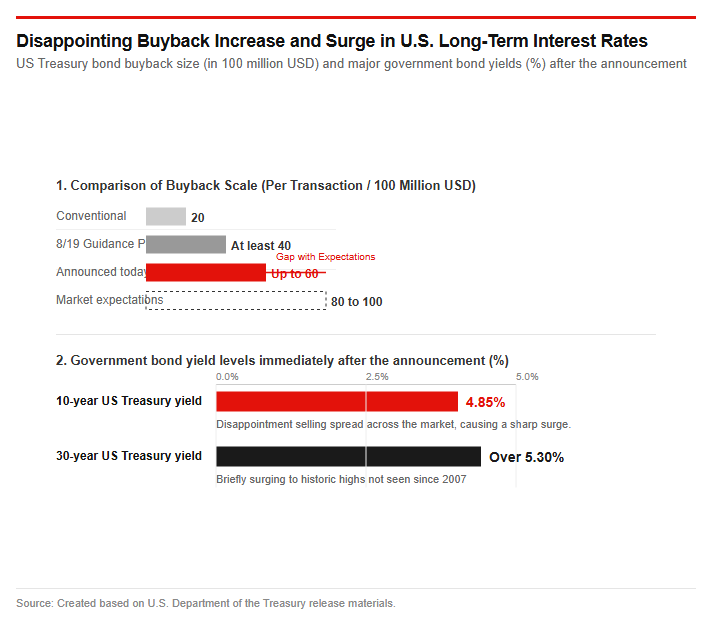
On September 9, 2026, the U.S. Department of the Treasury announced that it would increase the maximum size of its initial ultra-long-term Treasury buyback operations to $6 billion per operation. On August 19, 2026, the Treasury had outlined a policy to “at least double” the previous $2 billion cap to “at least $4 billion,” but the latest announcement went even further, tripling the original level. However, because market participants had anticipated and priced in an even larger-scale expansion of purchases—ranging from $8 billion to $10 billion—the $6 billion figure was perceived as an inadequate, half-measure that fell short of expectations. Driven by this “expectation gap,” a wave of disappointment selling immediately spread through the Treasury market, causing the yield on the 10-year U.S. Treasury note to surge to 4.85% and the 30-year Treasury yield to temporarily spike above 5.30%. Ironically, the authorities’ intervention aimed at curbing interest rates resulted in historic high yields not seen since 2007, creating significant ripple effects across the entire financial market. The chart below shows the interest rate trends before and after the buyback announcement.
Background of the Buyback Increase and Market Disappointment Sell-Off
Behind this recent expansion of buybacks lies the rapidly deteriorating fiscal structure of the United States. Due to tariff refunds resulting from the U.S. Supreme Court’s ruling that reciprocal tariffs are illegal, tax revenues have plummeted, pushing the U.S. fiscal deficit to a high level of around 5.85% to 6% of gross domestic product (GDP). Net interest payments on the national debt for fiscal 2025 reached $970.3 billion (3.2% of GDP), marking an unprecedented situation where they exceeded defense spending ($916.6 billion) on an annual basis for the first time since 1947. U.S. Treasury Secretary Scott Bessent has set a goal to “curb the fiscal deficit to within 3% of GDP by 2028,” but the surge in interest payments driven by rising interest rates has become the biggest obstacle to achieving this target. Lacking the authority to set interest rates, the Treasury Department utilized a technique known as a “Treasury twist”—buying back long-term bonds using funds raised by issuing short-term debt—in an attempt to keep long-term interest rates low through improved supply and demand dynamics. However, buybacks on the scale of several billion dollars were unable to absorb the massive supply pressure caused by the increased issuance of government bonds, causing excessive market expectations to backfire.
Divergence in Policies between the Ministry of Finance and the FRB and Structural Challenges
Policy Stances and Background of the Treasury and the FRB
A stark divergence in policy objectives and friction have become clear between the U.S. Department of the Treasury and the Federal Reserve Board (FRB), which are responsible for steering the U.S. economy. While Treasury Secretary Bessent strongly aims to lower long-term interest rates and curb borrowing costs through government bond buybacks and a stance favoring foreign exchange intervention, FRB Chair Warsh has outlined different priorities. In his speech at the Jackson Hole symposium on August 28, 2026, Chair Warsh pointed out that the personal consumption expenditures (PCE) price index is currently exceeding the 2% target, and repeatedly emphasized his stance of placing top priority on curbing inflation and stabilizing prices. Furthermore, expressing the view that current financial conditions cannot be considered sufficiently restrictive, he maintains a hawkish position that does not rule out further rate hikes depending on future inflation data. While the Treasury attempts to forcefully suppress rising interest rates through the manipulation of government bond supply and demand, the dynamic of the FRB signaling continued tightening to combat inflation leaves market participants with the impression of disjointed policies, thereby increasing uncertainty over future monetary policy management.
Structural Differences and Limitations Compared to Quantitative Easing (QE)
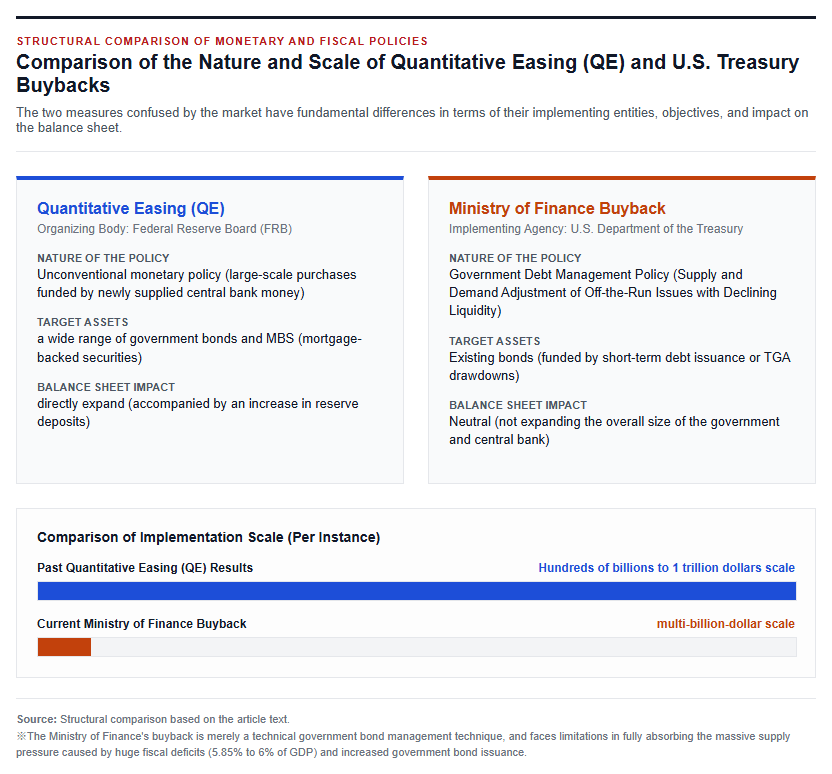
Some market participants view the Ministry of Finance’s buybacks as an easing measure equivalent to the Federal Reserve’s Quantitative Easing (QE), but their financial and structural characteristics are entirely different. QE implemented by the Fed is an unconventional monetary policy that directly expands the overall balance sheet by purchasing massive amounts of broad government bonds and mortgage-backed securities (MBS) using newly supplied central bank money (reserves). In contrast, the Ministry of Finance’s buybacks are merely “debt management policy” targeting previously issued “off-the-run issues” that have experienced a decline in liquidity. Because the funding is covered by issuing short-term debt (Treasury bills) or drawing down the Treasury General Account (TGA), it has no effect on expanding the overall size of the government and central bank balance sheets. Compared to past QEs that reached scales of hundreds of billions to 1 trillion dollars per operation, buybacks on the scale of several billion dollars per operation have a dramatically smaller direct quantitative impact on the market. Experts analyze that, barring fundamental reductions in the fiscal deficit or the curbing of inflation, there are limits to fundamentally reversing the upward trend in long-term interest rates through technical supply-and-demand adjustments alone. The following figure shows a comparison between QE and buybacks.
Ripple Effects on the Global Market and Impact on the Japanese Economy
Ripple effects on the Japanese market and the global economy
The rise in U.S. long-term interest rates and turbulence in buyback policies immediately spilled over into Japan’s financial and foreign exchange markets. The rise in U.S. rates heightened awareness of the widening U.S.-Japan interest rate differential, intensifying dollar-buying and yen-selling pressures and pushing the exchange rate toward further depreciation from the 160 yen to the 161 yen range per dollar. Combined with this severe yen depreciation, rising import prices, and domestic inflation and wage trends, the yield on Japan’s 10-year government bonds reached the milestone of 3.0% (briefly hitting 3.05%) on September 1, 2026—marking the first time in approximately 30 years, since September 1996, that it has reached this level. Bank of Japan (BOJ) Governor Kazuo Ueda and Deputy Governor Ryozo Himino have expressed caution regarding upside risks to underlying inflation and the spillover effects of exchange rates and AI demand, prompting a sudden surge in market expectations for an additional rate hike at the October 2026 Monetary Policy Meeting. A chain reaction of mutual spillovers is taking place, wherein the U.S. Treasury’s unsuccessful attempts to suppress interest rates are accelerating the pace of the BOJ’s monetary normalization, creating a dynamic where global bond markets are mutually driving each other toward higher interest rates.
Future Developments and Key Points
When forecasting future market trends and the trajectory of the global economy, attention is focused on several critical points. First is the U.S. Treasury’s Quarterly Refunding announcement scheduled for November 4, 2026, which will test whether authorities will step in with further buyback expansions or the full-scale deployment of Treasury General Account (TGA) funds to appease a disappointed market. Second is whether the 10-year U.S. Treasury yield will break through the psychological milestone of 5.0%, with the risk that such a breakout could trigger a massive adjustment shock in the stock and mortgage markets. Third is the outcome of the U.S. midterm elections on November 3, 2026, alongside the situation in Iran. President Trump’s indication that he will postpone ending the war with Iran until after the elections has prolonged high oil prices and inflation driven by geopolitical risks, further complicating the Federal Reserve’s rate-cut decisions. Amid the complex interplay of these factors, central banks and fiscal authorities in Japan and the U.S. are facing the need for exceptionally sophisticated navigation to simultaneously achieve interest rate and price stability while maintaining market confidence.
Reference Page
- [Bank of Japan] The Impact of Recent Changes in the U.S. Fiscal Balance on the U.S. Treasury Market https://www.boj.or.jp/research/wps_rev/wps_2003/iwp03j03.htm
[#USTreasury #USBonds #Buyback #LongTermInterestRates #FRB #RisingInterestRates #Economy #USDJPY]


コメント