As of June 2026, the number of Japanese companies operating in China fell to a record low of 10,118. The background includes rising geopolitical risks, intensifying competition with local companies, and moves to review supply chains.
- The Current State of Record-Low Market Entries and a Rush of Withdrawals
- Transformation from a Low-Cost Production Base to a Massive Market and the Emergence of Country Risk
- Tariff Wars, Geopolitical Risks, and a Profit-Driven Shift to the US
- Business Restructuring Associated with the Rise of Local Chinese Companies and the EV Shift
- Practical Steps for Relocating Hubs and Diversifying Operations to Southeast Asia and India
- Medium- to Long-Term Outlook Aimed at Overcoming Single-Pole Concentration and Driving Structural Transformation
The Current State of Record-Low Market Entries and a Rush of Withdrawals
According to a Teikoku Databank survey as of June 2026, the number of Japanese companies operating in China stood at 10,118, marking the lowest figure since comparable data became available in 2010. This represents a decrease of 2,916 companies (22.4%) from the 13,034 companies in the previous 2024 survey, and a significant drop of 4,276 companies (29.7%) from the peak of 14,394 companies recorded in 2012. A closer look at the trends over the past two years shows that new entrants opening local subsidiaries or bases remained at a record low of 1,221 companies, while withdrawals due to base closures, business discontinuations, and other factors reached a record high of 4,137 companies. By industry, manufacturing, which accounts for about 40% of the total, decreased by 933 to 4,206 companies, while wholesale trade fell to 3,320 companies (down 898), and services dropped to 1,213 companies (down 590), indicating that withdrawals and restructuring are underway across a wide range of industries. By region, Shanghai, the largest hub, fell 21.5% from 5,046 companies in the previous survey to 3,961 companies, and Beijing also saw a significant decline of 38.5% to 555 companies. The following chart shows the trend in the number of expanding companies and regional trends.
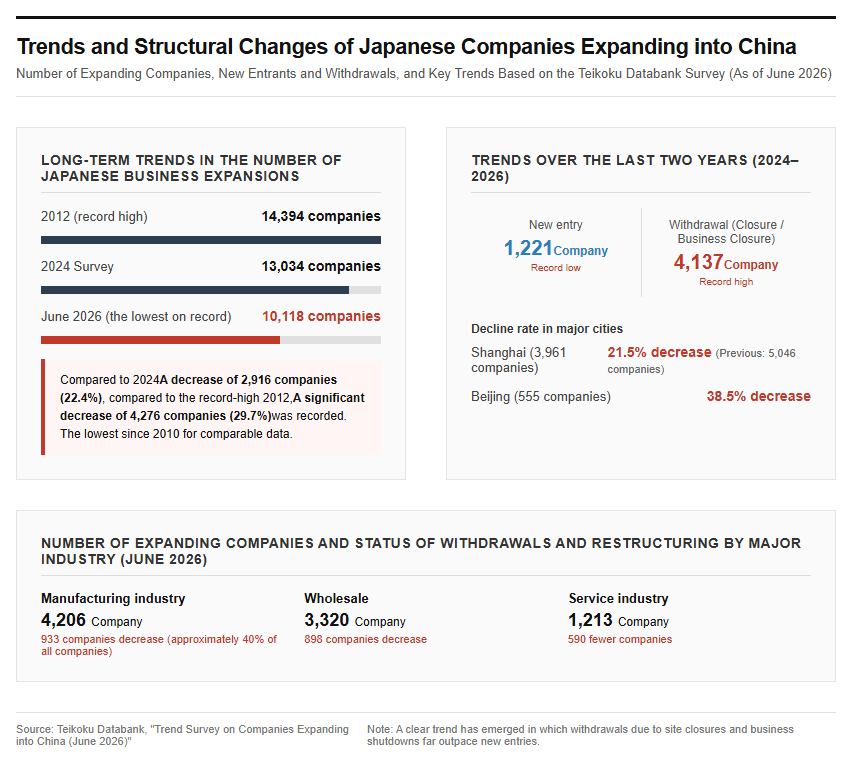
Thus, this highlights the reality that a rapid transition is underway from the former sole focus on expansion to a phase of business restructuring and contraction.
Transformation from a Low-Cost Production Base to a Massive Market and the Emergence of Country Risk
The positioning of Japanese companies in their China business has shifted from a production base utilizing cheap and abundant labor to a market driving massive consumption and logistics. Looking at the sales scale of expanding companies, the proportion of small and medium-sized enterprises (SMEs) with less than 100 million yen has dropped to 4.8%, while the proportion of mid-sized and large enterprises with 1 billion yen or more has increased, indicating a consolidation of companies equipped with advanced management capabilities. As of 2026, China’s minimum wage stands at 2,328 yuan per month (national average), a 45.7% increase from 1,598 yuan in 2016, causing its overwhelming cost advantage to fade. Furthermore, in addition to sluggish domestic demand caused by the real estate slump, the enforcement of the revised anti-espionage law, and price competition with local companies, 2026 saw heightened geopolitical tensions and economic coercion, such as tighter export controls on critical minerals destined for Japan. Compounded by incidents such as the detainment of a Japanese executive in August 2025, safety concerns have left companies facing unpredictable country risks in their Chinese operations. Consequently, alongside the declining appeal of China as a mere low-cost production base, fundamental reviews aimed at risk avoidance are accelerating.
The Multifaceted Impacts of the US-China Rivalry and Intensifying Market Competition
Tariff Wars, Geopolitical Risks, and a Profit-Driven Shift to the US
Trade friction and security-related confrontations between the US and China are dealing a heavy blow to the business performance of Japanese companies operating in China. According to a survey conducted by Teikoku Databank in November 2025, over 60% of companies responded that US tariff negotiations would impact their overseas expansion, reaching 64.8% among manufacturers. Furthermore, in their earnings forecasts for fiscal 2025, 58.4% of manufacturers operating in China expect a decline in profits, indicating strong apprehension about order decreases and rising costs due to the impact of Trump tariffs. In response to prolonged geopolitical risks, Japanese companies are rapidly shifting the core of their earnings from China to the US. According to estimates by Monex Group, the profit ratio of companies comprising the Tokyo Stock Price Index (TOPIX) derived from China dropped from 23% in 2020 to less than 15% in 2026. Meanwhile, the profit ratio from the US rose significantly from 25% to 35% over the same period. While the attraction of Japanese companies is progressing due to US re-industrialization policies and incentives, the reduction of reliance on China and the restructuring of profit models are becoming firmly established.
Business Restructuring Associated with the Rise of Local Chinese Companies and the EV Shift
Intense market competition and structural changes in the Chinese market are also driving Japanese companies to downscale their operations. According to JETRO’s fiscal 2025 survey, 74.5% of Japanese companies operating in China cited Chinese firms as their biggest competitors, with 60% of companies experiencing an increase in competitors and over 40% experiencing a shrinking market share over the past five years. The impact has been particularly severe in the automotive industry; amidst the global shift toward electric vehicles (EVs), the combined net profit of seven Japanese automakers for the fiscal year ending March 2026 plummeted by approximately 3.5 trillion yen from its peak. The sales share of Japanese cars in China has nosedived from 24.1% in 2020 to 13.8% in the first quarter of 2026. Chinese EV makers, led by BYD, have risen to prominence armed with high price competitiveness and rapid development speeds, forcing Honda and Nissan to record massive losses and compelling them to reorganize factories and optimize their business scale. The following chart illustrates the changes in the market environment and competitive landscape.
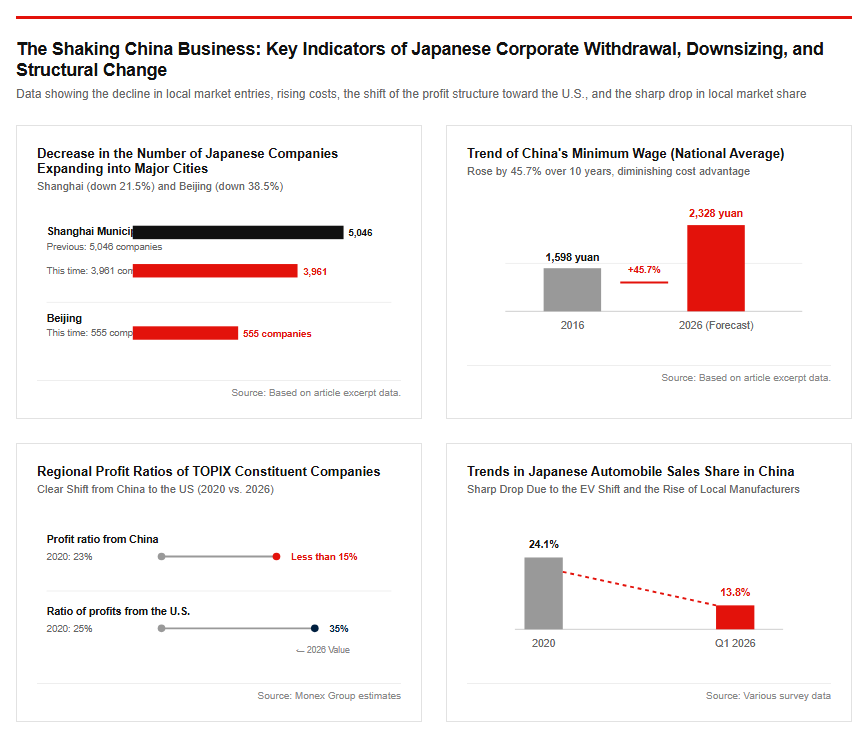
To avoid price competition, the trend of differentiating through quality and after-sales service while curbing excess production capacity has taken root.
Supply Chain Restructuring and the China Plus One Strategy
Practical Steps for Relocating Hubs and Diversifying Operations to Southeast Asia and India
The core of the supply chain restructuring being advanced by Japanese companies is not a complete withdrawal from China, but a diversification strategy known as “China Plus One.” In a Teikoku Databank survey, companies citing China as their most important production base remained in the top spot at 43.7%, though this is a decline from 49.0% in 2019. In contrast, the percentages choosing alternative bases in Southeast and South Asia—such as Vietnam (8.7%), Thailand (7.0%), Indonesia (3.5%), and India (2.8%)—are on the rise. Even more prominent is the diversification of sales bases: the proportion placing the highest importance on China plummeted 16.4 percentage points from 47.7% to 31.3%, marking a clear shift toward Thailand (9.7%), the United States (9.4%), and India (4.9%). Localization is also progressing in procurement, with the local procurement rate of Japanese companies in China reaching 73.6%, and efforts to cut costs can be seen through procuring roughly 70% of that from local Chinese enterprises. The following figure illustrates the restructuring status of production and sales bases.
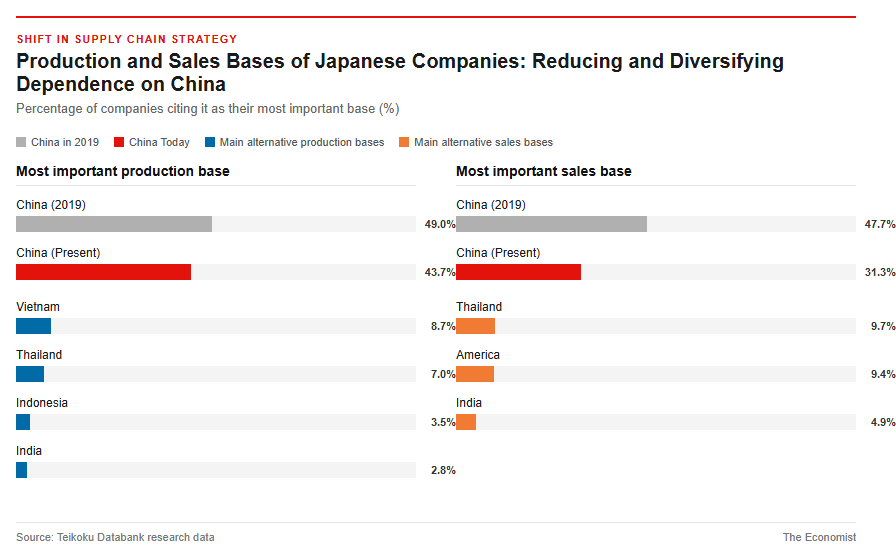
Companies are developing their bases by identifying high-risk items and placing phased pilot orders.
Medium- to Long-Term Outlook Aimed at Overcoming Single-Pole Concentration and Driving Structural Transformation
The biggest point of focus for the future is whether Japanese companies can redefine the Chinese market from an “indispensable single base” to “one of several important bases requiring risk management,” thereby enhancing their crisis management capabilities. Because China boasts a massive market scale and advanced industrial clusters covering everything from raw materials to logistics, complete decoupling often lacks economic rationality. For this reason, it is expected that over the medium to long term, structural transformation will progress—proceeding with the consolidation and closure of local subsidiaries and the streamlining of low-profitability businesses while specializing in high-added-value fields and areas of strength such as medical and precision equipment. Furthermore, it will be essential to accelerate diversification into Southeast Asia, Europe, and the US markets, building a resilient supply chain that prevents the entire business from halting even if unforeseen circumstances or export restrictions arise at Chinese bases. Establishing a management system that analyzes geopolitical risks, trade policies, and changes in local regulations in real time to flexibly optimize production and procurement will indeed be the survival strategy for enduring in the global market moving forward.
Reference Page
- [Japan External Trade Organization (JETRO)] [suspicious link removed]
【#ChinaBusiness #SupplyChainRestructuring #ChinaPlusOne #OverseasExpansion #JapaneseEconomy】


コメント