At a plenary session of the House of Councillors, Sanseito leader Sohei Kamiya called on Prime Minister Sanae Takaichi to link a flat-rate cut in the consumption tax rate with wage increases. Behind this lies a sense of crisis regarding Japan’s relative economic decline and concerns over the massive system costs associated with limiting tax cuts exclusively to food.
- Key Points of Kamiya’s Diet Questions and Events
- Prime Minister Takaichi’s Diet Reply and the Basic Stance of the LDP Administration
- System Modification Costs and Practical Challenges of Food Tax Reductions
- Combined Impact on Macroeconomy, Interest Rates, and Price Trends
- Protection of Industrial Sovereignty and Structural Reform for Growth and Distribution
- Future Outlook, Key Points, and Policy Direction
Key Points of Kamiya’s Diet Questions and Events
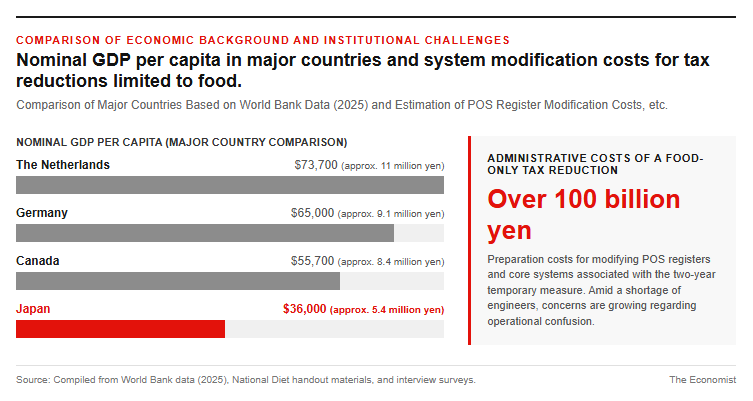
At a plenary session of the House of Councillors held on October 9, 2026, Sohei Kamiya, leader of Sanseito, addressed Prime Minister Sanae Takaichi with representative questions, strongly demanding a “flat-rate reduction in the consumption tax” and “linked corporate wage hikes” as measures to overcome the current inflation and promote economic growth. Through his overseas visits in the summer of 2026, Kamiya pointed out Japan’s relative decline in economic power compared to 25 years ago. Specifically, citing the World Bank’s 2025 data on nominal GDP per capita, he emphasized that while the Netherlands stands at approximately $73,700 (about 11 million yen), Germany at $65,000 (about 9.1 million yen), and Canada at about $55,700 (about 8.4 million yen), Japan remains at around $36,000 (about 5.4 million yen), keeping it at the lowest level among major nations. He argued that the reason why the working hours of Japanese people are equal to or longer than those in Western countries yet fail to translate into economic prosperity lies in past economic policy mistakes, and he urged a policy shift toward a substantial increase in income leveraged by government-led flat-rate tax cuts. Furthermore, as a support measure for low-income households and struggling farmers, he proposed providing the staple food of rice (through the distribution of rice vouchers).
Prime Minister Takaichi’s Diet Reply and the Basic Stance of the LDP Administration
In response to Mr. Kamiya’s question, Prime Minister Sanae Takaichi gave a clear refusal to the proposal for a flat-rate consumption tax cut. Prime Minister Takaichi explained that the consumption tax functions as a stable financial resource for social security systems such as pensions, medical care, nursing care, and measures against the declining birthrate, and that it is returned to households in the form of benefits. She expressed the view that changing the uniform tax rate is inappropriate because a flat-rate cut to the consumption tax would raise concerns about having a serious impact on administrative services essential to the livelihoods of citizens. Regarding the reduction of the consumption tax rate on food and beverages currently being considered by the government (such as a proposal to lower it from 8% to 1% ), she explained that it is a stopgap measure until the “Worker Burden Reduction Support Grant” scheduled for full implementation in fiscal 2029 (Reiwa 11), and serves as an emergency burden-relief measure targeted specifically at middle- and low-income groups suffering from high prices. Furthermore, regarding the proposed distribution of “rice coupons,” she stated the policy of not considering it, citing the fact that the current high prices have spread widely to food and beverages in general, and that multifaceted agricultural support measures are already being implemented.
Systemic Challenges and Economic Projections of Food-Limited Tax Reductions
System Modification Costs and Practical Challenges of Food Tax Reductions
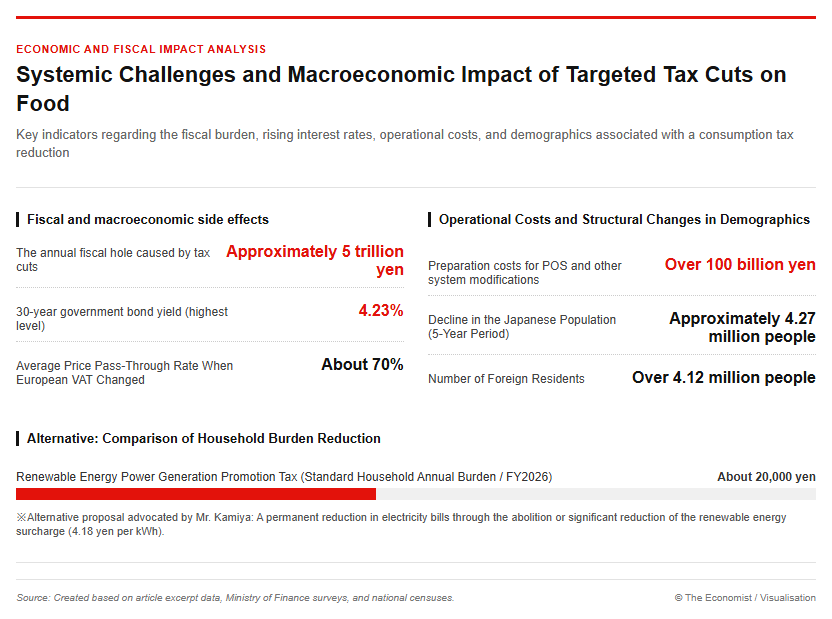
Mr. Kamiya strongly objected, from practical and economic standpoints, to the Takaichi administration’s proposed limited consumption tax cut targeting only food items. Citing estimates that preparation costs alone would exceed 100 billion yen just to modify POS registers and core systems for a two-year limited-time measure, he pointed out that the continuation of complex multiple tax rates would increase the operational burden on businesses and reduce productivity. In fact, hearings from five POS register manufacturers indicated that adapting to diverse specifications—such as ordering and receiving, accounting, and loyalty point management—would be necessary, with system modifications estimated to take at least one year. Furthermore, compounded by a severe shortage of system engineers, expectations are growing that initiating the tax cut within fiscal 2026 will be difficult, pushing the timeline back to around autumn 2027 at the earliest. As an alternative to avoid such operational chaos, Mr. Kamiya advocated for a permanent reduction in electricity bills through the abolition or drastic cut of the renewable energy promotion surcharge (4.18 yen per kWh in fiscal 2026, imposing a burden of about 20,000 yen per year on a standard household) currently collected monthly from citizens and businesses.
Combined Impact on Macroeconomy, Interest Rates, and Price Trends
Regarding the consumption tax cut, discussions are tangled between the effects of household support and the side effects on the macroeconomic economy. If the consumption tax rate on food were reduced to zero, it would create a revenue shortfall of approximately 5 trillion yen annually, which risks significantly disrupting the government’s long-sought plan to achieve a primary fiscal balance surplus. Out of concern over fiscal deterioration, selling took precedence in the government bond market, with Japan’s 30-year government bond yield rising to the 4.23% range and recording a historic high. The rise in interest rates harbors the risk of becoming a burden on the entire Japanese economy through increased borrowing costs for companies and hikes in mortgage rates. According to a research study on the European Value Added Tax (VAT) published by the Ministry of Finance, the final price-transfer rate at the time of tax rate changes in Europe remains at only around 70%, pointing to a structural challenge where retail prices do not drop sufficiently even when tax rates are lowered. There is also the risk that retailers may absorb the tax-equivalent amount or engage in size reduction (shrinkflation), meaning the price-suppression effect of the tax cut may not be as effective as expected.
Protection of Industrial Sovereignty and Structural Reform for Growth and Distribution
Protection of Industrial Sovereignty and Structural Reform for Growth and Distribution
During a representative question session, Mr. Kamiya urged that the maintenance of “industrial sovereignty,” which protects a country’s critical technologies and production bases, should be strengthened. Citing examples such as the U.S. making massive government investments in semiconductor plant construction and Europe causing soaring energy prices and a decline in the international competitiveness of its manufacturing sector due to rapid decarbonization policies, he emphasized the importance of protecting domestic production bases and human resource development. He also demanded the full disclosure of scientific risk analyses and cautious consultations regarding the relaxation of import restrictions on U.S. potatoes, in order to preemptively prevent the risk of damage to domestic agriculture caused by the intrusion of pests (potato cyst nematodes). Furthermore, citing the fact that the 2025 national census showed the Japanese population decreased by approximately 4.27 million over five years while foreign residents exceeded 4.12 million, he called for the correction of foreign acceptance policies lacking volume controls. According to an analysis by the Japan Research Institute, in promoting focused investments through proactive fiscal policy, appropriate household distribution through private-sector wage hikes is indispensable, and establishing a “virtuous cycle of growth and distribution” that delivers the fruits not only to corporations but to the entire citizenry is considered an urgent priority.
Future Outlook, Key Points, and Policy Direction
The future focus will be on the materialization of the consumption tax cut in the working-level consultations of the “National Council,” in which eight ruling and opposition parties participate, and the direction of securing financial resources for it. While the Takaichi administration has pledged to secure funding without relying on special deficit-covering bonds, and with expenditures of 111.8 billion yen being considered for cash register upgrade support and other budgetary measures, questions are being raised about which specific subsidy cuts or reallocation of existing budgets will be used to cover the massive revenue shortfall. In addition, the progress of cash register system modifications, which require a preparation period of more than a year, and the response to the shortage of IT engineers will determine the actual timing of the tax cut (likely from autumn 2027 or later). What market participants are watching closely is whether it will be possible to induce genuine wage increases at small and medium-sized enterprises while avoiding a surge in long-term interest rates and accelerated inflation driven by tax-cut populism. Through parliamentary debates, attention is focused on whether a sustainable economic policy solution can be derived that goes beyond mere consumption stimulus and achieves a balance between maintaining the industrial base and increasing national income.
Reference Page
- 【”Raise wages because we are cutting the consumption tax uniformly,” Sohei Kamiya requests Prime Minister Takaichi, pointing out the relative decline of the Japanese economy】https://news.livedoor.com/article/detail/32529934/
【#SoheiKamiya #SanaeTakaichi #ConsumptionTaxCut #WageIncrease #JapaneseEconomy #NationalCouncil】

コメント